Review
. 2014 Jul;40(4):248-56.
doi: 10.1097/ICL.0000000000000042.

The core mechanism of dry eye disease is inflammation

Affiliations
Review

The core mechanism of dry eye disease is inflammation

Yi Wei et al. Eye Contact Lens. 2014 Jul.

Erratum in

  • Eye Contact Lens. 2014 Sep;40(5):311

Abstract

Purpose: The purpose of this article is to review the evidence for the hypothesis that the core mechanism of dry eye disease (DED) is inflammation, including evidence from recent basic, clinical, and translational research involving human patients, animal models, and cell cultures.

Methods: Using the key words "dry eye + inflammation," the authors conducted a comprehensive search of the PubMed and Web of Science databases for scientific articles published in English between January 1, 1900 and August 30, 2013 on the role of inflammation in DED in cell cultures, animal models, and humans. The resulting articles were then categorized and reviewed.

Results: The literature search revealed a total of 458 publications, almost all published after 1992. The percentages of original studies and review articles are 77.29% (354) and 22.71% (104), respectively. Among the original studies, the number of reports on human DED is 200 (43.7%), on animal models is 115 (25.1%), and cell cultures is 39 (8.5%). A yearly distributing plot revealed that 76% were published from 2003 to 2011, 53% from 2008 to 2012, and 11% during the first 9 months of 2013. This distribution signifies a rapidly growing awareness of the importance of inflammation in DED pathogenesis.

Conclusions: Inflammation plays a key role in the pathogenesis of DED as evidenced by research using tissue culture, animal models, and subjects with DED. Developing biomarkers for inflammation of the ocular surface will provide improved understanding of the mechanisms leading to DED, classification of the severity of DED, and objective metrics for outcome measures of treatment. The chronicity of the disease suggests that dysregulation of immune mechanisms leads to a cycle of continued inflammation, accompanied by alterations in both innate and adaptive immune responses. Given the underlying mechanism for DED, developing effective and safe anti-inflammatory treatments is likely to be beneficial for patients with DED.


Figures
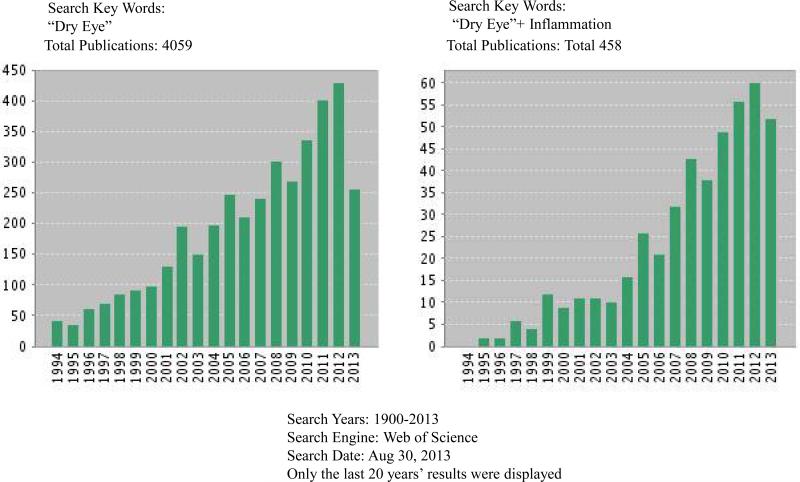
Figure 1
Figure 1
Subject distributions on “Dry Eye + Inflammation” since 1992.
Figure 2
Figure 2
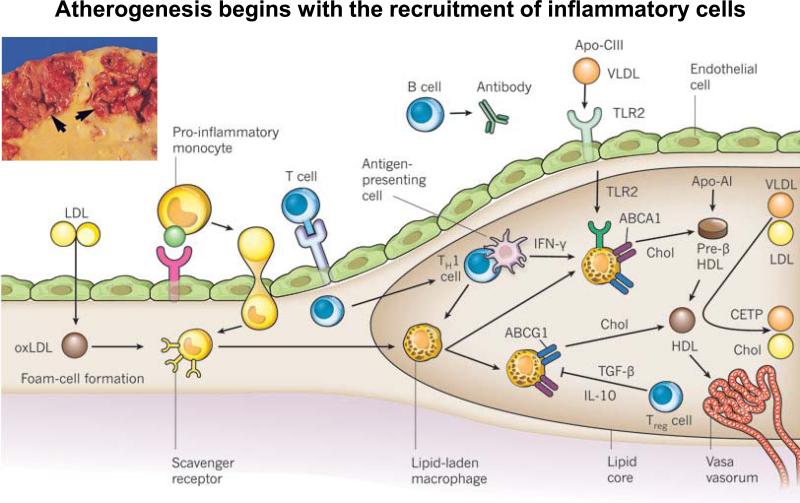
Atherogenesis and inflammation, adapted with permission from Libby P. et al. Nature 2011:473, 317–325. Atherogenesis begins with the recruitment of inflammatory cells to the intima. Activated endothelial cells express leukocyte adhesion molecules that capture and recruit blood monocytes to the intima. These activated monocytes express scavenger receptors that permit the uptake of modified LDL particles, such as oxidized LDL (oxLDL). Cholesterol loading leads to the formation of foam cells, and ultimately leads to the mature lipid-laden macrophages of the plaque's core. These cells can produce pro-inflammatory mediators, reactive oxygen species, and tissue factor pro-coagulants that amplify local inflammation and promote thrombotic complications. Although fewer in number than the mononuclear phagocytes, T cells also enter the intima and send decisive regulatory signals. After antigen-specific activation, T helper 1 (TH1) cells secrete the signature cytokine interferon-g (IFN-g), which can activate vascular wall cells and macrophages, and magnify and sustain the inflammatory response in the intima. Regulatory T (Treg) cells produce interleukin-10 (IL-10) and transforming growth factor-β (TGF-β), two cytokines considered to exert anti-inflammatory actions.
Figure 3
Figure 3
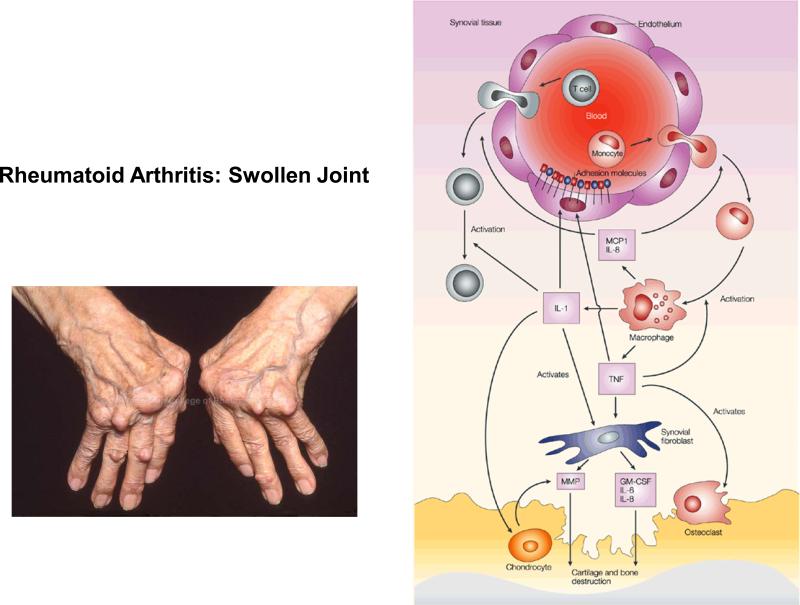
Rheumatoid Arthritis and inflammation, adapted with permission from Pope R. Nature Reviews Immunology 2002:2, 527-535. Monocytes are attracted to the rheumatoid arthritis (RA) joint, where they differentiate into macrophages and secrete inflammatory cytokines (TNF and IL-1) and chemokines (MCP-1 and IL-8). TNF increases the expression of adhesion molecules on endothelial cells, which recruit more inflammatory cells to the joint. Together with IL-1, TNF also induces synovial fibroblasts to express cytokines (such as IL-6), chemokines (such as IL-8), growth factors (such as GM-CSF) and matrix metalloproteinases (MMPs), which contribute to cartilage and bone destruction. Furthermore, TNF contributes to osteoclast activation and differentiation. In addition, IL-1 mediates cartilage degradation directly by inducing the expression of MMPs by chondrocytes.
Figure 4
Figure 4
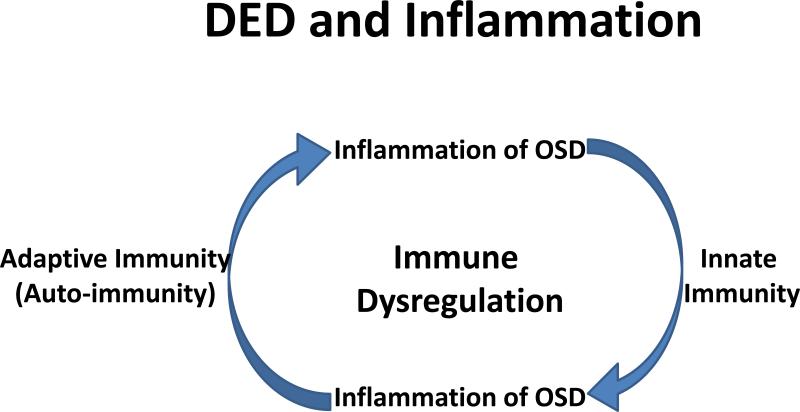
The current hypothesis of relationship between DED and inflammation. DED inflammation comprises both innate and adaptive immunity. It starts with an acute innate immune in response to environmental and/or microbial stresses, leading to activation and maturation of antigen-presenting cells (APCs). The matured APCs migrate into regional lymph nodes to generate and maintain dry eye- and ocular-specific autoreactive CD4+-T cells, autoantibody secreting B cells, leading to the adaptive immunity. Th17 cells back to the ocular surface through efferent blood vessels to promote production of inflammatory mediators, lymphangiogenesis and pathogenic immunocytic infiltration, leading to further damage of the ocular surface and progression of a chronic cycle of inflammation. Thus, the key mechanism in DED-related inflammation is not innate or adaptive immunity per se, but a abnormal inflammatory cycle sustained by dysregulation of immune response.

References

    1. DEWS The definition and classification of dry eye disease: report of the Definition and Classification Subcommittee of the International Dry Eye WorkShop (2007). Ocul Surf. 2007;5:75–92. - PubMed
    1. Stevenson W, Chauhan SK, Dana R. Dry eye disease: an immune-mediated ocular surface disorder. Arch Ophthalmol. 2012;130:90–100. - PMC - PubMed
    1. Pflugfelder SC, Stern ME. Immunoregulation on the ocular surface: 2nd Cullen Symposium. Ocul Surf. 2009;7:67–77. - PubMed
    1. Chen Y, Chauhan SK, Soo Lee H, Saban DR, Dana R. Chronic dry eye disease is principally mediated by effector memory Th17 cells. Mucosal Immunol. 2013 - PMC - PubMed
    1. Ferrero-Miliani L, Nielsen OH, Andersen PS, Girardin SE. Chronic inflammation: importance of NOD2 and NALP3 in interleukin-1beta generation. Clin Exp Immunol. 2007;147:227–235. - PMC - PubMed

Publication types