. 2015 Jan;65(1):145-50.
doi: 10.1007/s12576-014-0350-7. Epub 2014 Nov 13.

Changes in CEBPB expression in circulating leukocytes following eccentric elbow-flexion exercise

Affiliations

Changes in CEBPB expression in circulating leukocytes following eccentric elbow-flexion exercise

Jamie Blackwell et al. J Physiol Sci. 2015 Jan.

Abstract

In mouse models, CCAAT enhancer-binding protein beta (CEBPB) is necessary for M2 macrophage-mediated regeneration after muscle injury. In humans, CEBPB expression in blood was strongly associated with muscle strength. In this study we aimed to test whether CEBPB expression in blood in people is increased 2 days after exercise designed to induce muscle damage and subsequent repair. Sixteen healthy male volunteers undertook elbow flexor exercises designed to induce acute muscle micro-damage. Peripheral blood samples were collected at baseline and days 1, 2, 4 and 7 following exercise. Expression of CEBPB and related genes were analysed by qRT-PCR. Extent of muscle damage was determined by decline in maximal voluntary isometric torque and by plasma creatine kinase activity. Nine subjects had peak (day 4) creatine kinase activity exceeding 10,000 U/l. In this subgroup, CEBPB expression was elevated from baseline to 2 days post exercise (paired-samples t (1,8) = 3.72, p = 0.006). Related expression and selected cytokine changes after exercise did not reach significance. Muscle-damaging exercise in humans can be followed by induction of CEBPB transcript expression in peripheral blood. Associations between CEBPB expression in blood and muscle strength may be consistent with the CEBPB-dependent muscle repair process.


Conflict of interest statement

The authors declare that they have no competing interests.

Figures
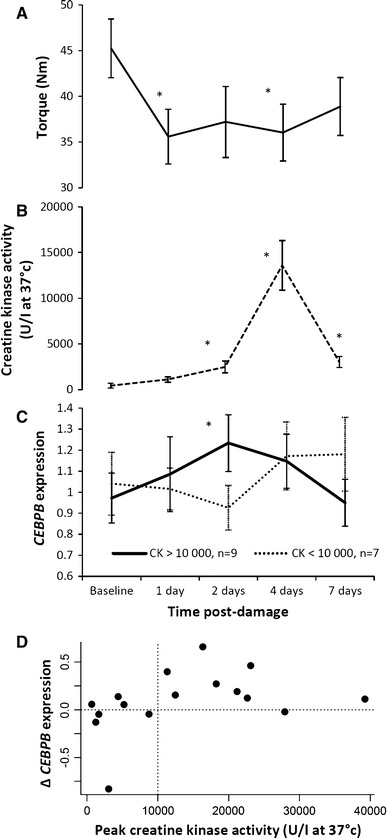
Fig. 1
Fig. 1
Time-course and relationship with CEBPB expression. Isometric strength (nm torque, ± SEM) decreases from baseline (a, *p < 0.05, n = 16) post-damage. Plasma creatine kinase activity (U/l, at 37 °C, ± SEM) increases from baseline (b, *p < 0.05, n = 16), peaking on day 4. Mean CEBPB blood transcript expression change (CEBPB quantification refers to CEBPB transcript expression relative to levels of the endogenous control gene PPIA and normalised to the mean CEBPB level over all samples, ± SEM) is higher at day 2 in n = 9 subjects with >10,000 peak plasma creatine kinase activity (c, *p = 0.006). d Shows the participants' change in CEBPB expression (day 2 minus baseline) and peak CK levels
Fig. 2
Fig. 2
Associations of CEBPB expression to macrophage polarisation-associated markers. Following exercise-induced muscle damage, CEBPB blood transcript expression change shows positive correlations with IL1β (a, p = 4.14 × 10−5) and ARG1 (b, p = 0.004) blood transcript expression change as well as change in circulating INF-γ (c, p = 0.013) and IL-4 concentration in plasma (d, p = 0.031) (∆T = [day 1 + day 2]/2 − baseline, n = 16)

References

    1. Tidball JG, Villalta SA. Regulatory interactions between muscle and the immune system during muscle regeneration. Am J Physiol Regul Integr Comp Physiol. 2010;298:R1173–R1187. doi: 10.1152/ajpregu.00735.2009. - DOI - PMC - PubMed
    1. Natsuka S, Akira S, Nishio Y, Hashimoto S, Sugita T, Isshiki H, Kishimoto T. Macrophage differentiation-specific expression of NF-IL6, a transcription factor for interleukin-6. Blood. 1992;79:460–466. - PubMed
    1. Ruffell D, Mourkioti F, Gambardella A, Kirstetter P, Lopez RG, Rosenthal N, Nerlov C. A CREB-C/EBPbeta cascade induces M2 macrophage-specific gene expression and promotes muscle injury repair. Proc Natl Acad Sci USA. 2009;106:17475–17480. doi: 10.1073/pnas.0908641106. - DOI - PMC - PubMed
    1. Charge SB, Rudnicki MA. Cellular and molecular regulation of muscle regeneration. Physiol Rev. 2004;84:209–238. doi: 10.1152/physrev.00019.2003. - DOI - PubMed
    1. Arnold L, Henry A, Poron F, Baba-Amer Y, van Rooijen N, Plonquet A, Gherardi RK, Chazaud B. Inflammatory monocytes recruited after skeletal muscle injury switch into antiinflammatory macrophages to support myogenesis. J Exp Med. 2007;204:1057–1069. doi: 10.1084/jem.20070075. - DOI - PMC - PubMed

Publication types

Substances
