. 2014 Nov 13:14:569.
doi: 10.1186/s12879-014-0569-1.

Repeated measures study of weekly and daily cytomegalovirus shedding patterns in saliva and urine of healthy cytomegalovirus-seropositive children

Repeated measures study of weekly and daily cytomegalovirus shedding patterns in saliva and urine of healthy cytomegalovirus-seropositive children

Michael J Cannon et al. BMC Infect Dis. .

Abstract

Background: To better understand potential transmission risks from contact with the body fluids of children, we monitored the presence and amount of CMV shedding over time in healthy CMV-seropositive children.

Methods: Through screening we identified 36 children from the Atlanta, Georgia area who were CMV-seropositive, including 23 who were shedding CMV at the time of screening. Each child received 12 weekly in-home visits at which field workers collected saliva and urine. During the final two weeks, parents also collected saliva and urine daily.

Results: Prevalence of shedding was highly correlated with initial shedding status: children shedding at the screening visit had CMV DNA in 84% of follow-up saliva specimens (455/543) and 28% of follow-up urine specimens (151/539); those not shedding at the screening visit had CMV DNA in 16% of follow-up saliva specimens (47/303) and 5% of follow-up urine specimens (16/305). Among positive specimens we found median viral loads of 82,900 copies/mL in saliva and 34,730 copies/mL in urine (P=0.01), while the viral load for the 75th percentile was nearly 1.5 million copies/mL for saliva compared to 86,800 copies/mL for urine. Younger age was significantly associated with higher viral loads, especially for saliva (P<0.001). Shedding prevalence and viral loads were relatively stable over time. All children who were shedding at the screening visit were still shedding at least some days during weeks 11 and 12, and median and mean viral loads did not change substantially over time.

Conclusions: Healthy CMV-seropositive children can shed CMV for months at high, relatively stable levels. These data suggest that behavioral prevention messages need to address transmission via both saliva and urine, but also need to be informed by the potentially higher risks posed by saliva and by exposures to younger children.


Figures

Figure 1
Figure 1
Comparison of saliva and urine viral loads per mL across all specimens collected in longitudinal follow up. Circles are only plotted for children who were shedding; negative results (i.e., viral loads below the limit of detection) are not plotted. Blue circles represent saliva results, and yellow circles represent urine results. Shedding prevalences and viral loads are not directly comparable because the two specimen types had different PCR limits of detection, due to their different collection formats.
Figure 2
Figure 2
CMV viral loads per mL as a function of children's ages in months. Panel A shows results for saliva viral loads, and panel B shows results for urine viral loads. Circles are only plotted for children who were shedding; negative results (i.e., below the limit of detection) are not plotted. Blue circles represent saliva results, and yellow circles represent urine results. The regression line in Panel A is log10 (CMV viral load) =6.9-0.095 (age in months), with r2 = 0.39 and P < 0.001; the regression line in Panel B is log10 (CMV viral load) =4.9-0.012 (age in months), with r2 = 0.05 and P = 0.003.
Figure 3
Figure 3
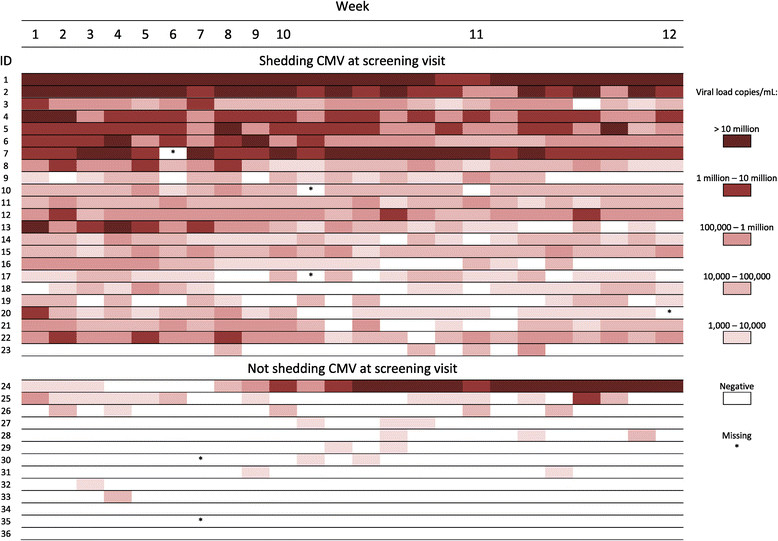
CMV viral shedding among individual children by specimen type over the course of the study.
Figure 4
Figure 4
CMV viral load among individual children over the course of the study. Viral load was determined by taking the highest value of the saliva or urine viral load. Saliva viral load was highest in 801 of the 858 patient visits that had available results.
Figure 5
Figure 5
CMV shedding prevalences and viral loads over time. Panel A: Group mean and median CMV viral loads in saliva by visit number. Panel B: CMV shedding prevalences in saliva by visit number. Panel C: Group mean and median CMV viral loads in urine by visit number. Panel D: CMV shedding prevalences in urine by visit number.
Figure 6
Figure 6
Histogram of changes in CMV viral load category from one visit to the next for saliva and urine. For example, a visit with a viral load in the 105-106 copies/mL category that was followed by a visit with a viral load in that same category would be added to the "zero" column of the histogram. On the other hand, if the visit was followed by a visit with a viral load in the 106-107 copies/mL category or the 104-105 copies/mL category, it would be added to the "one" column of the histogram.

References

    1. Cannon MJ. Congenital cytomegalovirus (CMV) epidemiology and awareness. J Clin Virol. 2009;46S:S6–S10. doi: 10.1016/j.jcv.2009.09.002. - DOI - PubMed
    1. Dollard SC, Grosse SD, Ross DS. New estimates of the prevalence of neurological and sensory sequelae and mortality associated with congenital cytomegalovirus infection. Rev Med Virol. 2007;17(5):355–363. doi: 10.1002/rmv.544. - DOI - PubMed
    1. Mocarski ES, Jr, Shenk T, Pass RF. Cytomegaloviruses. In: Knipe DM, Howley PM, editors. Fields' Virology. 5. Philadelphia: Lippincott Williams & Wilkins; 2007. pp. 2702–2772.
    1. Adler SP, Finney JW, Manganello AM, Best AM. Prevention of child-to-mother transmission of cytomegalovirus by changing behaviors: a randomized controlled trial. Pediatr Infect Dis J. 1996;15(3):240–246. doi: 10.1097/00006454-199603000-00013. - DOI - PubMed
    1. Cannon MJ, Davis KF: Washing our hands of the congenital cytomegalovirus disease epidemic. BMC Public Health 2005, 5(1):70., - PMC - PubMed

MeSH terms