. 2014 Nov;10(11):20140487.
doi: 10.1098/rsbl.2014.0487.

Human children rely more on social information than chimpanzees do

Affiliations

Human children rely more on social information than chimpanzees do

Edwin J C van Leeuwen et al. Biol Lett. 2014 Nov.

Abstract

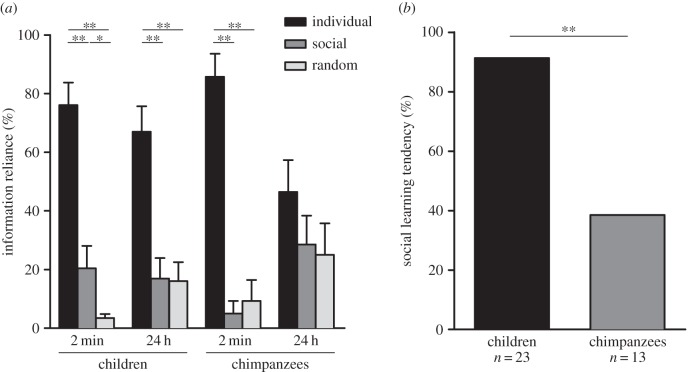
Human societies are characterized by more cultural diversity than chimpanzee communities. However, it is currently unclear what mechanism might be driving this difference. Because reliance on social information is a pivotal characteristic of culture, we investigated individual and social information reliance in children and chimpanzees. We repeatedly presented subjects with a reward-retrieval task on which they had collected conflicting individual and social information of equal accuracy in counterbalanced order. While both species relied mostly on their individual information, children but not chimpanzees searched for the reward at the socially demonstrated location more than at a random location. Moreover, only children used social information adaptively when individual knowledge on the location of the reward had not yet been obtained. Social information usage determines information transmission and in conjunction with mechanisms that create cultural variants, such as innovation, it facilitates diversity. Our results may help explain why humans are more culturally diversified than chimpanzees.

Keywords: children; chimpanzees; culture; decision-making; social learning.


Figures

Figure 1.
Figure 1.
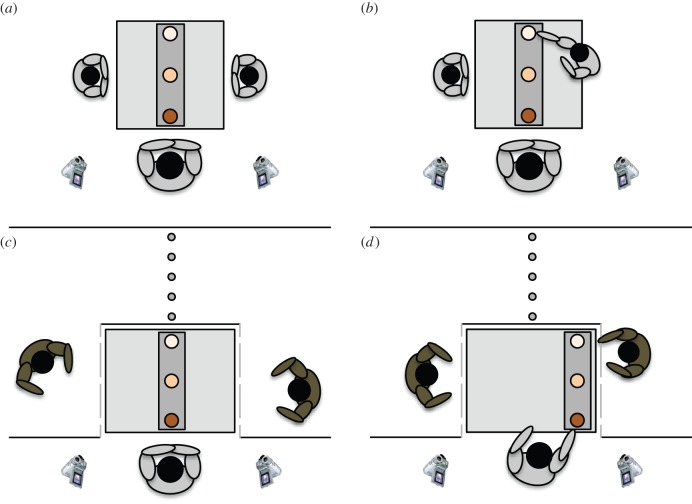
(a) Two children were seated at a table such that they faced each other. Three covers were placed in the middle of the table, in between the children. After giving a concise instruction, the experimenter (E; at the head of the table) placed an occluder over the covers, showed the toy to both children and baited one of the covers with this toy. (b) Subsequently, one child was given its turn to choose one cover to explore, the other child observed this choice and its result. (c) Two chimpanzees were placed in adjacent rooms such that they could see each other, but not enter each others' room. Each chimpanzee had access to a choice-window, which was a see-through perspex panel with three choice-holes in it (left, middle, right; grey vertical bars in front of the chimpanzees). The two choice-windows were connected by a plastic tray (larger grey rectangle) on top of which another tray was placed that contained the three covers (smaller dark grey rectangle with three circles on top). After showing a grape to both individuals, E placed an occluder over the covers and baited one of them. (d) Subsequently, the small tray was slid towards one chimpanzee (in this case, towards the chimpanzee on the right) who then indicated which cover it wanted to explore by putting one or several fingers through one of the choice-holes. The chimpanzee was allowed to explore the cover by him/herself; after the cover was removed by the chimpanzee, E would lift up the cover entirely to make the choice and result also visible to the observing chimpanzee (in this case, the chimpanzee on the left). (Online version in colour.)
Figure 2.
Figure 2.
Children rely more on social information than chimpanzees do. (a) Mean (+s.e.m.) information reliance for the children and chimpanzees across both time-delay conditions as a percentage, and (b) percentage of children and chimpanzees who explored the location that had been observed to be rewarding for a conspecific during their first individual trial. One asterisk, p < 0.05; two asterisks, p < 0.01.

References

    1. Richerson PJ, Boyd R. 2005. Not by genes alone: how culture transformed human evolution. Chicago, IL: The University of Chicago Press.
    1. Luncz LV, Mundry R, Boesch C. 2012. Evidence for cultural differences between neighboring chimpanzee communities. Curr. Biol. 22, 922–926. (10.1016/J.Cub.2012.03.031) - DOI - PubMed
    1. van Leeuwen EJC, Cronin KAC, Haun DBM, Mundry R, Bodamer MD. 2012. Neighbouring chimpanzee communities show different preferences in social grooming behaviour. Proc. R. Soc. B 279, 4362–4367. (10.1098/rspb.2012.1543) - DOI - PMC - PubMed
    1. Mesoudi A. 2011. Cultural evolution: how Darwinian theory can explain human culture and synthesize the social sciences. London, UK: University of Chicago Press.
    1. Whiten A, van Schaik CP. 2007. The evolution of animal 'cultures’ and social intelligence. Phil. Trans. R. Soc. B 362, 603–620. (10.1098/rstb.2006.1998) - DOI - PMC - PubMed

Publication types