Diabetes eye screening in urban settings serving minority populations: detection of diabetic retinopathy and other ocular findings using telemedicine
- PMID: 25393129
- PMCID: PMC4479273
- DOI: 10.1001/jamaophthalmol.2014.4652
Diabetes eye screening in urban settings serving minority populations: detection of diabetic retinopathy and other ocular findings using telemedicine
Erratum in
-
Omission in article information.JAMA Ophthalmol. 2015 May;133(5):621. doi: 10.1001/jamaophthalmol.2015.1176. JAMA Ophthalmol. 2015. PMID: 25974651 No abstract available.
Abstract
Importance: The use of a nonmydriatic camera for retinal imaging combined with the remote evaluation of images at a telemedicine reading center has been advanced as a strategy for diabetic retinopathy (DR) screening, particularly among patients with diabetes mellitus from ethnic/racial minority populations with low utilization of eye care.
Objective: To examine the rate and types of DR identified through a telemedicine screening program using a nonmydriatic camera, as well as the rate of other ocular findings.
Design, setting, and participants: A cross-sectional study (Innovative Network for Sight [INSIGHT]) was conducted at 4 urban clinic or pharmacy settings in the United States serving predominantly ethnic/racial minority and uninsured persons with diabetes. Participants included persons aged 18 years or older who had type 1 or 2 diabetes mellitus and presented to the community-based settings.
Main outcomes and measures: The percentage of DR detection, including type of DR, and the percentage of detection of other ocular findings.
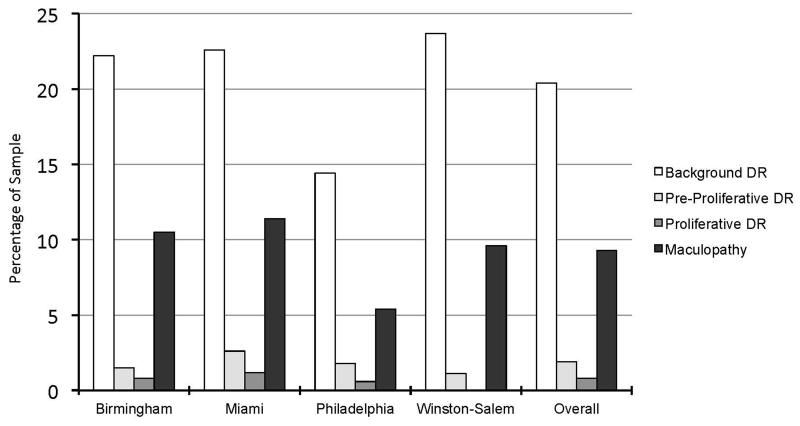
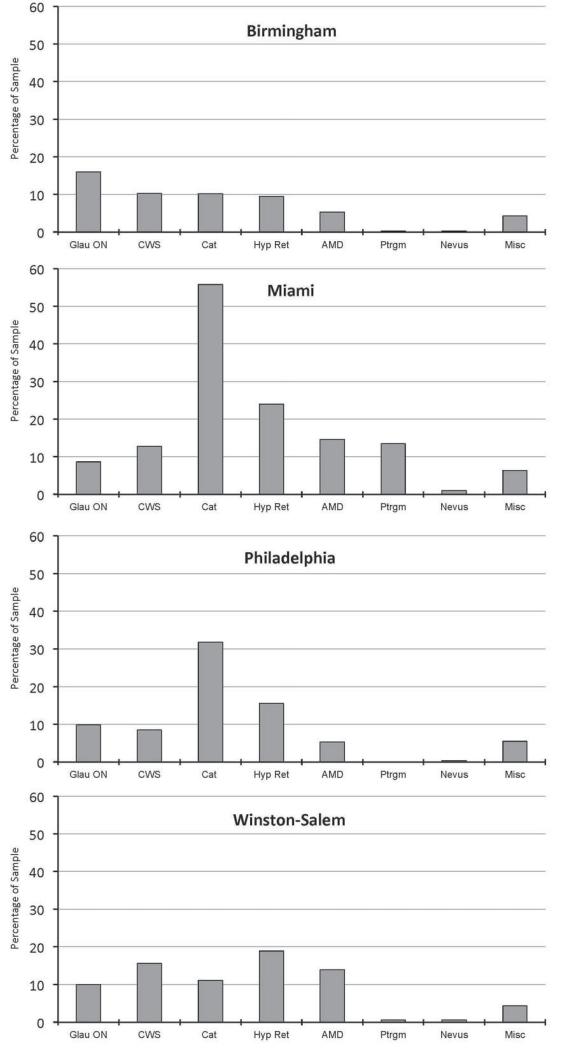
Results: A total of 1894 persons participated in the INSIGHT screening program across sites, with 21.7% having DR in at least 1 eye. The most common type of DR was background DR, which was present in 94.1% of all participants with DR. Almost half (44.2%) of the sample screened had ocular findings other than DR; 30.7% of the other ocular findings were cataract.
Conclusions and relevance: In a DR telemedicine screening program in urban clinic or pharmacy settings in the United States serving predominantly ethnic/racial minority populations, DR was identified on screening in approximately 1 in 5 persons with diabetes. The vast majority of DR was background, indicating high public health potential for intervention in the earliest phases of DR when treatment can prevent vision loss. Other ocular conditions were detected at a high rate, a collateral benefit of DR screening programs that may be underappreciated.
Figures
References
-
- Centers for Disease Control and Prevention . National Diabetes Statistics Report: Estimates of Diabetes and Its Burden in the United States. US Department of Health and Human Services; Atlanta GA: 2014. http://www.cdc.gov/diabetes/pubs/statsreport14.htm.
-
- Boyle JP, Honeycutt AA, Narayan KM, et al. Projection of diabetes burden through 2050. Diabetes Care. 2001;24:1936–1940. - PubMed
-
- Saaddine JB, Honeycutt AA, Narayan KM, Zhang X, Klein R, Boyle JP. Projection of diabetic retinopathy and other major eye diseaes among people with diabetes mellitus: United States, 2005-2050. Arch Ophthalmol. 2008;126:1740–1747. - PubMed
-
- Rein D, Zhang P, Wirth K, et al. The economic burden of major adult visual disorders in the United States. Arch Ophthalmol. 2006;124:1754–1760. - PubMed
Publication types
MeSH terms
Substances
Grants and funding
- U58 DP002655/DP/NCCDPHP CDC HHS/United States
- 5U58DP002652/DP/NCCDPHP CDC HHS/United States
- 5U58DP002653/DP/NCCDPHP CDC HHS/United States
- U58 DP002653/DP/NCCDPHP CDC HHS/United States
- P30 DK079626/DK/NIDDK NIH HHS/United States
- 5U58DP002655/DP/NCCDPHP CDC HHS/United States
- U58DP002653/ACL/ACL HHS/United States
- U58 DP002652/DP/NCCDPHP CDC HHS/United States
- 5U58DP002651/DP/NCCDPHP CDC HHS/United States
- U01 DP005127/DP/NCCDPHP CDC HHS/United States
- U58DP002652/ACL/ACL HHS/United States
- U58 DP002651/DP/NCCDPHP CDC HHS/United States
LinkOut - more resources
Full Text Sources
Other Literature Sources
Medical