Financial incentives for abstinence among socioeconomically disadvantaged individuals in smoking cessation treatment
- PMID: 25393172
- PMCID: PMC4431094
- DOI: 10.2105/AJPH.2014.302102
Financial incentives for abstinence among socioeconomically disadvantaged individuals in smoking cessation treatment
Abstract
Objectives: We evaluated the effectiveness of offering adjunctive financial incentives for abstinence (contingency management [CM]) within a safety net hospital smoking cessation program.
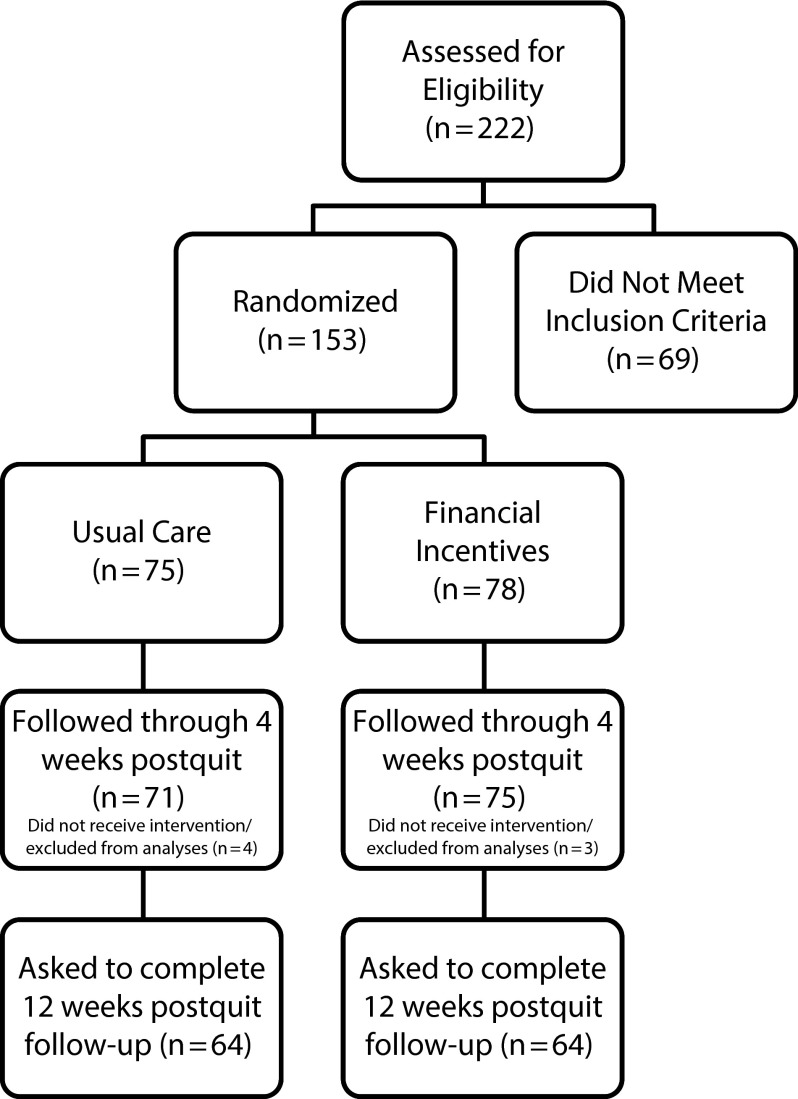
Methods: We randomized participants (n = 146) from a Dallas County, Texas, Tobacco Cessation Clinic from 2011 to 2013 to usual care (UC; cessation program; n = 71) or CM (UC + 4 weeks of financial incentives; n = 75), and followed from 1 week before the quit date through 4 weeks after the quit date. A subset (n = 128) was asked to attend a visit 12 weeks after the scheduled quit date.
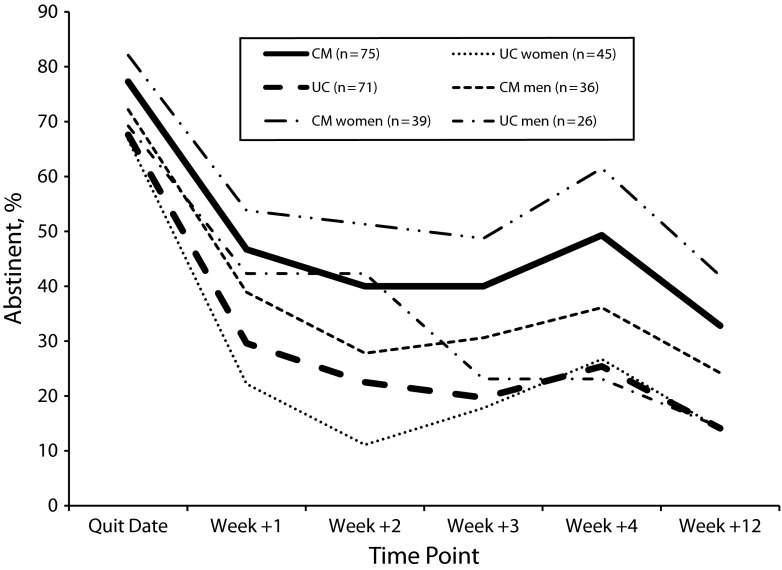
Results: Participants were primarily Black (62.3%) or White (28.1%) and female (57.5%). Most participants were uninsured (52.1%) and had an annual household income of less than $12 000 (55.5%). Abstinence rates were significantly higher for those assigned to CM than UC at all visits following the quit date (all Ps < .05). Point prevalence abstinence rates in the CM and UC groups were 49.3% versus 25.4% at 4 weeks after the quit date and 32.8% versus 14.1% at 12 weeks after the quit date. CM participants earned an average of $63.40 ($150 possible) for abstinence during the first 4 weeks after the scheduled quit date.
Conclusions: Offering small financial incentives for abstinence might be an effective means to improve abstinence rates among socioeconomically disadvantaged individuals participating in smoking cessation treatment.
Figures
References
-
- Mokdad AH, Marks JS, Stroup DF, Gerberding JL. Actual causes of death in the United States, 2000. JAMA. 2004;291(10):1238–1245. - PubMed
-
- Siahpush M, Carlin JB. Financial stress, smoking cessation and relapse: results from a prospective study of an Australian national sample. Addiction. 2006;101(1):121–127. - PubMed
-
- Fernández E, Schiaffino A, Borrell C et al. Social class, education, and smoking cessation: long-term follow-up of patients treated at a smoking cessation unit. Nicotine Tob Res. 2006;8(1):29–36. - PubMed
-
- Wetter DW, Cofta-Gunn L, Irvin JE et al. What accounts for the association of education and smoking cessation? Prev Med. 2005;40(4):452–460. - PubMed
Publication types
MeSH terms
LinkOut - more resources
Full Text Sources
Medical