


Prospective study of sickle cell trait and venous thromboembolism incidence
- PMID: 25393788
- PMCID: PMC4294976
- DOI: 10.1111/jth.12787
Prospective study of sickle cell trait and venous thromboembolism incidence
Abstract
Background: Sickle cell trait may increase risk of venous thromboembolism, but this is not fully established.
Objectives: We sought to determine the association of sickle cell trait with deep vein thrombosis and pulmonary embolism.
Methods: Middle-aged African Americans participating in a prospective, population-based cohort investigation, the Atherosclerosis Risk in Communities Study, were followed from 1987 through 2011 for incident hospitalized pulmonary embolism (n = 111) or isolated deep vein thrombosis (n = 138), verified by physician review of medical records. Sickle cell trait (heterozygosity for hemoglobin S, n = 268) was compared with no sickle cell trait (n = 3748).
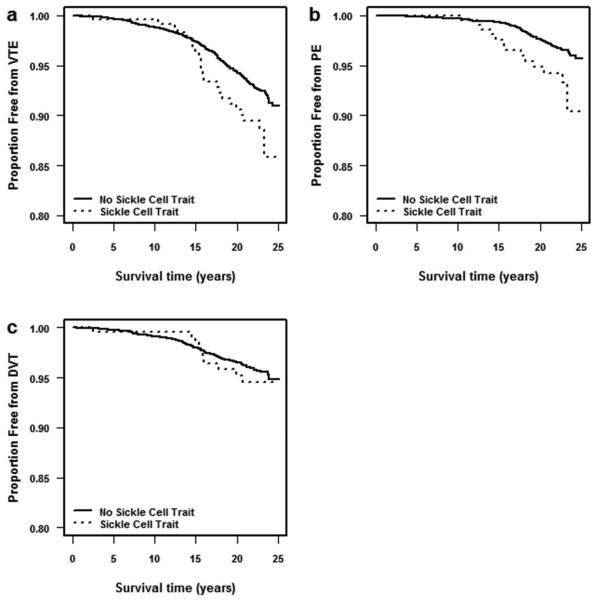
Results: Over a median of 22 years of follow-up, 249 participants had an incident venous thromboembolism. The hazard ratio of venous thromboembolism was 1.50 (95% confidence interval [CI] 0.96-2.36) for participants with vs. without sickle cell trait, after adjustment for age, sex, ancestry, hormone replacement therapy (women), body mass index, diabetes, and estimated glomerular filtration rate. This hazard ratio was 2.05 (95% CI 1.12-3.76) for pulmonary embolism and 1.15 (95% CI 0.58-2.27) for deep vein thrombosis without pulmonary embolism.
Conclusions: Sickle cell trait in African Americans carries a 2-fold increased risk of pulmonary embolism but does not elevate deep vein thrombosis risk. Because neonatal screening for sickle hemoglobin is being conducted in the United States, consideration should be paid to the increased pulmonary embolism risk of individuals with sickle cell trait.
Keywords: epidemiology; prospective study; risk factors; sickle cell trait; venous thromboembolism.
© 2014 International Society on Thrombosis and Haemostasis.
Figures
References
-
- Stein PD, Beemath A, Meyers FA, Skaf E, Olson RE. Deep venous thrombosis and pulmonary embolism in hospitalized patients with sickle cell disease. Am J Med. 2006;119:897.e7–11. - PubMed
-
- Porter B, Key NS, Jauk VC, Adam S, Biggio J, Tita A. Impact of sickle hemoglobinopathies on pregnancy-related venous thromboembolism. Am J Perinatol. 2014;31:805–10. - PubMed
-
- Lim MY, Ataga KI, Key NS. Hemostatic abnormalities in sickle cell disease. Curr Opin Hemato. 2013;20:472–7. - PubMed
-
- Ataga KI, Key NS. Hypercoagulability in sickle cell disease: new approaches to an old problem. Hematology Am Soc Hematol Educ Program. 2007;91:6. - PubMed
Publication types
MeSH terms
Grants and funding
LinkOut - more resources
Full Text Sources
Other Literature Sources
Medical
