. 2015 Jun 15;136(12):2822-30.
doi: 10.1002/ijc.29329. Epub 2014 Nov 28.

Trends in Kaposi's sarcoma-associated Herpesvirus antibodies prior to the development of HIV-associated Kaposi's sarcoma: a nested case-control study

Affiliations

Trends in Kaposi's sarcoma-associated Herpesvirus antibodies prior to the development of HIV-associated Kaposi's sarcoma: a nested case-control study

Katie Wakeham et al. Int J Cancer. .

Abstract

HIV-associated Kaposi's sarcoma (KS) is a public health challenge in sub-Saharan Africa since both the causative agent, Kaposi's sarcoma associated-herpesvirus (KSHV), and the major risk factor, HIV, are prevalent. In a nested case-control study within a long-standing clinical cohort in rural Uganda, we used stored sera to examine the evolution of antibody titres against the KSHV antigens K8.1 and latency-associated nuclear antigen (LANA) among 30 HIV-infected subjects who subsequently developed HIV-related KS (cases) and among 108 matched HIV/KSHV coinfected controls who did not develop KS. Throughout the 6 years prior to diagnosis, antibody titres to K8.1 and LANA were significantly higher among cases than controls (p < 0.0001), and titres increased prior to diagnosis in the cases. K8.1 titres differed more between KS cases and controls, compared to LANA titres. These differences in titre between cases and controls suggest a role for lytic viral replication in the pathogenesis of HIV-related KS in this setting.

Keywords: AIDS; HIV; HIV-associated Kaposi's sarcoma; Kaposi's sarcoma associated-herpesvirus; sub-Saharan Africa.


Figures

Figure 1
Figure 1
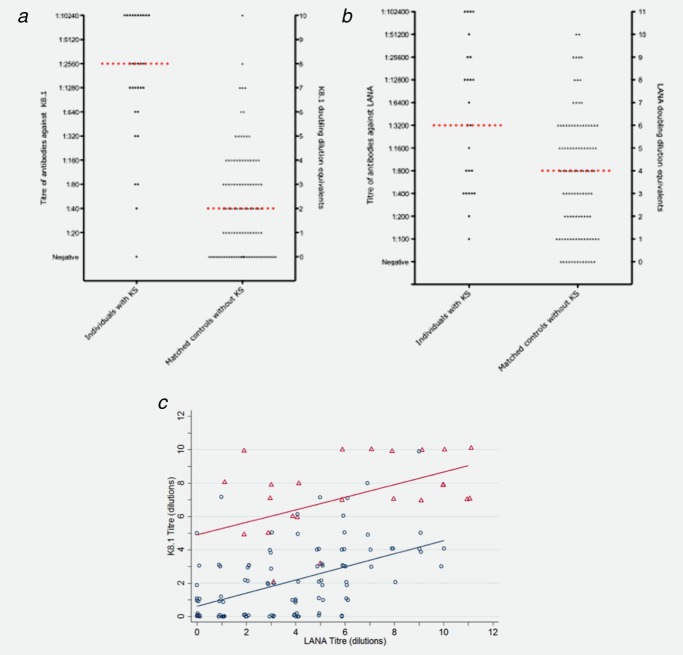
Distribution of titres of antibodies to K8.1 (A) and LANA (8), and doubling dilution equivalents, is 30 HIV-positive individuals with Kaposi's sarcoma (KS) and 108 matched controls, at time of diagnosis (for cases) of pseudo-diagnosis (for controls). For each patient with KS, up to four controls without KS were selected matched for sex, CD4 count group and age. The median titre in each group is indicated by a horizontal red line. Scatter plot of K8.1 versus LANA titre (C) with linear fits plotted separately for the cases and controls.
Figure 2
Figure 2
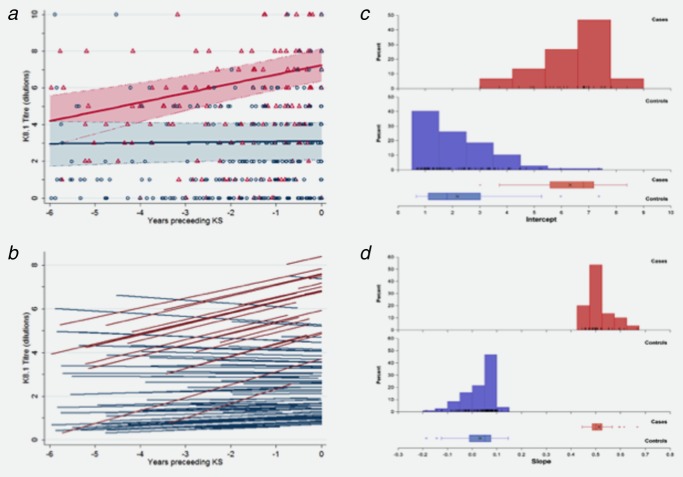
K8.1 titres in the six years prior to diagnosis (for cases) or pseudo-diagnosis (for controls). (A) for Kaposi's sarcoma (KS) cases (red symbols and lines) and non-KS controls (blue symbols and lines) with predictions bases on the GEE (A) and random effects (B) regression models presented in Table 2. GEE regression model predictions are based on a group of patients in a 1:1 sex ratio, at the median of 37 years at diagnosis and with a C04 count between 200 and 500 cells/ml; the shaded areas represent the 95% confidence intervals. Random effects model predictions are the fitted lines for each individual patient with at least 2 measurements. Distributions of individual intercept (C) and slope (D) estimates from the random effect model. Red bars/boxes denote KS cases and blue bars/boxes denote control patients.
Figure 3
Figure 3
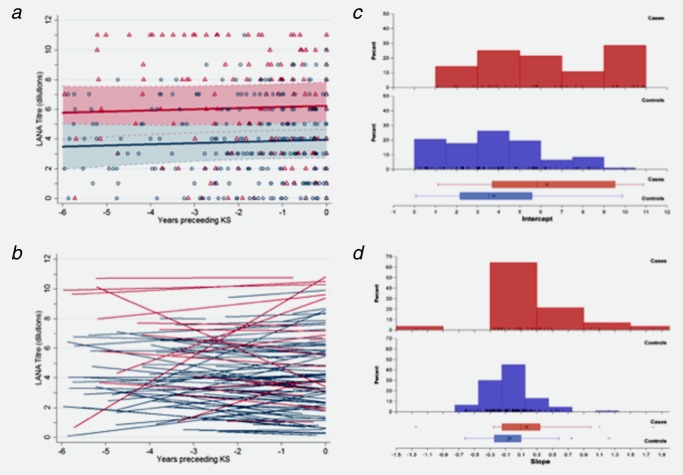
LANA titres in the six years prior to diagnosis (for cases) or pseudo-diagnosis (for controls). (A) for Kaposi's sarcoma (KS) cases (red symbols and lines) and non-KS controls (blue symbols and lines) with predictions bases on the GEE (A) and random effects (B) regression models presented in Table 2. GEE regression model predictions are based on a group of patients in a 1:1 sex ratio, at the median of 37 years at diagnosis and with a C04 count between 200 and 500 cells/ml; the shaded areas represented the 95% confidence intervals. Random effects model predictions are the fitted lines for each individual patient with at least 2 measurements. Distributions of individual intercept (C) and slope (D) estimates from the random effect model. Red bars/boxes denote KS cases and blue/boxes denote control patients.

References

    1. Bray F, Ren JS, Masuyer E, Ferlay J. Global estimates of cancer prevalence for 27 sites in the adult population in 2008. Int J Cancer. 2013;132:1133–45. - PubMed
    1. Mbisa GL, Miley W, Gamache CJ, et al. Detection of antibodies to Kaposi's sarcoma-associated herpesvirus: a new approach using K8.1 ELISA and a newly developed recombinant LANA ELISA. J Immunol Methods. 2010;356:39–46. - PMC - PubMed
    1. Newton R, Ziegler J, Bourboulia D, et al. Infection with Kaposi's sarcoma-associated herpesvirus (KSHV) and human immunodeficiency virus (HIV) in relation to the risk and clinical presentation of Kaposi's sarcoma in Uganda. Br J Cancer. 2003;89:502–4. - PMC - PubMed
    1. Sitas F, Carrara H, Beral V, et al. Antibodies against human herpesvirus 8 in black South African patients with cancer. New Engl J Med. 1999;340:1863–71. - PubMed
    1. Grulich AE, Olsen SJ, Luo K, et al. Kaposi's sarcoma-associated herpesvirus: a sexually transmissible infection? J Acquir Immune Defic Syndr Hum Retrovirol. 1999;20:387–93. - PubMed

Publication types

MeSH terms