


Comment
doi: 10.1038/ni.3030.
The RIP1-RIP3 complex initiates mitochondrial fission to fuel NLRP3
Affiliations
- PMID: 25396345
- PMCID: PMC5115691
- DOI: 10.1038/ni.3030
Item in Clipboard
Comment
The RIP1-RIP3 complex initiates mitochondrial fission to fuel NLRP3
Nat Immunol.
2014 Dec.
Erratum in
-
Corrigendum: The RIP1-RIP3 complex initiates mitochondrial fission to fuel NLRP3.Nat Immunol. 2015 Mar;16(3):326. doi: 10.1038/ni0315-326c. Nat Immunol. 2015. PMID: 25689445 No abstract available.
-
Corrigendum: The RIP1-RIP3 complex initiates mitochondrial fission to fuel NLRP3.Nat Immunol. 2015 Dec;16(12):1292. doi: 10.1038/ni1215-1292b. Nat Immunol. 2015. PMID: 26580509 No abstract available.
Abstract
Vesicular stomatitis virus, a single-stranded RNA virus, triggers activation of the serine-threonine kinases RIP1 and RIP3, which damages mitochondria by activating the GTPase DRP1. This results in excessive production of reactive oxygen species and subsequent activation of the NLRP3 inflammasome.
Figures
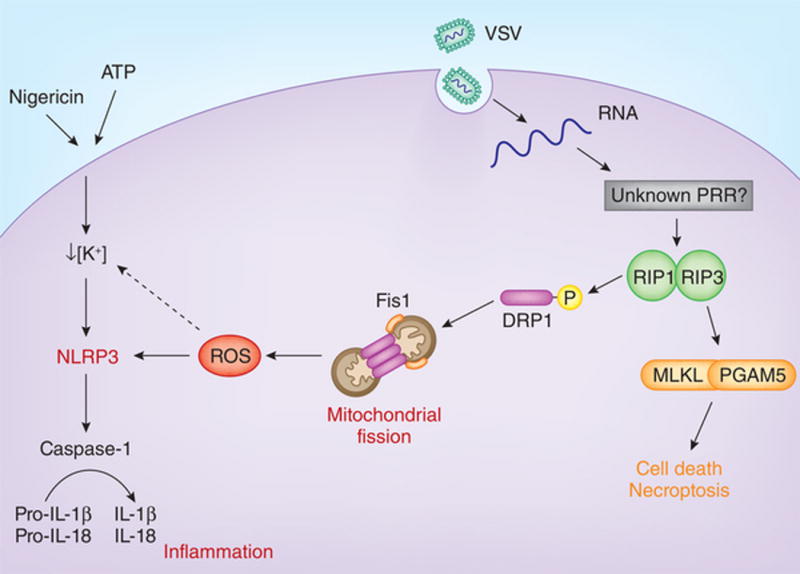
Once activated, NLRP3 leads to the processing of pro-caspase-1 into its active form. Active caspase-1 then cleaves the pro-IL-1β and pro-IL-18 into their secreted, mature forms. Wang et al. show that during infection with RNA viruses such as VSV, the activation of NLRP3 is closely tied to necroptosis. Virus-derived cytosolic RNA induces formation of the RIP1-RIP3 complex, in which RIP1 phosphorylates DRP1. DRP1 then engages Fis1 on the mitochondrial outer membrane, where DRP1 is known to oligomerize to induce mitochondrial fission. Mitochondrial fission leads to increased cytosolic levels of ROS and activated NLRP3. Notably, the authors demonstrate that this arm of RIP1-RIP3 signaling cascade is distinct from the necroptotic arm that is executed by MLKL and PGAM5. Additionally, the mechanisms presented here are also distinct from the activation of NLRP3 by other well-known NLRP3 agonists, such as ATP and nigericin. PRR, pattern-recognition receptor.
Comment on
-
RNA viruses promote activation of the NLRP3 inflammasome through a RIP1-RIP3-DRP1 signaling pathway.Nat Immunol. 2014 Dec;15(12):1126-33. doi: 10.1038/ni.3015. Epub 2014 Oct 19. Nat Immunol. 2014. PMID: 25326752
References
Publication types
MeSH terms
Substances
Grants and funding
LinkOut - more resources
Full Text Sources
Other Literature Sources
Miscellaneous
