


Predictors of children's secondhand smoke exposure at home: a systematic review and narrative synthesis of the evidence
- PMID: 25397875
- PMCID: PMC4232519
- DOI: 10.1371/journal.pone.0112690
Predictors of children's secondhand smoke exposure at home: a systematic review and narrative synthesis of the evidence
Abstract
Background: Children's exposure to secondhand smoke (SHS) has been causally linked to a number of childhood morbidities and mortalities. Over 50% of UK children whose parents are smokers are regularly exposed to SHS at home. No previous review has identified the factors associated with children's SHS exposure in the home.
Aim: To identify by systematic review, the factors which are associated with children's SHS exposure in the home, determined by parent or child reports and/or biochemically validated measures including cotinine, carbon monoxide or home air particulate matter.
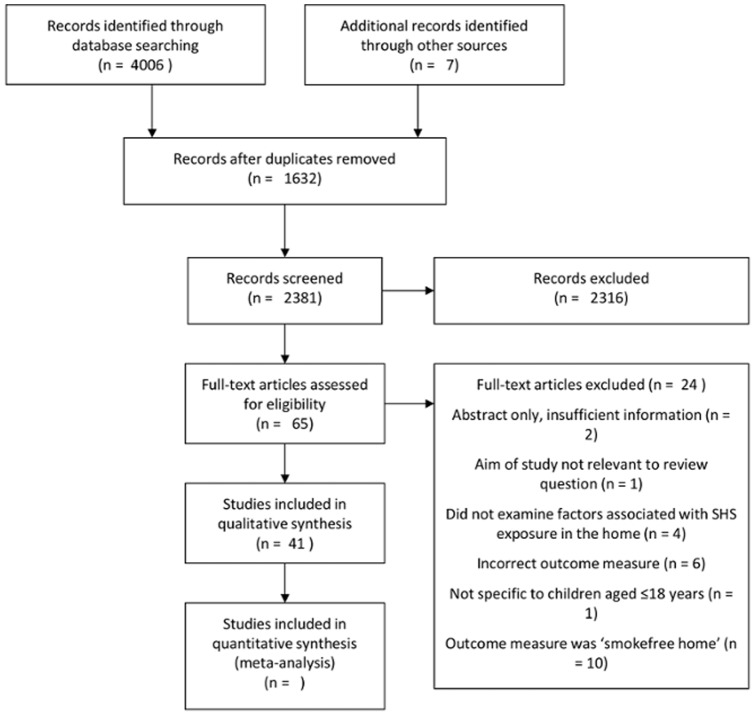
Methods: Electronic searches of MEDLINE, EMBASE, PsychINFO, CINAHL and Web of Knowledge to July 2014, and hand searches of reference lists from publications included in the review were conducted.
Findings: Forty one studies were included in the review. Parental smoking, low socioeconomic status and being less educated were all frequently and consistently found to be independently associated with children's SHS exposure in the home. Children whose parents held more negative attitudes towards SHS were less likely to be exposed. Associations were strongest for parental cigarette smoking status; compared to children of non-smokers, those whose mothers or both parents smoked were between two and 13 times more likely to be exposed to SHS.
Conclusion: Multiple factors are associated with child SHS exposure in the home; the best way to reduce child SHS exposure in the home is for smoking parents to quit. If parents are unable or unwilling to stop smoking, they should instigate smoke-free homes. Interventions targeted towards the socially disadvantaged parents aiming to change attitudes to smoking in the presence of children and providing practical support to help parents smoke outside the home may be beneficial.
Conflict of interest statement
Figures
References
-
- Royal College of Physicians (2010) Passive smoking and children. A report of the Tobacco Advisory Group of the Royal College of Physicians. London: Royal College of Physicians.
-
- US Surgeon General (2006) The health consequences of involuntary exposure to tobacco smoke: a report of the Surgeon General. Atlanta, US: US Department of Health and Human Services, Centers for Disease Control for Chronic Disease Prevention and Health Promotion, National Center for Chronic Disease Prevention and Health Promotion, Office on Smoking and Health.
-
- Oberg M, Jaakkola M, Woodward A, Peruga A, Pruss-Ustun A (2011) Worldwide burden of disease from exposure to second-hand smoke: a retrospective analysis of data from 192 countries. Lancet 377: 139–146. - PubMed
-
- Jarvis MJ, Mindell J, Gilmore A, Feyerabend C, West R (2009) Smoke-free homes in England: prevalence, trends and validation by cotinine in children. TobControl 18: 491–495. - PubMed
-
- Sims M, Tomkins S, Judge K, Taylor G, Jarvis M, et al. (2010) Trends in and predictors of second-hand smoke exposure indexed by cotinine in children in England from 1996 to 2006. Addiction 105: 543–553. - PubMed
Publication types
MeSH terms
Substances
Grants and funding
LinkOut - more resources
Full Text Sources
Other Literature Sources
Medical
