


Phenomapping for novel classification of heart failure with preserved ejection fraction
- PMID: 25398313
- PMCID: PMC4302027
- DOI: 10.1161/CIRCULATIONAHA.114.010637
Phenomapping for novel classification of heart failure with preserved ejection fraction
Abstract
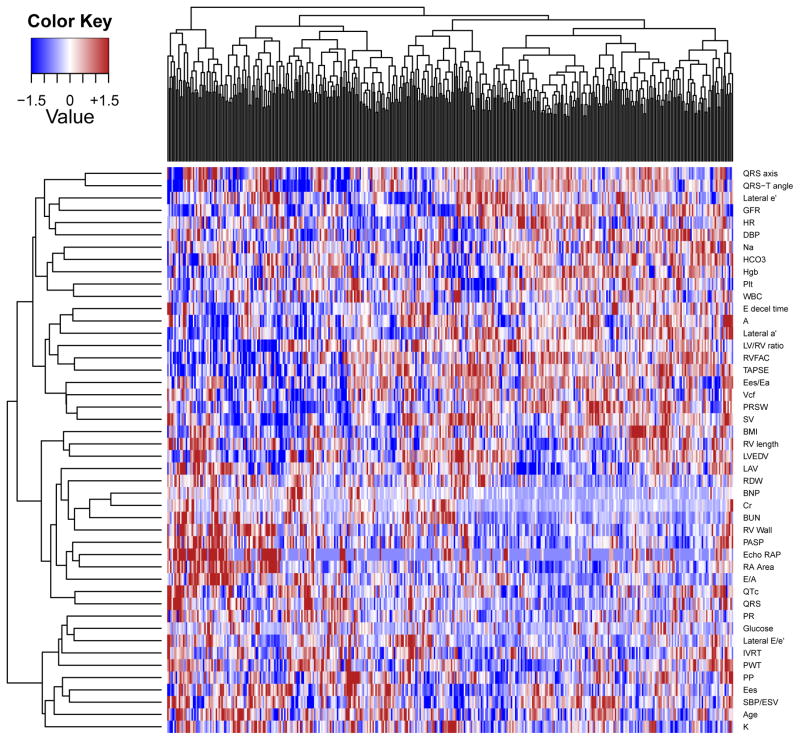
Background: Heart failure with preserved ejection fraction (HFpEF) is a heterogeneous clinical syndrome in need of improved phenotypic classification. We sought to evaluate whether unbiased clustering analysis using dense phenotypic data (phenomapping) could identify phenotypically distinct HFpEF categories.
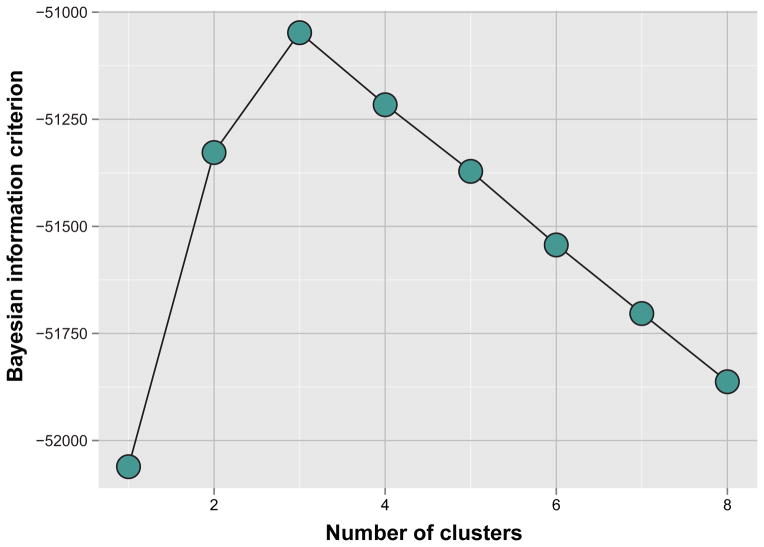
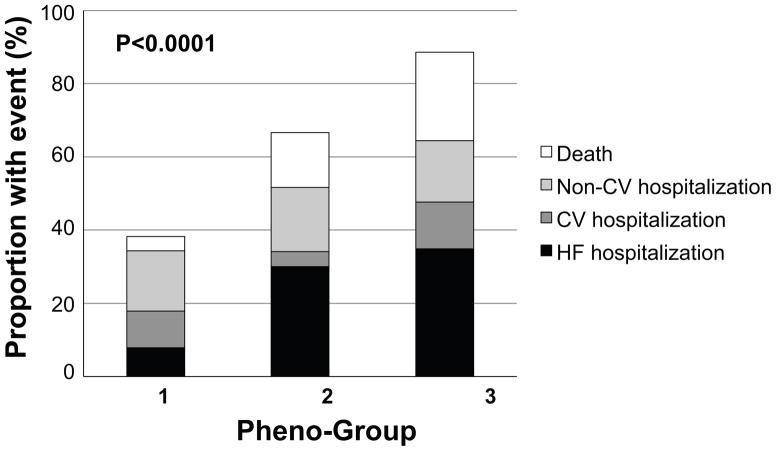
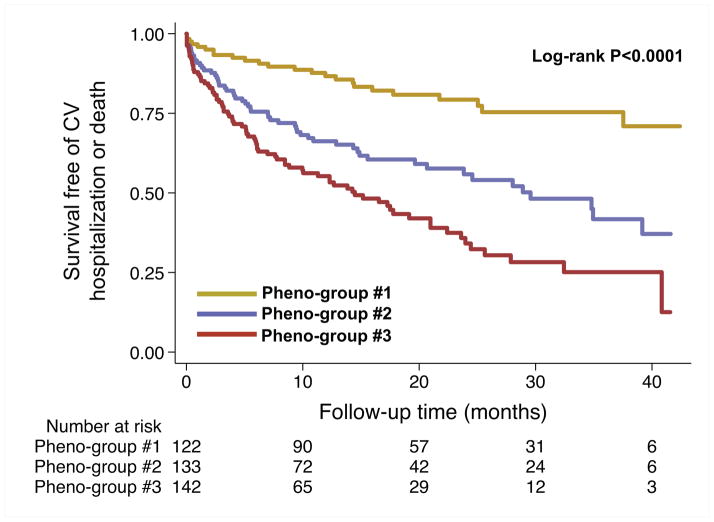
Methods and results: We prospectively studied 397 patients with HFpEF and performed detailed clinical, laboratory, ECG, and echocardiographic phenotyping of the study participants. We used several statistical learning algorithms, including unbiased hierarchical cluster analysis of phenotypic data (67 continuous variables) and penalized model-based clustering, to define and characterize mutually exclusive groups making up a novel classification of HFpEF. All phenomapping analyses were performed by investigators blinded to clinical outcomes, and Cox regression was used to demonstrate the clinical validity of phenomapping. The mean age was 65±12 years; 62% were female; 39% were black; and comorbidities were common. Although all patients met published criteria for the diagnosis of HFpEF, phenomapping analysis classified study participants into 3 distinct groups that differed markedly in clinical characteristics, cardiac structure/function, invasive hemodynamics, and outcomes (eg, phenogroup 3 had an increased risk of HF hospitalization [hazard ratio, 4.2; 95% confidence interval, 2.0-9.1] even after adjustment for traditional risk factors [P<0.001]). The HFpEF phenogroup classification, including its ability to stratify risk, was successfully replicated in a prospective validation cohort (n=107).
Conclusions: Phenomapping results in a novel classification of HFpEF. Statistical learning algorithms applied to dense phenotypic data may allow improved classification of heterogeneous clinical syndromes, with the ultimate goal of defining therapeutically homogeneous patient subclasses.
Keywords: cluster analysis; echocardiography; heart failure, diastolic; patient outcome assessment.
© 2014 American Heart Association, Inc.
Figures
Comment in
-
Using "big data" to dissect clinical heterogeneity.Circulation. 2015 Jan 20;131(3):232-3. doi: 10.1161/CIRCULATIONAHA.114.014106. Circulation. 2015. PMID: 25601948 No abstract available.
References
-
- Shah AM, Pfeffer MA. The many faces of heart failure with preserved ejection fraction. Nat Rev Cardiol. 2012;9:555–556. - PubMed
-
- Shah AM, Solomon SD. Phenotypic and pathophysiological heterogeneity in heart failure with preserved ejection fraction. Eur Heart J. 2012;33:1716–1717. - PubMed
-
- Hinton GE, Salakhutdinov RR. Reducing the dimensionality of data with neural networks. Science. 2006;313:504–507. - PubMed
Publication types
MeSH terms
Grants and funding
LinkOut - more resources
Full Text Sources
Other Literature Sources
Medical
Research Materials
Miscellaneous
