


Sodium-to-potassium ratio and blood pressure, hypertension, and related factors
- PMID: 25398734
- PMCID: PMC4224208
- DOI: 10.3945/an.114.006783
Sodium-to-potassium ratio and blood pressure, hypertension, and related factors
Abstract
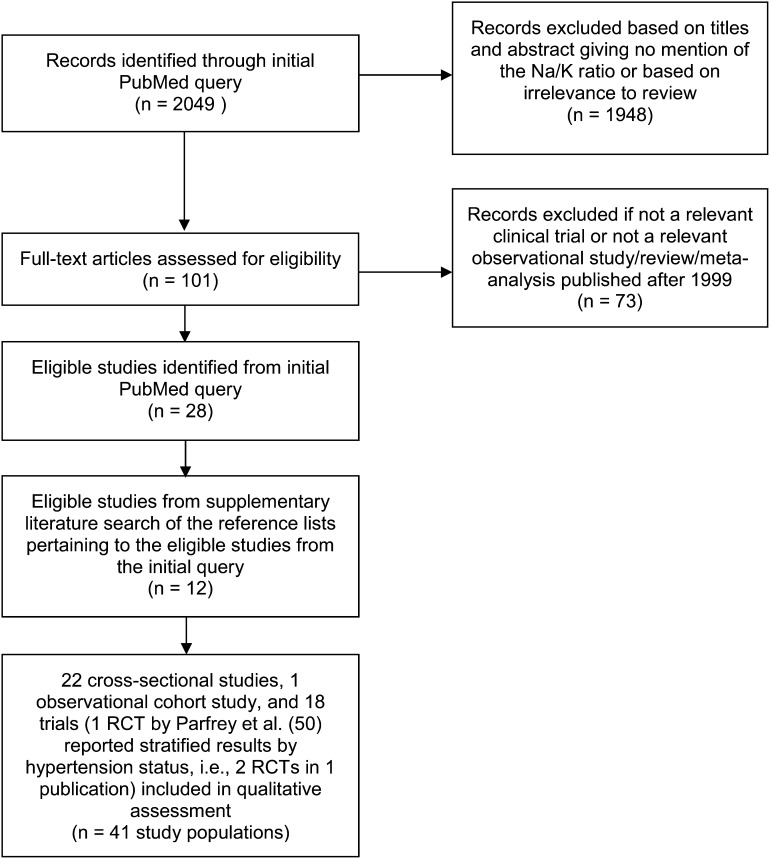
The potential cost-effectiveness and feasibility of dietary interventions aimed at reducing hypertension risk are of considerable interest and significance in public health. In particular, the effectiveness of restricted sodium or increased potassium intake on mitigating hypertension risk has been demonstrated in clinical and observational research. The role that modified sodium or potassium intake plays in influencing the renin-angiotensin system, arterial stiffness, and endothelial dysfunction remains of interest in current research. Up to the present date, no known systematic review has examined whether the sodium-to-potassium ratio or either sodium or potassium alone is more strongly associated with blood pressure and related factors, including the renin-angiotensin system, arterial stiffness, the augmentation index, and endothelial dysfunction, in humans. This article presents a systematic review and synthesis of the randomized controlled trials and observational research related to this issue. The main findings show that, among the randomized controlled trials reviewed, the sodium-to-potassium ratio appears to be more strongly associated with blood pressure outcomes than either sodium or potassium alone in hypertensive adult populations. Recent data from the observational studies reviewed provide additional support for the sodium-to-potassium ratio as a superior metric to either sodium or potassium alone in the evaluation of blood pressure outcomes and incident hypertension. It remains unclear whether this is true in normotensive populations and in children and for related outcomes including the renin-angiotensin system, arterial stiffness, the augmentation index, and endothelial dysfunction. Future study in these populations is warranted.
© 2014 American Society for Nutrition.
Conflict of interest statement
Author disclosures: At the time this research was conducted and completed, V. Perez was employed by Exponent, Inc., a for-profit corporation that provides science and engineering consulting services. E. T. Chang is employed by Exponent, Inc.
Figures
References
-
- Lloyd-Jones DM, Hong Y, Labarthe D, Mozaffarian D, Appel LJ, Van Horn L, Greenlund K, Daniels S, Nichol G, Tomaselli GF, et al. Defining and setting national goals for cardiovascular health promotion and disease reduction: the American Heart Association's strategic Impact Goal through 2020 and beyond. Circulation 2010;121:586–613. - PubMed
-
- Lambers Heerspink HJ, Perkovic V, de Zeeuw D. Renal and cardio-protective effects of direct renin inhibition: a systematic literature review. J Hypertens 2009;27:2321–31. - PubMed
-
- Schmieder RE, Hilgers KF, Schlaich MP, Schmidt BM. Renin-angiotensin system and cardiovascular risk. Lancet 2007;369:1208–19. - PubMed
-
- Payne RA, Wilkinson IB, Webb DJ. Arterial stiffness and hypertension: emerging concepts. Hypertension 2010;55:9–14. - PubMed
Publication types
MeSH terms
Substances
LinkOut - more resources
Full Text Sources
Other Literature Sources
Medical
