Herpes simplex virus type 2 serostatus is not associated with inflammatory or metabolic markers in antiretroviral therapy-treated HIV
- PMID: 25399537
- PMCID: PMC4348084
- DOI: 10.1089/AID.2014.0183
Herpes simplex virus type 2 serostatus is not associated with inflammatory or metabolic markers in antiretroviral therapy-treated HIV
Abstract
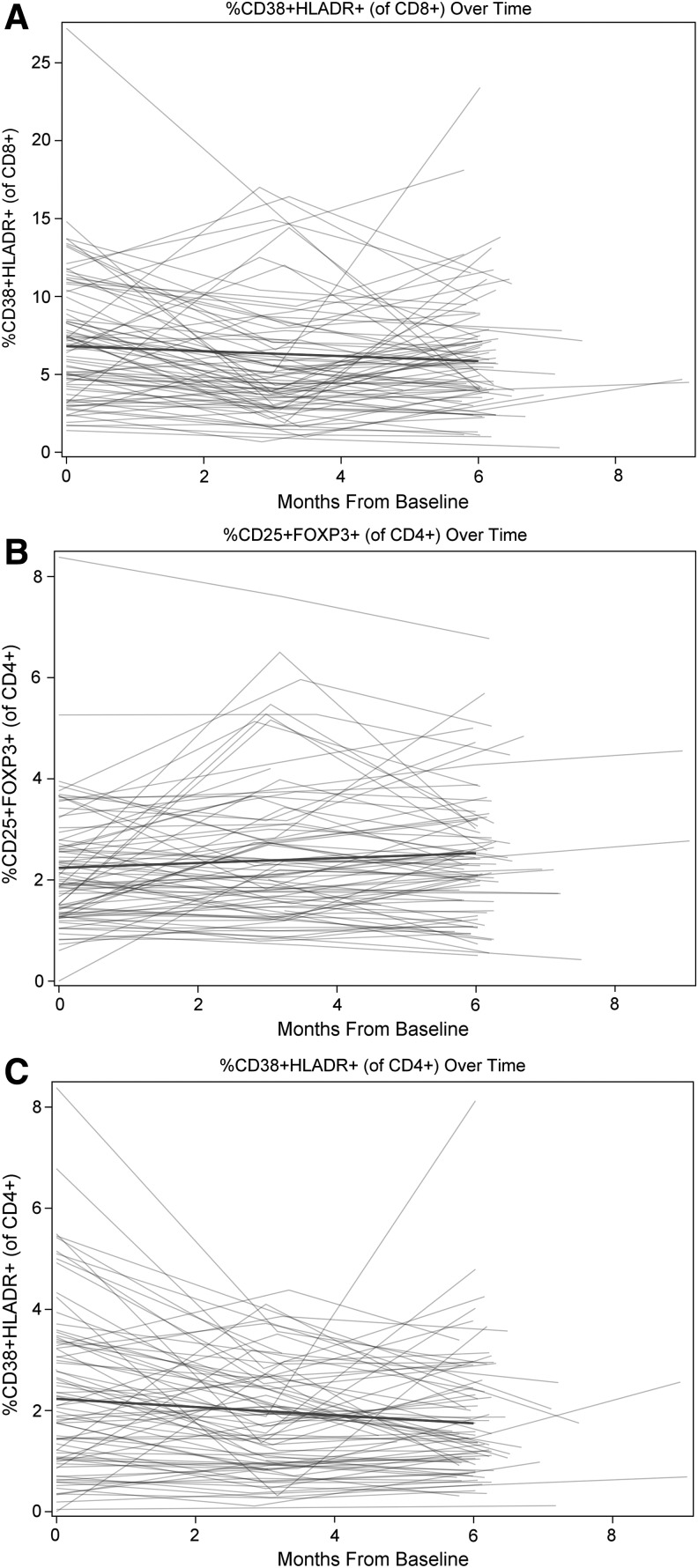
Systemic inflammation and immune activation may persist in HIV-infected persons on suppressive combination antiretroviral therapy (cART) and contribute to adverse health outcomes. We compared markers of immune activation, inflammation, and abnormal glucose and lipid metabolism in HIV-infected adults according to herpes simplex virus type 2 (HSV-2) serostatus in a 6-month observational cohort study in Toronto, Canada. HIV-infected adults on suppressive (viral load <50 copies/ml) cART were categorized as HSV-2 seropositive or seronegative using the HerpeSelect ELISA, and underwent study visits at baseline, 3 months, and 6 months. The primary outcome was the median percentage of activated (CD38(+)HLADR(+)) CD8 T cells. Secondary outcome measures included additional immune (activated CD4, regulatory T cells) and inflammatory (hsCRP, D-dimer, IL-1b, IL-6, MCP-1, TNF, sICAM-1, sVCAM-1, Ang1/Ang2 ratio) markers. Metabolic outcomes included the proportion with impaired fasting glucose/impaired glucose tolerance/diabetes, insulin sensitivity (calculated using the Matsuda index), insulin resistance (homeostasis model assessment of insulin resistance), and fasting lipids. The impact of HSV-2 on each outcome was estimated using generalized estimating equation regression models. Of 84 participants, 38 (45%) were HSV-2 seropositive. HSV signs and symptoms were uncommon. Aside from D-dimer, which was more often detectable in HSV-2 seropositives (adjusted odds ratio=3.58, 95% CI=1.27, 10.07), HSV-2 serostatus was not associated with differences in any other immune, inflammatory cytokine, acute phase reactant, endothelial activation, or metabolic markers examined in univariable or multivariable models. During the study, CD8 and CD4 T cell activation declined by 0.16% and 0.08% per month, respectively, while regulatory T cells increased by 0.05% per month. HSV-2 serostatus was not consistently associated with immune activation, inflammatory, or lipid and glucose metabolic markers in this cohort of HIV-infected adults on suppressive cART.
Figures
References
-
- Hunt PW, Martin JN, Sinclair E, et al. : T cell activation is associated with lower CD4+ T cell gains in human immunodeficiency virus-infected patients with sustained viral suppression during antiretroviral therapy. J Infect Dis 2003;187:1534–1543 - PubMed
-
- El-Sadr WM, Lundgren JD, Neaton JD, et al. : CD4+ count-guided interruption of antiretroviral treatment. N Engl J Med 2006;355:2283–2296 - PubMed
-
- Romanowski B, Myziuk LN, Walmsley SL, et al. : Seroprevalence and risk factors for herpes simplex virus infection in a population of HIV-infected patients in Canada. Sex Transm Dis 2009;36:165–169 - PubMed
-
- Gupta R, Warren T, and Wald A: Genital herpes. Lancet 2008;370:2127–2137 - PubMed
-
- Yi TJ, Walmsley S, Szadkowski L, et al. : A randomized controlled pilot trial of valacyclovir for attenuating inflammation and immune activation in HIV/herpes simplex virus 2-coinfected adults on suppressive antiretroviral therapy. Clin Infect Dis 2013;57:1331–1338 - PubMed
Publication types
MeSH terms
Substances
Grants and funding
LinkOut - more resources
Full Text Sources
Other Literature Sources
Medical
Research Materials
Miscellaneous