Early enteral nutrition within 24 hours or between 24 and 72 hours for acute pancreatitis: evidence based on 12 RCTs
- PMID: 25399541
- PMCID: PMC4247233
- DOI: 10.12659/MSM.892770
Early enteral nutrition within 24 hours or between 24 and 72 hours for acute pancreatitis: evidence based on 12 RCTs
Abstract
Background: Although (EEN) is a relatively safer route by which to feed patients with severe acute pancreatitis (SAP) or predicted SAP (pSAP) compared to total parental nutrition (TPN), the appropriate starting time for EEN administration after admission is still controversial. This study pooled all relevant studies to assess the complications associated with EEN by stratifying relevant RCTs into subgroups according to the starting time (<24 h or between 24 and 72 h after admission).
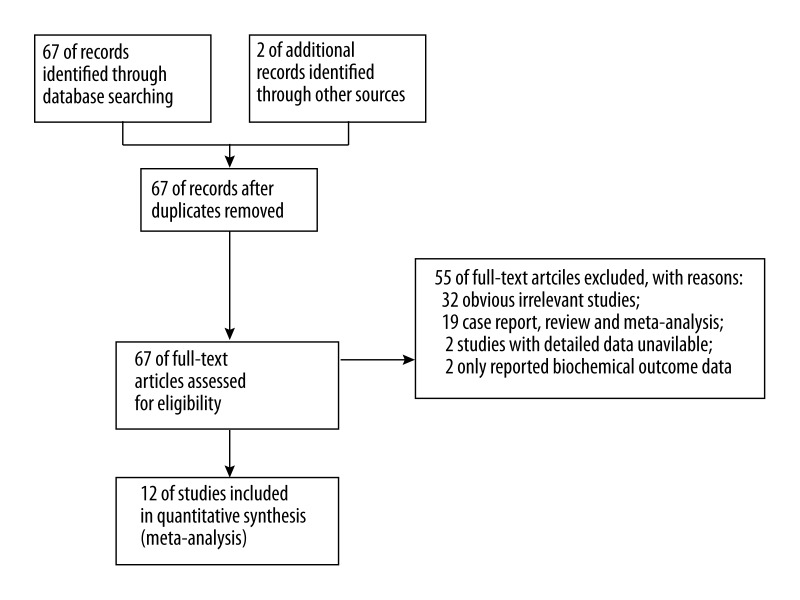
Material/methods: Relevant studies were searched for among 5 databases. The association between intervention and complications, including pancreatic infection, mortality, hyperglycemia, organ failure, and catheter-related septic complications, were assessed by using pooled risk ratio (RR) and the corresponding 95% confidential interval (CI).
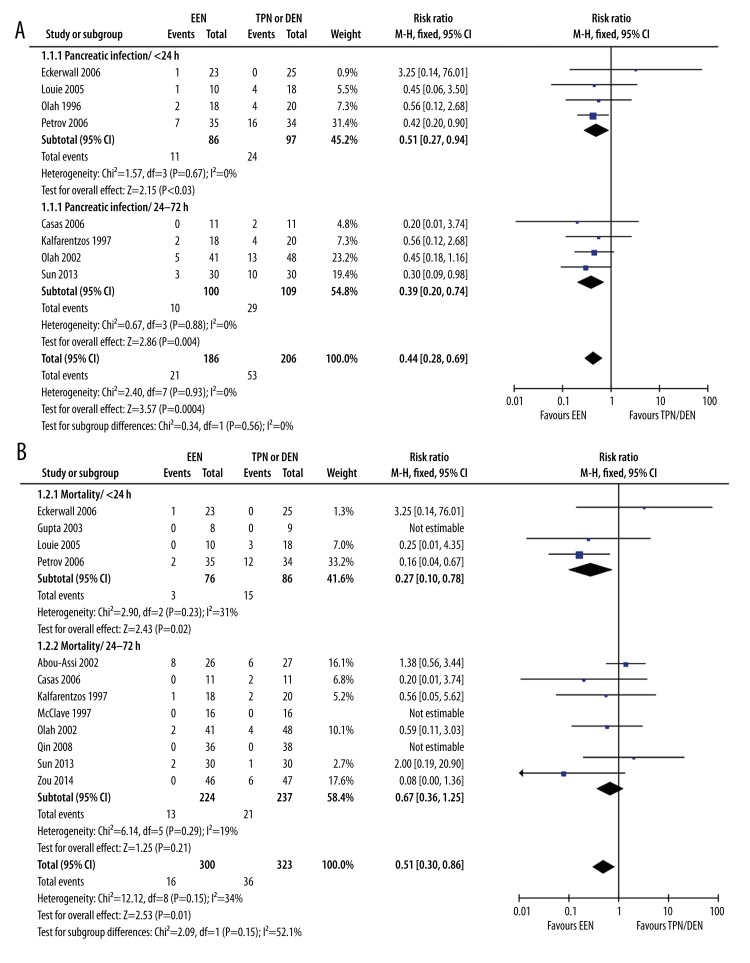
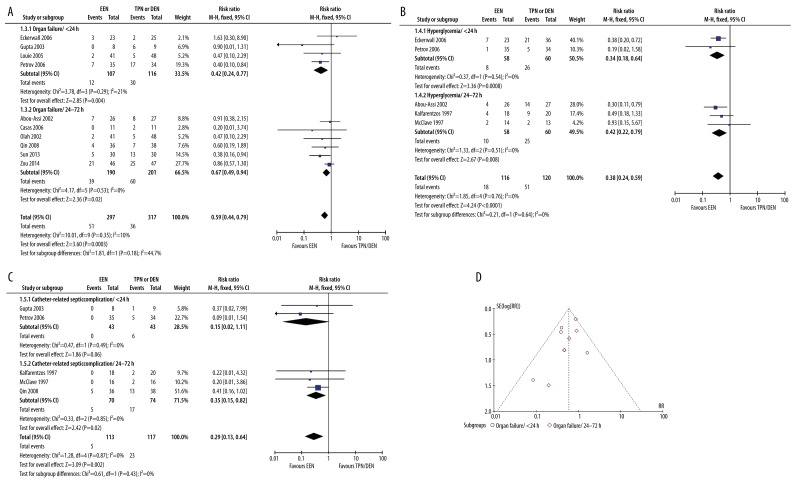
Results: Twelve RCTs were identified through our literature search. Pooled analysis showed that EEN, but not TPN or delayed enteral nutrition (DEN), is associated with reduced risk of pancreatic infection, mortality, organ failure, hyperglycemia, and catheter-related septic complications. EEN within 24 h of admission presented significantly better outcome in morality than EEN between 24 and 72 h. However, no significant heterogeneity was observed in the risk of pancreatic infection, organ failure, hyperglycemia, and catheter-related septic complications between the 2 subgroups.
Conclusions: If the patients are reasonably expected to have high compliance to EN therapy, it could be considered as early as possible.
Figures
References
-
- Lees C, Howie S, Sartor RB, Satsangi J. The hedgehog signalling pathway in the gastrointestinal tract: implications for development, homeostasis, and disease. Gastroenterology. 2005;129(5):1696–710. - PubMed
-
- Halonen KI, Pettila V, Leppaniemi AK, et al. Multiple organ dysfunction associated with severe acute pancreatitis. Crit Care Med. 2002;30(6):1274–79. - PubMed
-
- Jha RK, Ma Q, Sha H, Palikhe M. Acute pancreatitis: a literature review. Med Sci Monit. 2009;15(7):RA147–56. - PubMed
-
- Whitcomb DC. Clinical practice. Acute pancreatitis. N Engl J Med. 2006;354(20):2142–50. - PubMed
Publication types
MeSH terms
LinkOut - more resources
Full Text Sources
Other Literature Sources
Medical
Research Materials
Miscellaneous