


Effects of polypharmacy on adverse drug reactions among geriatric outpatients at a tertiary care hospital in Karachi: a prospective cohort study
- PMID: 25402452
- PMCID: PMC4234513
- DOI: 10.1371/journal.pone.0112133
Effects of polypharmacy on adverse drug reactions among geriatric outpatients at a tertiary care hospital in Karachi: a prospective cohort study
Abstract
Background: Adverse drug reactions (ADRs) present a challenging and expensive public health problem. Polypharmacy is defined according to the WHO criteria as the, "concurrent use of five or more different prescription medication". Elderly are more prone to adverse reactions due to comorbid conditions, longer lists of medications and sensitivity to drug effects. The aim of the study is to estimate the incidence and strength of association of ADRs due to polypharmacy among the geriatric cohort attending outpatient clinics at a tertiary care center.
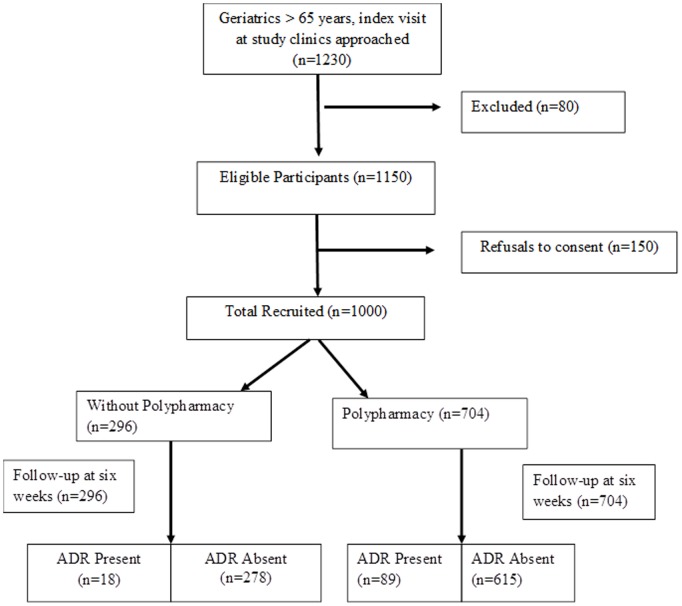
Methods: A hospital based prospective cohort study was conducted at ambulatory care clinics of Aga Khan University Hospital April 2012 to March 2013. One thousand geriatrics patients (age ≥ 65 years) visiting ambulatory clinics were identified. They were divided on the basis of exposure (polypharmacy vs. no polypharmacy). We followed them from the time of their enrollment (day zero) to six weeks, checking up on them once a week. Incidence was calculated and Cox Proportional Hazard Model estimates were used.
Results: The final analysis was performed on 1000 elderly patients. The occurrence of polypharmacy was 70% and the incidence of ADRs was 10.5% among the study cohort. The majority (30%) of patients were unable to read or write. The use of herbal medicine was reported by 3.2% of the patients and homeopathic by 3%. Our Cox adjusted model shows that polypharmacy was 2.3 times more associated with ADRs, con-current complementary and alternative medicine (CAM) was 7.4 times and those who cannot read and write were 1.5 times more associated with ADRs.
Conclusion: The incidence of ADRs due to poly pharmacy is alarmingly high. The factors associated with ADRs are modifiable. Policies are needed to design and strengthen the prescription pattern.
Conflict of interest statement
References
-
- Nobili A, Licata G, Salerno F, Pasina L, Tettamanti M, et al. (2011) Polypharmacy, length of hospital stay, and in-hospital mortality among elderly patients in internal medicine wards. The REPOSI study. European journal of clinical pharmacology 67: 507–519. - PubMed
-
- (2013) United Nations, Department of Economic and Social Affairs, Population Division (2013) World Population Ageing.
-
- Steinman MA, Seth Landefeld C, Rosenthal GE, Berthenthal D, Sen S, et al. (2006) Polypharmacy and prescribing quality in older people. Journal of the American Geriatrics Society 54: 1516–1523. - PubMed
-
- Hajjar ER, Hanlon JT, Artz MB, Lindblad CI, Pieper CF, et al. (2003) Adverse drug reaction risk factors in older outpatients. The American journal of geriatric pharmacotherapy 1: 82–89. - PubMed
Publication types
MeSH terms
LinkOut - more resources
Full Text Sources
Other Literature Sources
Medical
Miscellaneous
