. 2015 May;13(4):540-50.
doi: 10.1111/pbi.12278. Epub 2014 Nov 18.

Altered lipid composition and enhanced lipid production in green microalga by introduction of brassica diacylglycerol acyltransferase 2

Affiliations

Altered lipid composition and enhanced lipid production in green microalga by introduction of brassica diacylglycerol acyltransferase 2

Irshad Ahmad et al. Plant Biotechnol J. 2015 May.

Abstract

Higher lipid biosynthesis and accumulation are important to achieve economic viability of biofuel production via microalgae. To enhance lipid content, Chlamydomonas reinhardtii was genetically engineered with a key enzyme diacylglycerol acyltransferase (BnDGAT2) from Brassica napus, responsible for neutral lipid biosynthesis. The transformed colonies harbouring aph7 gene, screened on hygromycin-supplemented medium, achieved transformation frequency of ~120 ± 10 colonies/1 × 10(6) cells. Transgene integration and expression were confirmed by PCR, Southern blots, staining lipid droplets, proteins and spectro-fluorometric analysis of Nile red-stained cells. The neutral lipid is a major class (over 80% of total lipids) and most significant requirement for biodiesel production; this was remarkably higher in the transformed alga than the untransformed control. The levels of saturated fatty acids in the transformed alga decreased to about 7% while unsaturated fatty acids increased proportionately when compared to wild type cells. Polyunsaturated fatty acids, especially α-linolenic acid, an essential omega-3 fatty acid, were enhanced up to 12% in the transformed line. Nile red staining confirmed formation of a large number of lipid globules in the transformed alga. Evaluation of long-term stability and vitality of the transgenic alga revealed that cryopreservation produced significantly higher quantity of lipid than those maintained continuously over 128 generations on solid medium. The overexpression of BnDGAT2 significantly altered the fatty acids profile in the transformed alga. Results of this study offer a valuable strategy of genetic manipulation for enhancing polyunsaturated fatty acids and neutral lipids for biofuel production in algae.

Keywords: biodiesel; bioenergy; green algae; neutral lipids; polyunsaturated fatty acids; transgenic algae.


Figures

Figure 1
Figure 1
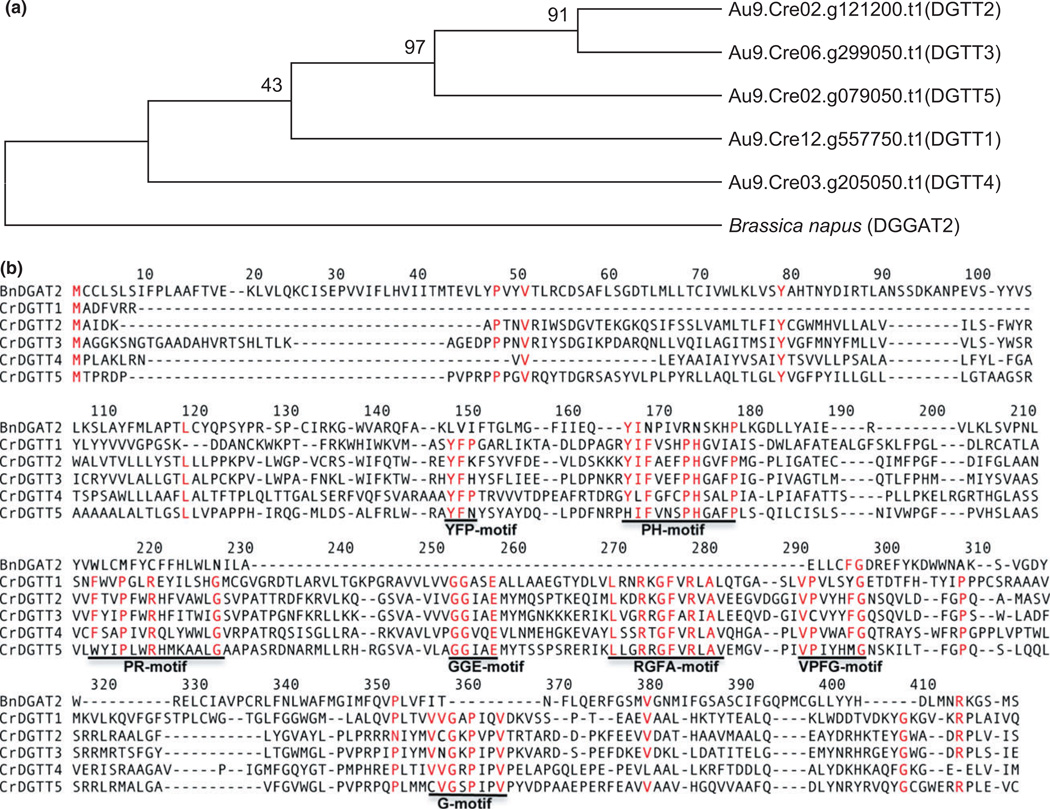
(a–b) Phylogenetic tree and alignment of diacylglycerol acyltransferase type 2 of Brassica napus DGAT2 amino acids with DGATs isoforms (1–5) of Chlamydomonas reinhardtii. (a) Phylogenetic tree showing relationship of C. reinhardtii DGTT 1–5 with DGAT2 of B. napus. The whole-DGAT amino acid sequences were used for calculating the per cent identity. Phylogenetic tree was generated using the MEGA5.0 software and statistical support for tree branches was evaluated by bootstrap analysis (1000 replicates) mentioned on the nodes. (b) Multiple alignment of BnDGAT2 amino acid sequence with CrDGTTs isoforms (1–5) using Tcoffee (http://tcoffee.crg.cat). The red fonts and underlined motifs indicate the seven conserved domains among diacylglycerol acyltransferase type 2 family. The per cent identity of C. reinhardtii DGTTs was observed to be 19–25% with BnDGAT2.
Figure 2
Figure 2
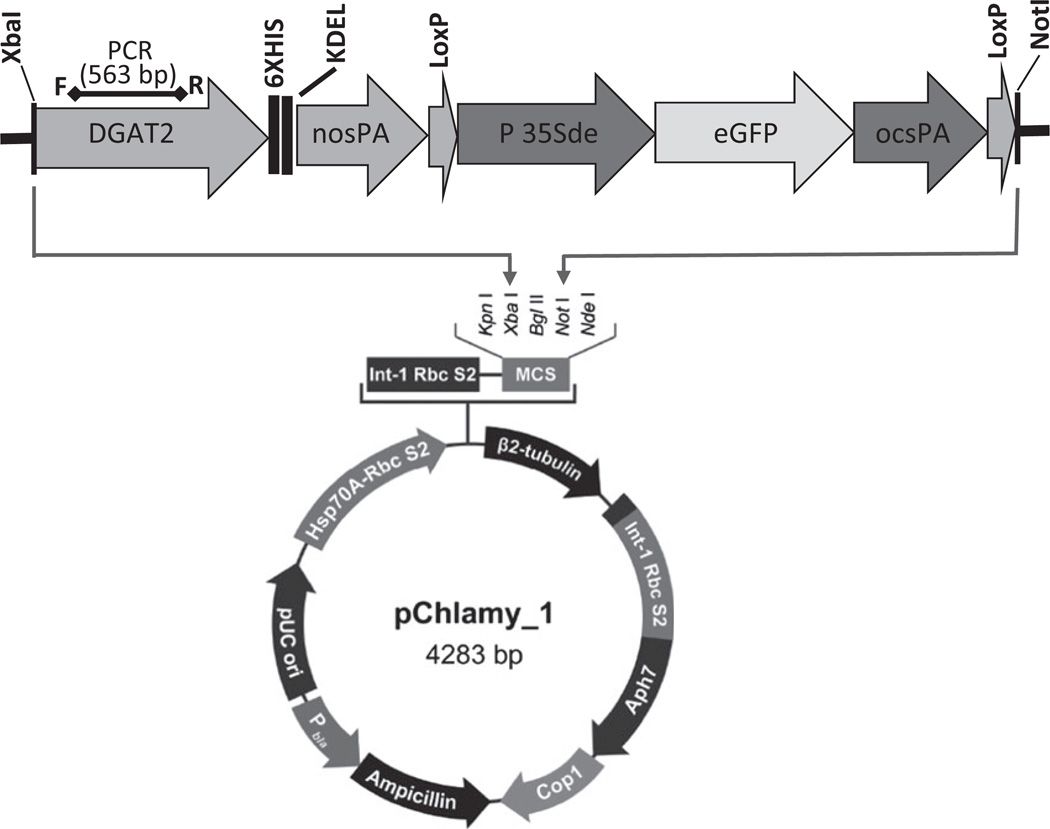
Construction of pAlgaeDGAT-eGFP vector to transform the Chlamydomonas reinhardtii cells. The synthetic cassette containing BnDGAT2-6XHIS-Tag-KDEL-NOS-PolyA-35Sde-eGFP was cloned in pChlamy_1 at restriction sites XbaI and NotI. BnDGAT2 (Accession No. AF155224) was expressed by Hsp70-RbcS2 promoter and was tagged with 6XHis and KDEL sequences at the C-terminal. Enhanced GFP (Accession No. JN596101) was expressed by a double enhancer 35Sde promoter (Accession No. V00140.1). The letters F and R above DGAT2 gene denote the forward and reverse PCR primers used in the preliminary assessment of transgene integration in algal cells.
Figure 3
Figure 3
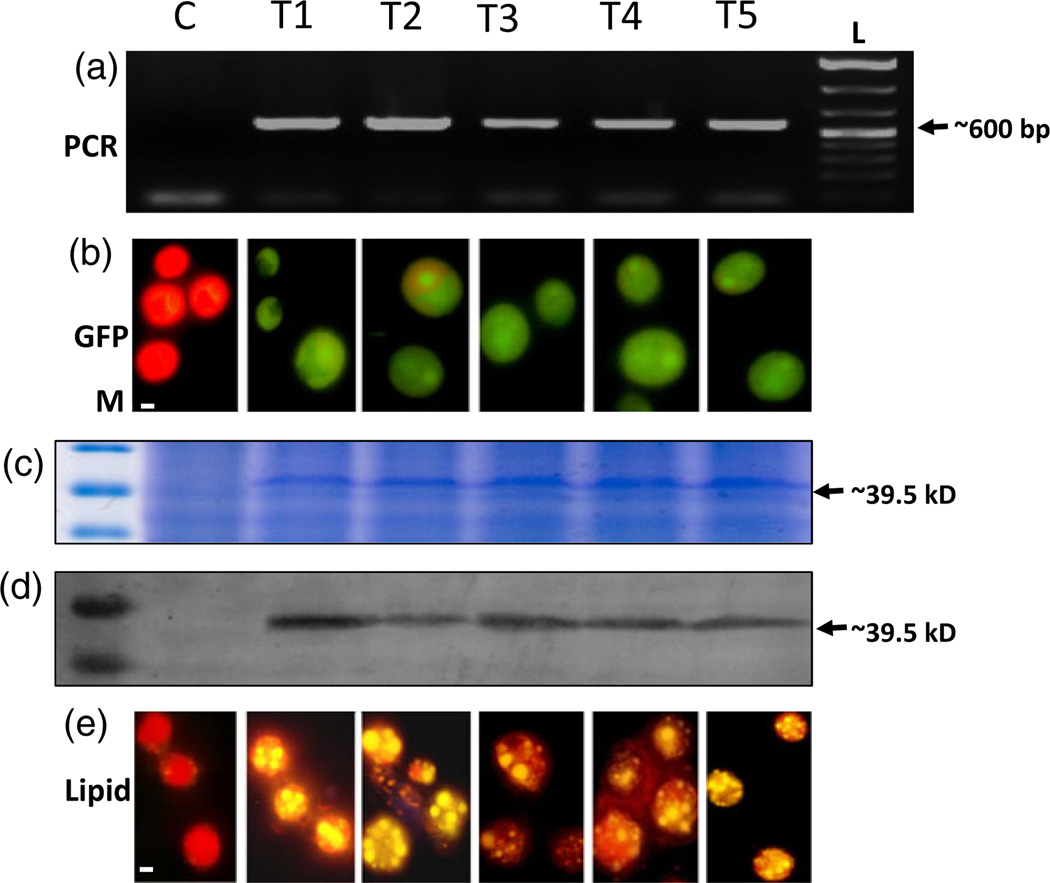
(a–e) Expression of BnDGAT2 of Brassica napus into C. reinhardtii cells. (a) Transformed lines (T1–T5) versus control nontransformed C. reinhardtii were amplified by PCR primers, which specifically bind to BnDGAT2 as shown in Figure 2 and produced amplicon of ~600bp in transformed cell lines. (b) Fluorescence micrograph of eGFP expression in transformed cell lines T1–T5. Control line appeared red due to autofluorescence of chlorophyll. (c) SDS-PAGE 12.5% gel showing ~39.5 kD protein in lines T1–T5, stained with Coomassie dye G-250. (d) Western blot analysis in lines T1–T5 developed by ECL. (e) Nile red staining of T1–T5 line. Lipid droplets visualized in golden colour. Control cells observed with the least number of lipid droplets. In c–d, no BnDGAT2 signal was detected in control cells. The bar size in b and e is 10 µm, denoted by a white line.
Figure 4
Figure 4
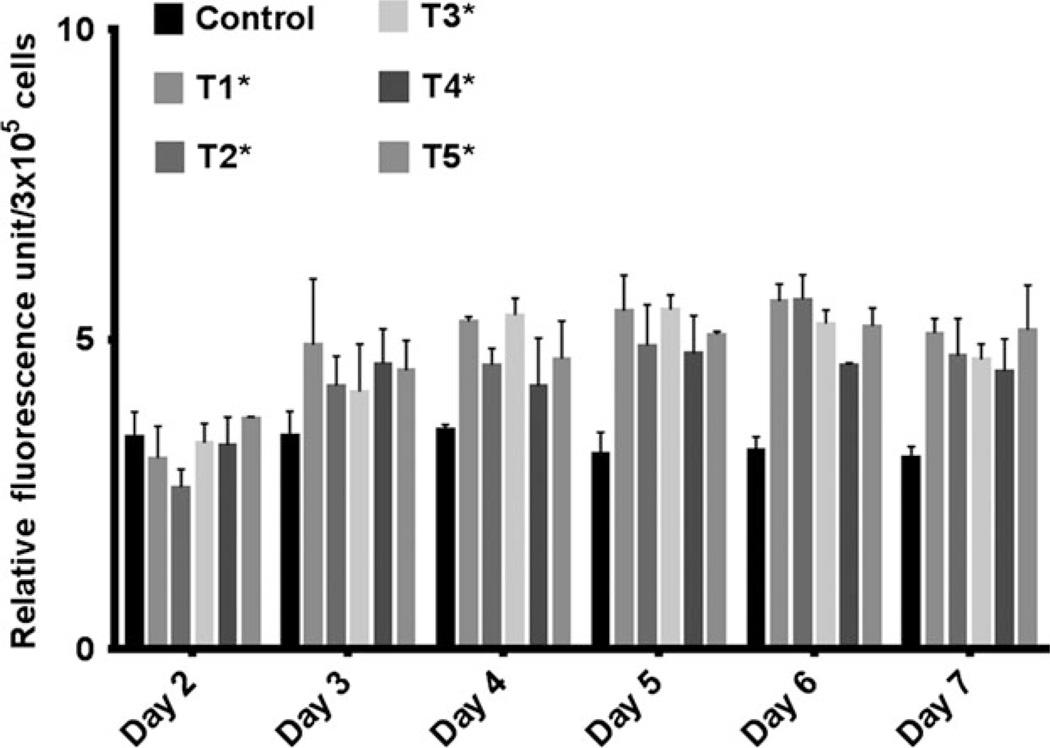
Relative fluorescence intensity of C. reinhardtii cell lines T1–T5 transformed with BnDGAT2 of B. napus. Triplicate samples of C. reinhardtii cells were stained with Nile Red from days 2–7. Maximum intensity was observed on the sixth day in T1–T5 lines. Transformed cell line T2 was selected for further analysis due to its capacity for accumulating highest amount lipid and maximum growth rate. Relative fluorescent intensity was found significant at *P < 0.05 when compared the mean of relative fluorescent intensity of all transgenics (T1–T5) with the mean of relative fluorescent intensity of wild type samples by one-way anova with Dunnett’s multiple comparisons test (n = 3; average ± SD).
Figure 5
Figure 5
The per cent Fatty Acid Methyl Esters (FAME) in transformed cell line (T2) and control untransformed cells (C) was analysed with the help of GC-MS. The composition of fatty acids in the predominant region of carbon chain length C16–C18 was altered in the transformed cells. Saturated fatty acids C16:0 and C18:0 were reduced while polyunsaturated acids C18:1 and C18:3 increased in transformed algal cells compared to control cells. SFA, MUFA and PUFA are Saturated, Monounsaturated and Polyunsaturated fatty acids. Significant at ****P < 0.0001 or **P < 0.001 compared with the wild type by two-way ANOVA with Sidaks’s multiple comparisons test (n = 3; average ± SD).
Figure 6
Figure 6
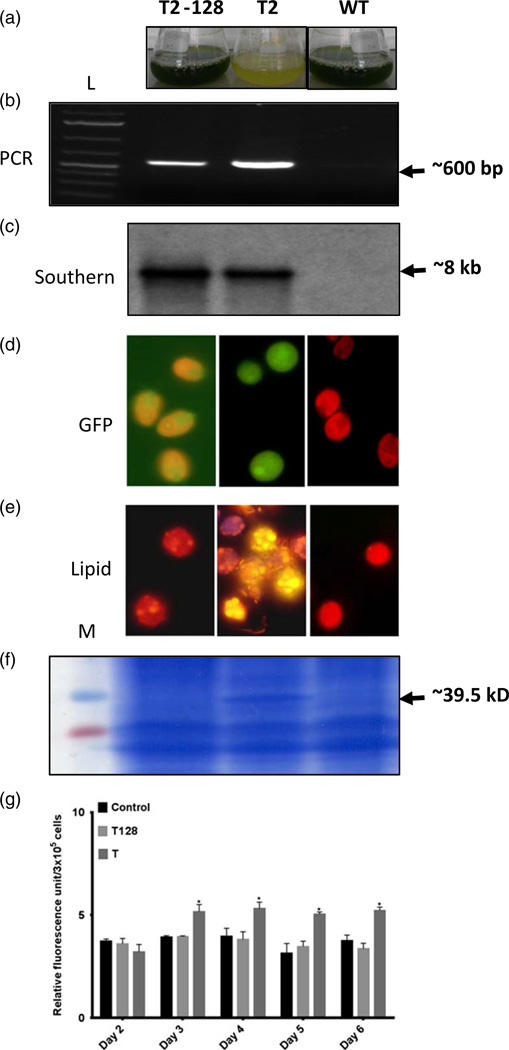
Comparison of T2 cryopreserved versus T2 derived cell line maintained up to 128 generation on solid medium. (a) Cultures of T2–128 after 128th generation, T2 cell line from cryopreservation and wild type cells (WT). (b) PCR analysis for confirming the transgene presence and (c) Southern Blot confirmation of the stability of integrated DGAT2 transgene in T2–128. (d) Fading GFP expression in T2–128 cultures compared to T2 cells. (e) T2–128 cells stained with Nile red with the least number of lipid droplets. Cells are mostly producing red autofluorescence due to chlorophyll presence as WT cells. (f) Absence of BnDGAT2 protein analysed by Coomassie blue gel. (g). Spectro-fluorometry analysis of Nile red stained T128 (T2–128) algal cells compared with T (T2) cryopreserved line and wild type cells. Significant at *P < 0.05 compared with the wild type by one-way ANOVA with Dunnett’s multiple comparison test (n = 3; average ± SD).

References

    1. Altschul SF, Madden TL, Schäffer AA, Zhang J, Zhang Z, Miller W, Lipman DJ. Gapped BLAST and PSI-BLAST: a new generation of protein database search programs. Nucleic Acids Res. 1997;25:3389–3402. - PMC - PubMed
    1. Bligh EG, Dyer WJ. A rapid method of total lipid extraction and purification. Can. J. Biochem. 1959;37:911–917. - PubMed
    1. Boyle NR, Page MD, Liu B, Blaby IK, Casero D, Kropat J, Cokus SJ, Hong-Hermesdorf A, Shaw J, Karpowicz SJ. Three acyltransferases and nitrogen-responsive regulator are implicated in nitrogen starvation-induced triacylglycerol accumulation in Chlamydomonas. J. Biol. Chem. 2012;287:15811–15825. - PMC - PubMed
    1. Cao H. Structure-function analysis of diacylglycerol acyltransferase sequences from 70 organisms. BMC Res. Notes. 2011;4:249. - PMC - PubMed
    1. Cases S, Smith SJ, Zheng Y-W, Myers HM, Lear SR, Sande E, Novak S, Collins C, Welch CB, Lusis AJ. Identification of a gene encoding an acyl CoA: diacylglycerol acyltransferase, a key enzyme in triacylglycerol synthesis. Proc. Natl Acad. Sci. 1998;95:13018–13023. - PMC - PubMed

Publication types

MeSH terms

LinkOut - more resources