Comparative Study
. 2014;43 Suppl 1(Suppl 1):113-25.
doi: 10.1007/s13280-014-0566-z.

Assessing and managing freshwater ecosystems vulnerable to environmental change

Affiliations
Comparative Study

Assessing and managing freshwater ecosystems vulnerable to environmental change

David G Angeler et al. Ambio. 2014.

Abstract

Freshwater ecosystems are important for global biodiversity and provide essential ecosystem services. There is consensus in the scientific literature that freshwater ecosystems are vulnerable to the impacts of environmental change, which may trigger irreversible regime shifts upon which biodiversity and ecosystem services may be lost. There are profound uncertainties regarding the management and assessment of the vulnerability of freshwater ecosystems to environmental change. Quantitative approaches are needed to reduce this uncertainty. We describe available statistical and modeling approaches along with case studies that demonstrate how resilience theory can be applied to aid decision-making in natural resources management. We highlight especially how long-term monitoring efforts combined with ecological theory can provide a novel nexus between ecological impact assessment and management, and the quantification of systemic vulnerability and thus the resilience of ecosystems to environmental change.


Figures
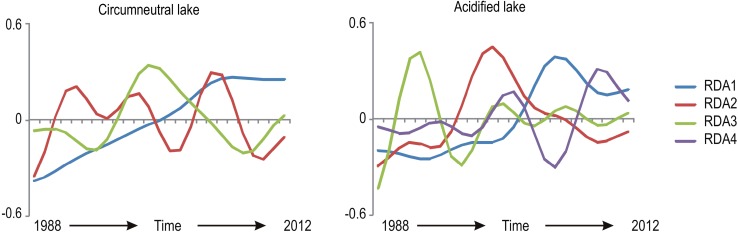
Fig. 1
Fig. 1
Example of time series modeling showing temporal patterns of species groups associated with canonical (RDA) axes in one circumneutral and one acidified lake. Shown are the temporal patterns with 3 and 4 significant canonical axes in the time series models, respectively, that capture the temporal scaling structure in the data
Fig. 2
Fig. 2
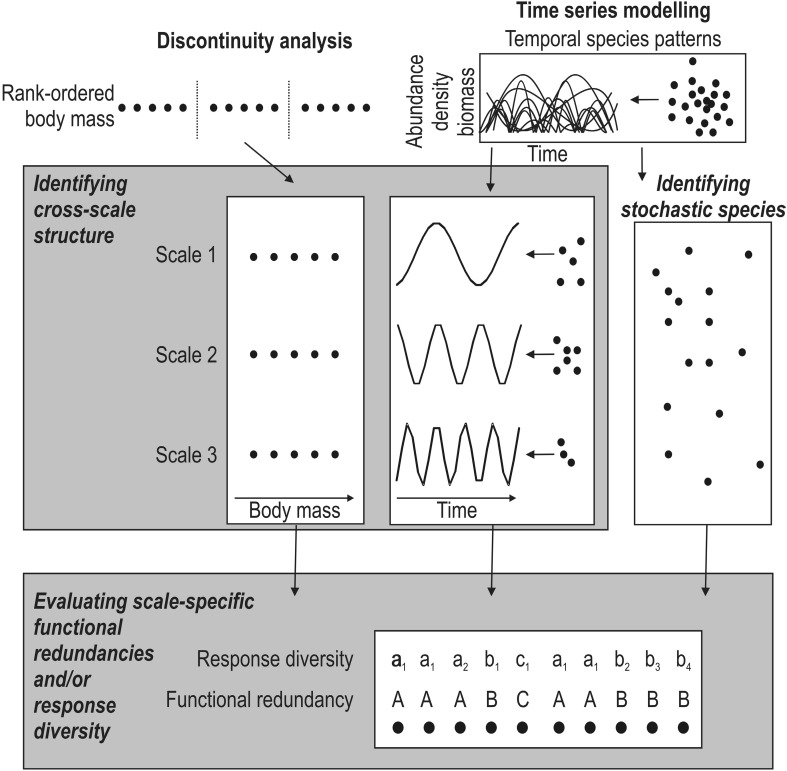
Conceptual model outlining approaches for identifying scale-specific structures necessary for understanding the systemic vulnerability of ecological systems to global change. In a first step, discontinuity analysis or time series analysis can be used to identify the cross-scale structure in data sets; time series analyses also allow the identification of species with stochastic patterns that are not contributing to cross-scale structure. After identifying cross-scale (and stochastic) patterns, functional redundancy, and response diversity can be assessed for species explaining scaling patterns and also stochastic species
Fig. 3
Fig. 3
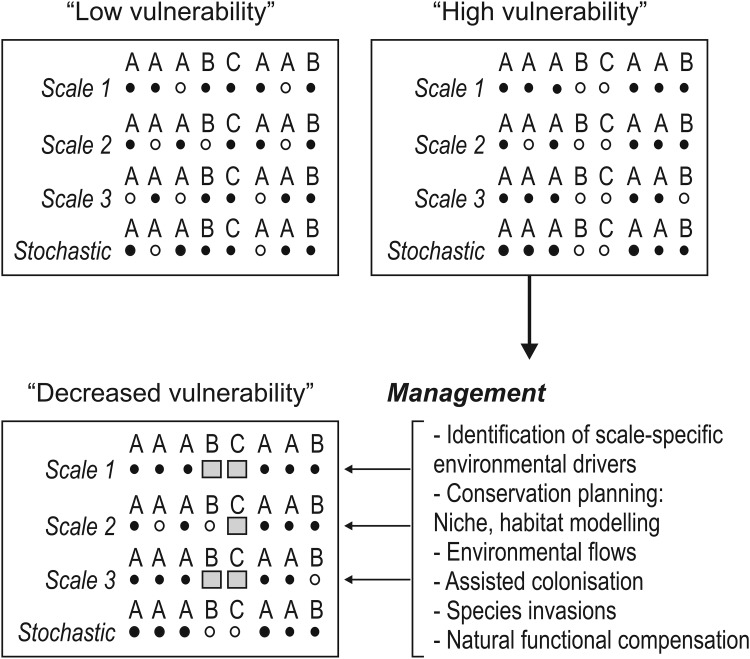
Scenarios contrasting high and low systemic vulnerabilities to environmental change of ecological systems, and how vulnerability can be decreased through management. The “low vulnerability” scenario shows that functions A, B, and C are carried out by “vulnerable” (white dots) and “tolerant” (black dots) species and all functions are redundant within and across scales. In the “high vulnerability” scenario within- and cross-scale redundancies of functions B are decreased, and function C has been lost. The model shows how management can be geared towards maintenance of these functions

References

    1. Allen CR, Holling CS. Discontinuities in ecosystems and other complex systems. New York: Columbia University Press; 2008.
    1. Allen CR, Gunderson L, Johnson AR. The use of discontinuities and functional groups to assess relative resilience in complex systems. Ecosystems. 2005;8:958–966. doi: 10.1007/s10021-005-0147-x. - DOI
    1. Allen CR, Angeler DG, Garmestani AS, Gunderson LH, Holling CS. Panarchy: Theory and application. Ecosystems. 2014;17:578–589. doi: 10.1007/s10021-013-9744-2. - DOI
    1. Angeler DG, Johnson RK. Temporal scales and patterns of invertebrate biodiversity dynamics in boreal lakes recovering from acidification. Ecological Applications. 2012;22:1172–1186. doi: 10.1890/11-1474.1. - DOI - PubMed
    1. Angeler, D.G., C.R. Allen, C. Rojo, M. Alvarez-Cobelas, M.A. Rodrigo, and S. Sánchez-Carrillo. 2013a. Inferring the relative resilience of alternative states. PLoS ONE 8(10): e77338. doi:10.1371/journal.pone.0077338. - PMC - PubMed

Publication types

LinkOut - more resources