Review
. 2015 Jan;12(1):81-93.
doi: 10.1007/s13311-014-0316-8.

The evolving biology of microglia in Alzheimer's disease

Affiliations
Review

The evolving biology of microglia in Alzheimer's disease

Tarja M Malm et al. Neurotherapeutics. 2015 Jan.

Abstract

Alzheimer's disease (AD) is typified by a robust microglial-mediated inflammatory response within the brain. Indeed, microglial accumulation around plaques in AD is one of the classical hallmarks of the disease pathology. Although microglia have the capacity to remove β-amyloid deposits and alleviate disease pathology, they fail to do so. Instead, they become chronically activated and promote inflammation-mediated impairment of cognition and cytotoxicity. However, if microglial function could be altered to engage their phagocytic response, promote their tissue maintenance functions, and prevent release of factors that promote tissue damage, this could provide therapeutic benefit. This review is focused on the current knowledge of microglial homeostatic mechanisms in AD, and mechanisms involved in the regulation of microglial phenotype in this context.


Figures
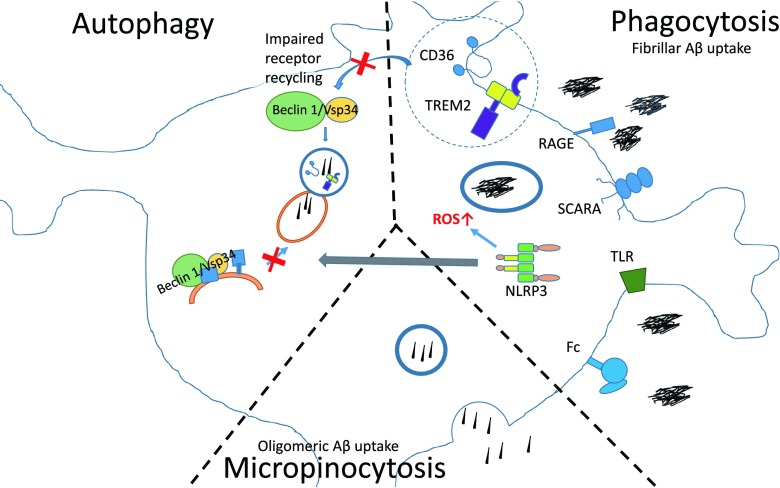
Fig. 1
Fig. 1
Multiple pathways for microglial uptake of β-amyloid (Aβ) are impaired in Alzheimer’s disease (AD). Microglia clear Aβ by phagocytosis, micropinocytosis, and autophagy. The figure indicates different receptors capable of recognizing Aβ. In AD the level of these receptors is downregulated, leading to reduced Aβ uptake. Reduced levels of beclin 1 lead to impairment in autophagic processes. As beclin 1 also regulates the receptor recycling of CD36 and Trem2, and may promote phagocytic clearance, reduced levels of beclin 1 may also cause defects in phagocytosis. However, inflammasome activation leads to increased formation of reactive oxygen species (ROS), and may also impair autophagy through interaction with beclin 1. NLRP3 = nucleotide-binding oligomerization domain-like receptor 3; SCARA = class A1 scavenger receptor, TLR = Toll-like receptor; RAGE = receptor for advanced glycation endproducts; Fc = Fc receptor

References

    1. Lawson LJ, Perry VH, Dri P, Gordon S. Heterogeneity in the distribution and morphology of microglia in the normal adult mouse brain. Neuroscience. 1990;39:151–170. doi: 10.1016/0306-4522(90)90229-W. - DOI - PubMed
    1. Alliot F, Godin I, Pessac B. Microglia derive from progenitors, originating from the yolk sac, and which proliferate in the brain. Brain Res Dev Brain Res. 1999;117:145–152. doi: 10.1016/S0165-3806(99)00113-3. - DOI - PubMed
    1. Ginhoux F, Greter M, Leboeuf M, et al. Fate mapping analysis reveals that adult microglia derive from primitive macrophages. Science. 2010;330:841–845. doi: 10.1126/science.1194637. - DOI - PMC - PubMed
    1. Nimmerjahn A, Kirchhoff F, Helmchen F. Resting microglial cells are highly dynamic surveillants of brain parenchyma in vivo. Science. 2005;308:1314–1318. doi: 10.1126/science.1110647. - DOI - PubMed
    1. Davalos D, Grutzendler J, Yang G, et al. ATP mediates rapid microglial response to local brain injury in vivo. Nat Neurosci. 2005;8:752–758. doi: 10.1038/nn1472. - DOI - PubMed
