


Targeted next generation sequencing for molecular diagnosis of Usher syndrome
- PMID: 25404053
- PMCID: PMC4245769
- DOI: 10.1186/s13023-014-0168-7
Targeted next generation sequencing for molecular diagnosis of Usher syndrome
Abstract
Background: Usher syndrome is an autosomal recessive disease that associates sensorineural hearing loss, retinitis pigmentosa and, in some cases, vestibular dysfunction. It is clinically and genetically heterogeneous. To date, 10 genes have been associated with the disease, making its molecular diagnosis based on Sanger sequencing, expensive and time-consuming. Consequently, the aim of the present study was to develop a molecular diagnostics method for Usher syndrome, based on targeted next generation sequencing.
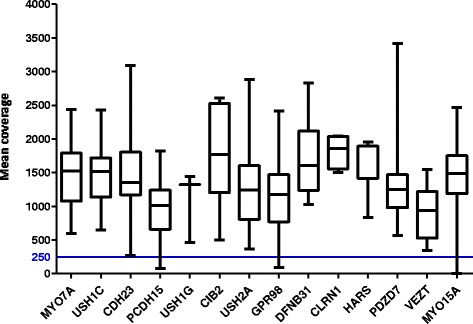
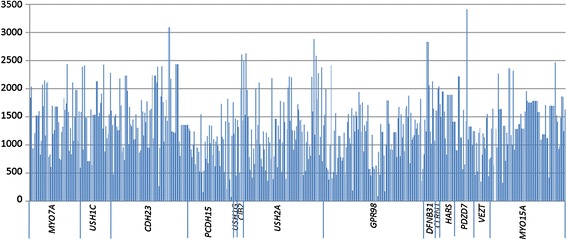
Methods: A custom HaloPlex panel for Illumina platforms was designed to capture all exons of the 10 known causative Usher syndrome genes (MYO7A, USH1C, CDH23, PCDH15, USH1G, CIB2, USH2A, GPR98, DFNB31 and CLRN1), the two Usher syndrome-related genes (HARS and PDZD7) and the two candidate genes VEZT and MYO15A. A cohort of 44 patients suffering from Usher syndrome was selected for this study. This cohort was divided into two groups: a test group of 11 patients with known mutations and another group of 33 patients with unknown mutations.
Results: Forty USH patients were successfully sequenced, 8 USH patients from the test group and 32 patients from the group composed of USH patients without genetic diagnosis. We were able to detect biallelic mutations in one USH gene in 22 out of 32 USH patients (68.75%) and to identify 79.7% of the expected mutated alleles. Fifty-three different mutations were detected. These mutations included 21 missense, 8 nonsense, 9 frameshifts, 9 intronic mutations and 6 large rearrangements.
Conclusions: Targeted next generation sequencing allowed us to detect both point mutations and large rearrangements in a single experiment, minimizing the economic cost of the study, increasing the detection ratio of the genetic cause of the disease and improving the genetic diagnosis of Usher syndrome patients.
Figures
References
Publication types
MeSH terms
LinkOut - more resources
Full Text Sources
Other Literature Sources
Medical
