. 2014 Dec 2;111(48):17278-83.
doi: 10.1073/pnas.1416625111. Epub 2014 Nov 17.

Densovirus associated with sea-star wasting disease and mass mortality

Affiliations

Densovirus associated with sea-star wasting disease and mass mortality

Ian Hewson et al. Proc Natl Acad Sci U S A. .

Abstract

Populations of at least 20 asteroid species on the Northeast Pacific Coast have recently experienced an extensive outbreak of sea-star (asteroid) wasting disease (SSWD). The disease leads to behavioral changes, lesions, loss of turgor, limb autotomy, and death characterized by rapid degradation ("melting"). Here, we present evidence from experimental challenge studies and field observations that link the mass mortalities to a densovirus (Parvoviridae). Virus-sized material (i.e., <0.2 μm) from symptomatic tissues that was inoculated into asymptomatic asteroids consistently resulted in SSWD signs whereas animals receiving heat-killed (i.e., control) virus-sized inoculum remained asymptomatic. Viral metagenomic investigations revealed the sea star-associated densovirus (SSaDV) as the most likely candidate virus associated with tissues from symptomatic asteroids. Quantification of SSaDV during transmission trials indicated that progression of SSWD paralleled increased SSaDV load. In field surveys, SSaDV loads were more abundant in symptomatic than in asymptomatic asteroids. SSaDV could be detected in plankton, sediments and in nonasteroid echinoderms, providing a possible mechanism for viral spread. SSaDV was detected in museum specimens of asteroids from 1942, suggesting that it has been present on the North American Pacific Coast for at least 72 y. SSaDV is therefore the most promising candidate disease agent responsible for asteroid mass mortality.

Keywords: Asteroidea; densovirus; disease; virus; wasting.


Conflict of interest statement

The authors declare no conflict of interest.

Figures
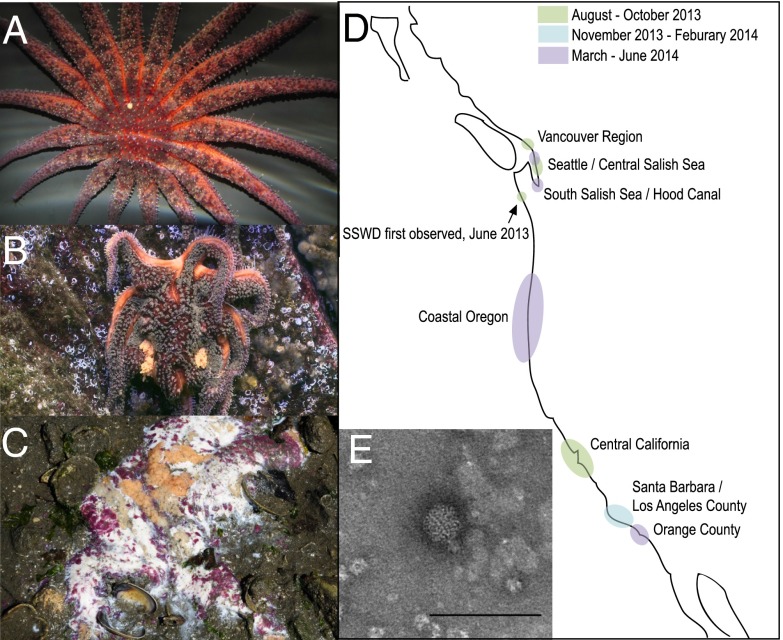
Fig. 1.
Fig. 1.
Photographs of SSWD-affected stars (A) asymptomatic P. helianthoides, (B) symptomatic P. helianthoides, and (C) symptomatic P. ochraceus. Disease symptoms are consistent with loss of turgor, loss of rays, formation of lesions, and animal decomposition. (D) Map showing occurrence of SSWD based on first reported observation. (E) Transmission electron micrograph of negatively stained (uranyl acetate) viruses extracted from an affected wild E. troschelii from Vancouver . The sample contained 20–25-nm diameter nonenveloped icosohedral viral particles on a background of cellular debris (primarily ribosomal subunits) and degraded viral particles of similar morphology. (Scale bar: 100 nm.)
Fig. 2.
Fig. 2.
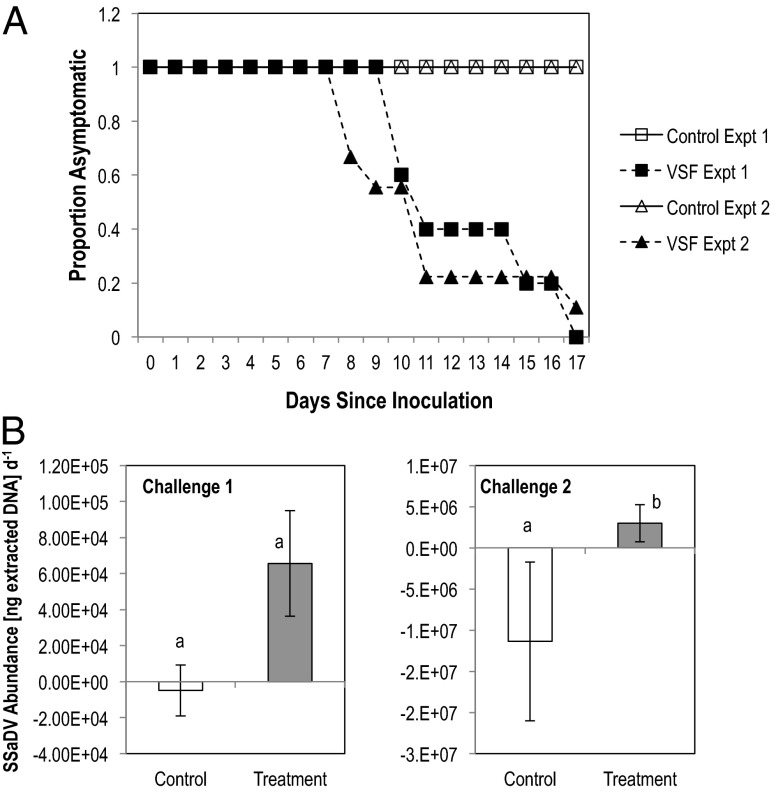
(A) Proportion of stars remaining asymptomatic after inoculation with control (heat-killed) or virus-sized fraction (VSF) of asteroid homogenates in first (Expt 1) and second (Expt 2) challenge. Survival analysis (20) indicates that the time to lesion development differs among treatment and control groups (log-rank test: χ2 = 18.6, df = 1, P = <0.0001), but there is no difference in time to development of lesions in the two experiments (log-rank test: χ2 = 0.2, df = 1, P = 0.698) (B) Change in SSaDV load between initiation of viral challenge and termination of experiment (i.e., animal expiry in live challenge or euthanasia of control animals). Note difference in scale. Viral load was determined by quantitative PCR (qPCR) targeting the NS1 gene of the SSaDV genome. Different letters above bars indicate that the mean viral abundance change is significantly different (P < 0.05, two-tailed Wilcoxon signed-rank test to account for heteroskedasticity; Fisher’s F-test P > 0.05). Error bars = SE.
Fig. 3.
Fig. 3.
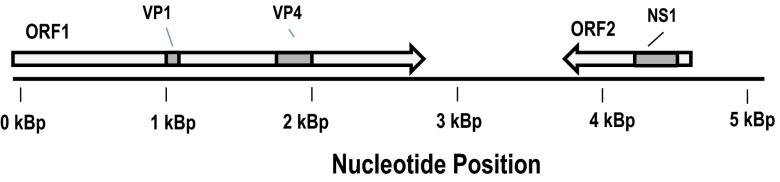
Genome architecture of the sea star-associated densovirus (SSaDV).
Fig. 4.
Fig. 4.
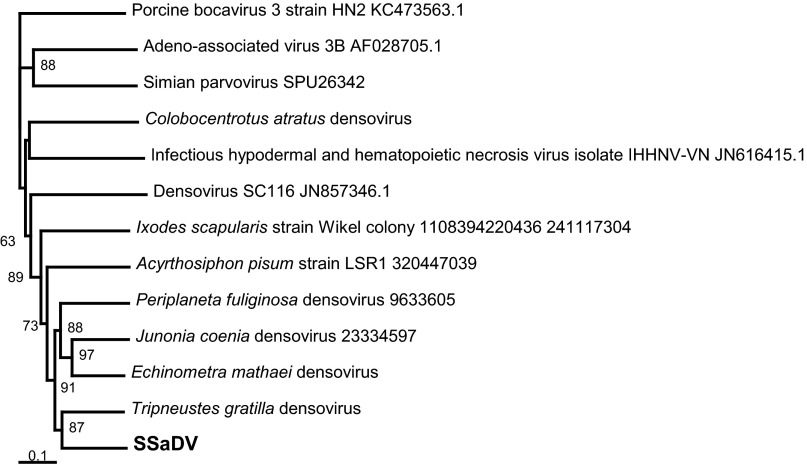
Phylogenetic representation of the sea star-associated densovirus (SSaDV) NS1 capsid protein. The phylogenetic tree is based on an amino acid alignment performed by MUSCLE. The tree was constructed based on maximum-likelihood distance.
Fig. 5.
Fig. 5.
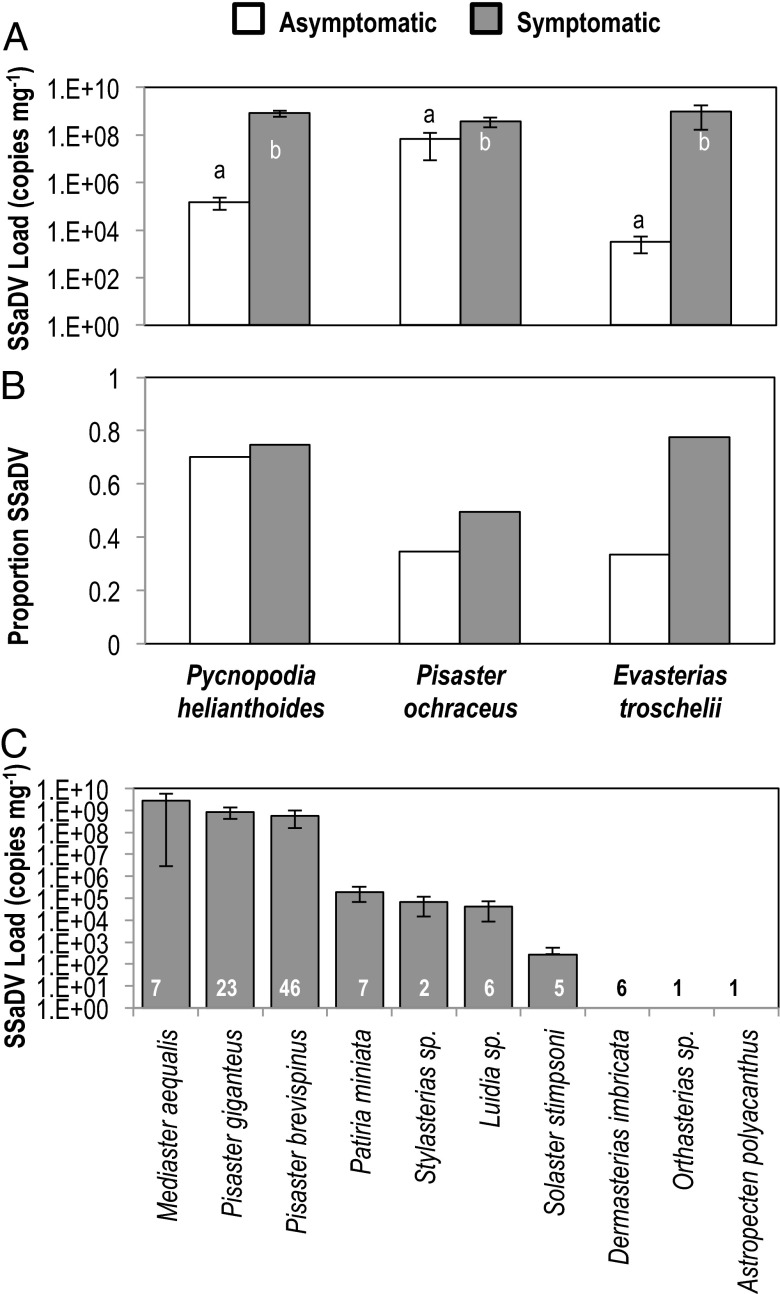
(A) Mean viral load and (B) prevalence (i.e., proportion of SSaDV-positive individuals) (B) as determined by qPCR targeting the VP4 gene of the SSaDV genome. qPCR was applied to P. helianthoides (n = 10 asymptomatic and 79 symptomatic), P. ochraceus (n = 26 asymptomatic and 72 symptomatic), and E. troschelii (n = 6 asymptomatic and 31 symptomatic) whole-tissue DNA extracts. (C) SSaDV load in sympatric asteroid species. All stars except Dermasterias imbricata, Orthasterias sp., and Astropecten polyacanthus were symptomatic. The number of individuals tested is indicated for each species. Different letters within bars represent significant difference in the percentage of viral reads between asymptomatic and symptomatic asteroids (P < 0.001; df = 113 for P. helianthoides, df = 42 for E. troschelii, and df = 117 for P. ochraceus; data log-transformed and corrected for heteroskedasticity by x/√x; t test). The probability of being infected with the virus was higher in symptomatic asteroids. Logistic regression (generalized linear model with binomial distribution and logit link) comparing models with species and disease status and their interaction indicated that a model including species (likelihood ratio test: χ = 19.7, df = 2; P < 0.0001) and disease status (likelihood ratio test: χ =7.4, df = 1; P = 0.0065) additively had the greatest support. This result indicates that viral prevalence differs among species and disease status, but the difference among disease status does not differ significantly among species (likelihood ratio test: χ = 2.50, df = 1; P = 0.29). The odds ratios suggest that symptomatic stars are 3.2 times more likely to be virus-positive than asymptomatic stars. Error bars = SE.
Fig. 6.
Fig. 6.
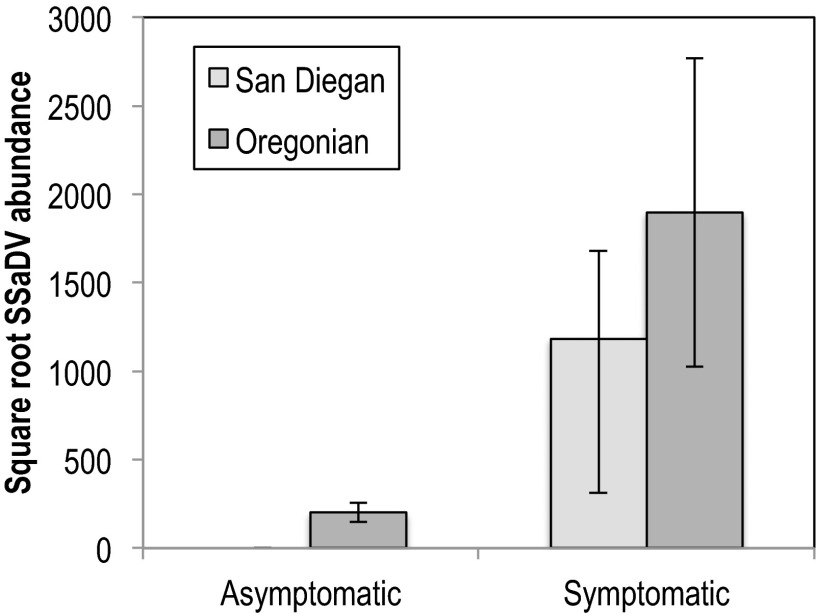
Square root-transformed viral load in asymptomatic and symptomatic asteroids in San Diegan (i.e., south of Point Conception) and Oregonian (i.e., north of Point Conception) biogeographical provinces. For the relationship between SSaDV abundance and disease, we used a logistic model of symptomatic vs. asymptomatic to evaluate the potential independent effects of SSaDV abundance, sea star species, geography (San Diegan vs. Oregonian province), and sea-star size (measured as arm circumference) in the 107 P. ochraceus, P. helianthoides, and E. troschelii for which we had both size measurements and a mix of asymptomatic and symptomatic stars. The main significant predictive variable for being symptomatic was the abundance of SSaDV [logistic regression, square root-transformed count of SSaDV, estimate = 0.0013 (0.0008 SE) chance of being symptomatic increasing with viral count, P = 0.006]. Error bars = SE.
Fig. 7.
Fig. 7.
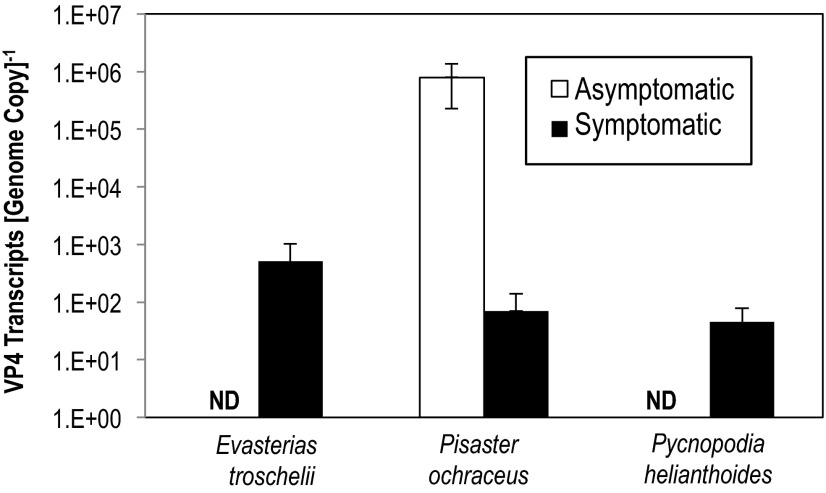
Transcription of the SSaDV VP4 as assessed by qRT-PCR comparing asymptomatic and symptomatic tissues. qRT-PCR was performed on whole-tissue RNA extracts from E. troschelii (n = 5 asymptomatic and 5 symptomatic), P. ochraceus (n = 5 asymptomatic and 6 symptomatic), and P. helianthoides (n = 10 asymptomatic and 10 symptomatic), and normalized to quantities of SSaDV assessed by qPCR in cDNA extracts. Transcript levels were significantly higher in asymptomatic P. ochraceus than symptomatic individuals (Mann–Whitney U test; P = 0.039, df = 11). Error bars = SE.
Fig. 8.
Fig. 8.
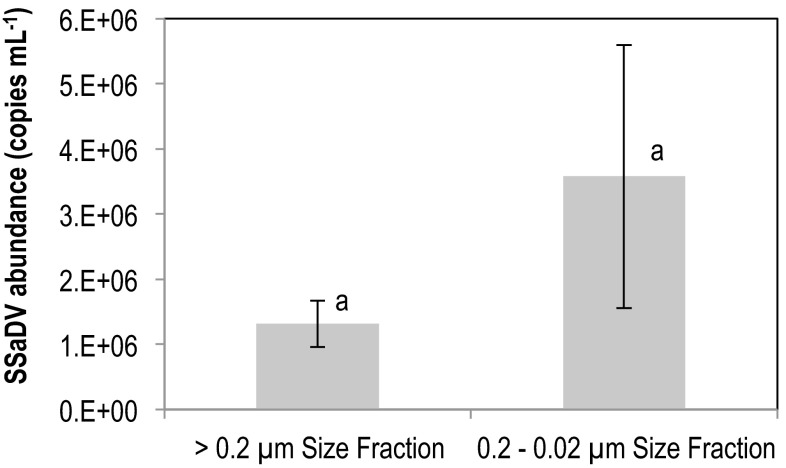
Viral abundance in particle (i.e., >0.2 µm) and virioplankton (0.2–0.02 µm) size fractions of water collected at field sites, experimental incubations, and public aquaria. Viral abundance was determined by qPCR targeting the VP4 gene of the SSWDAV genome. Means were not significantly different.
Fig. 9.
Fig. 9.
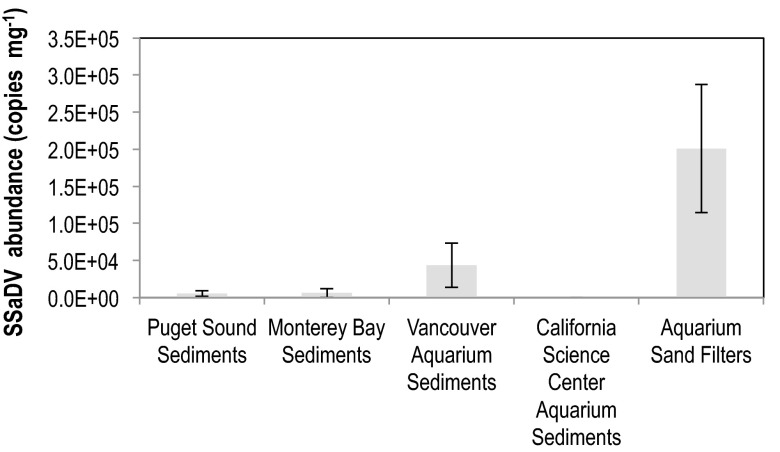
Viral abundance in sediments from aquaria and field sites and in aquarium sand filters, as determined by qPCR targeting the VP4 gene of the SSaDV genome.
Fig. 10.
Fig. 10.
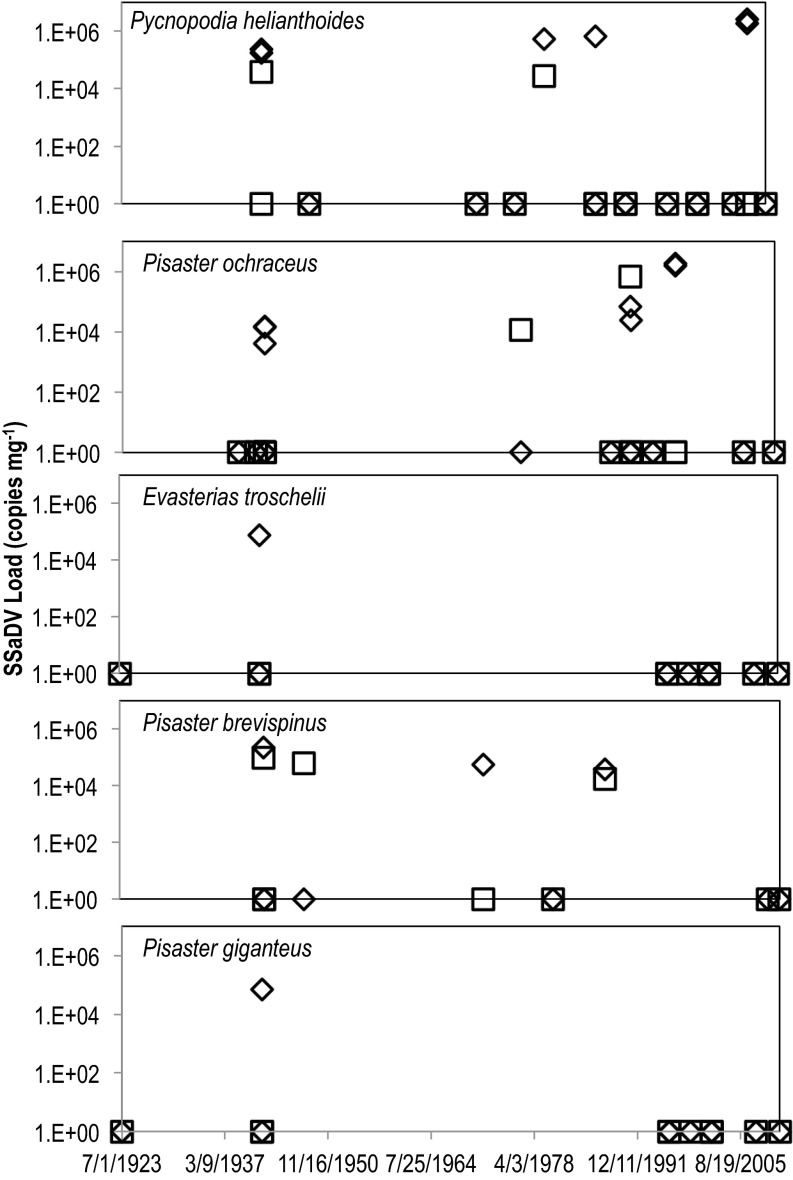
Detection and load of SSaDV in ethanol-preserved museum specimens from 1923 to the present. SSaDV load was assessed by qPCR targeting the VP4 gene on the SSaDV genome and normalized to extracted tissue weight. We targeted both NS1 (□) and VP4 (◇) for this analysis because homologous viruses and recombination may have led to spurious results in old asteroids. Both NS1 and VP4 were found in 6 (of 67 tested) specimens from 1942, 1980, 1987, and 1991. We also detected large loads of either NS1 or VP4 in 16 asteroids. These results suggest that SSaDV or perhaps related densoviruses have been present in populations of several Northeastern Pacific Coast asteroid species, at least since 1942.

References

    1. Dungan ML, Miller TE, Thomson DA. Catastrophic decline of a top carnivore in the Gulf of California rocky intertidal zone. Science. 1982;216(4549):989–991. - PubMed
    1. Eckert G, Engle JM, Kushner D. 1999. Sea star disease and population declines at the Channel Islands. Proceedings of the Fifth California Islands Symposium (Minerals Management Service, Washington, DC), pp 390–393.
    1. Bates AE, Hilton BJ, Harley CDG. Effects of temperature, season and locality on wasting disease in the keystone predatory sea star Pisaster ochraceus. Dis Aquat Organ. 2009;86(3):245–251. - PubMed
    1. Zann L, Brodie J, Vuki V. History and dynamics of the crown-of-thorns starfish Acanthaster planci (L) in the Suva Area, Fiji. Coral Reefs. 1990;9:135–144.
    1. Pratchett MS. An infectious disease in crown-of-thorns starfish on the Great Barrier Reef. Coral Reefs. 1999;18:272.

Publication types

MeSH terms

Associated data