Comparative Study
. 2014 Nov 18:14:243.
doi: 10.1186/s12909-014-0243-8.

Productivity in medical education research: an examination of countries of origin

Comparative Study

Productivity in medical education research: an examination of countries of origin

Asif Doja et al. BMC Med Educ. .

Abstract

Background: Productivity and countries of origin of publications within the field of medical education research have not been explored. Using bibliometric techniques we conducted an analysis of studies evaluating medical education interventions, examining the country where research originated as well as networks of authors within countries identified as 'most productive'.

Methods: PubMed was used to search for evaluative studies of medical education. We then examined relative productivity of countries with >100 publications in our sample (number of publications/number of medical schools in country). Author networks from the top 2 countries with the highest relative productivity were constructed.

Results: 6874 publications from 18,883 different authors were included. The countries with the highest relative publication productivity were Canada (37.1), Netherlands (28.3), New Zealand (27), the UK (23), and the U.S.A (17.1). Author collaboration networks differed in both numbers of authors and intensity of collaborations in the countries with highest relative productivity.

Conclusions: In terms of the number of publications of evaluative studies in medical education, Canada.


Figures
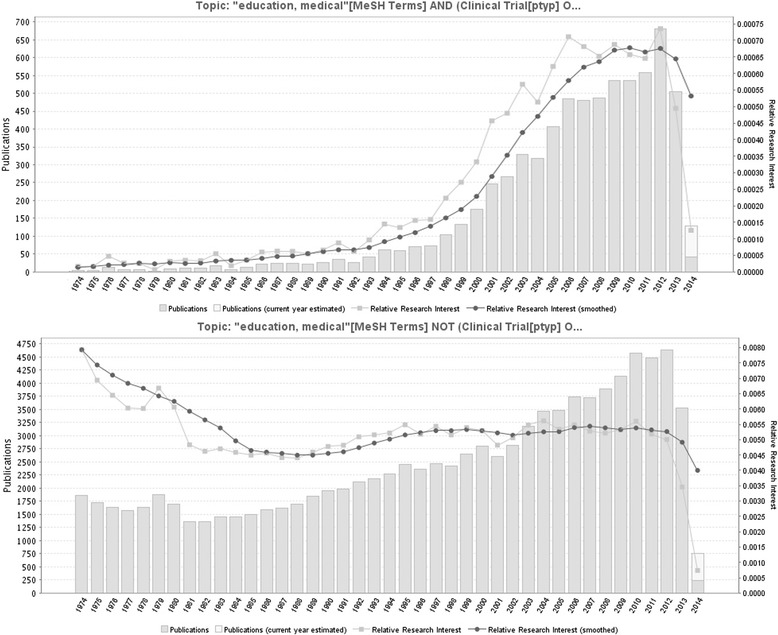
Figure 1
Figure 1
Publications by year for evaluative and non-evaluative studies. Data based on the first 100,000 record obtained in GoPubMed from 1974–2014. Data obtained on April 14, 2014.
Figure 2
Figure 2
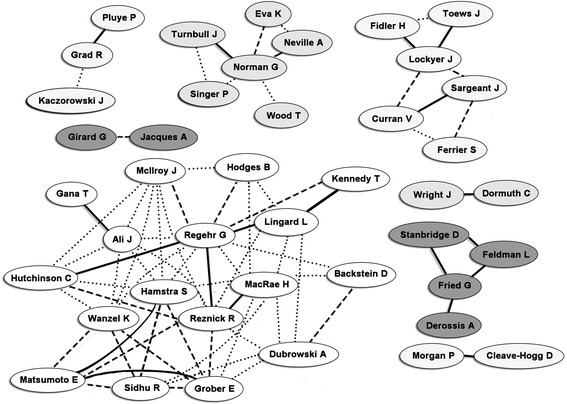
Authorship collaborations for eligible papers from first authors from Canada. Solid lines denote three or more co-publications, dashed lines denote two co-publications and dotted lined denote a single co-publication. Differential shading is used to more clearly distinguish between networks. Network representation is based on data from Feb 29, 2012.
Figure 3
Figure 3
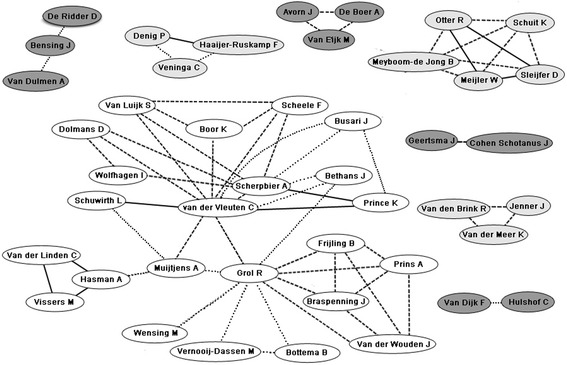
Authorship collaborations for eligible papers from first authors from the Netherlands. Solid lines denote three or more co-publications, dashed lines denote two co-publications and dotted lined denote a single co-publication. Differential shading is used to more clearly distinguish between networks. Network representation is based on data from Feb 29, 2012.

References

    1. Tutarel O. Geographical distribution of publications in the field of medical education. BMC Med Educ. 2002;2:3. doi: 10.1186/1472-6920-2-3. - DOI - PMC - PubMed
    1. Tutarel O. Composition of the editorial boards of leading medical education journals. BMC Med Res Methodol. 2004;4:3. doi: 10.1186/1471-2288-4-3. - DOI - PMC - PubMed
    1. Rotgans J. The themes, institutions, and people of medical education research 1988–2010: content analysis of abstracts from six journals. Adv Health Sci Educ Theory Prac. 2012;17(4):515–527. doi: 10.1007/s10459-011-9328-x. - DOI - PubMed
    1. Sampson MJ, Horsely T, Doja A. A Bibliometric Analysis of Evaluative Medical Education Studies: Characteristics and Indexing Accuracy. Acad Med. 2013;88(3):421–427. doi: 10.1097/ACM.0b013e3182820b5c. - DOI - PubMed
    1. National Library of Medicine: Clinical queries filter table. [http://www.ncbi.nlm.nih.gov/entrez/query/static/clinicaltable.html]

Publication types

LinkOut - more resources