. 2014 Nov 5;9(1):602.
doi: 10.1186/1556-276X-9-602. eCollection 2014.

Structural properties of magnetic nanoparticles determine their heating behavior - an estimation of the in vivo heating potential

Affiliations

Structural properties of magnetic nanoparticles determine their heating behavior - an estimation of the in vivo heating potential

Robert Ludwig et al. Nanoscale Res Lett. .

Abstract

Magnetically induced heating of magnetic nanoparticles (MNP) in an alternating magnetic field (AMF) is a promising minimally invasive tool for localized tumor treatment by sensitizing or killing tumor cells with the help of thermal stress. Therefore, the selection of MNP exhibiting a sufficient heating capacity (specific absorption rate, SAR) to achieve satisfactory temperatures in vivo is necessary. Up to now, the SAR of MNP is mainly determined using ferrofluidic suspensions and may distinctly differ from the SAR in vivo due to immobilization of MNP in tissues and cells. The aim of our investigations was to study the correlation between the SAR and the degree of MNP immobilization in dependence of their physicochemical features. In this study, the included MNP exhibited varying physicochemical properties and were either made up of single cores or multicores. Whereas the single core MNP exhibited a core size of approximately 15 nm, the multicore MNP consisted of multiple smaller single cores (5 to 15 nm) with 65 to 175 nm diameter in total. Furthermore, different MNP coatings, including dimercaptosuccinic acid (DMSA), polyacrylic acid (PAA), polyethylenglycol (PEG), and starch, wereinvestigated. SAR values were determined after the suspension of MNP in water. MNP immobilization in tissues was simulated with 1% agarose gels and 10% polyvinyl alcohol (PVA) hydrogels. The highest SAR values were observed in ferrofluidic suspensions, whereas a strong reduction of the SAR after the immobilization of MNP with PVA was found. Generally, PVA embedment led to a higher immobilization of MNP compared to immobilization in agarose gels. The investigated single core MNP exhibited higher SAR values than the multicore MNP of the same core size within the used magnetic field parameters. Multicore MNP manufactured via different synthesis routes (fluidMAG-D, fluidMAG/12-D) showed different SAR although they exhibited comparable core and hydrodynamic sizes. Additionally, no correlation between ζ-potential and SAR values after immobilization was observed. Our data show that immobilization of MNP, independent of their physicochemical properties, can distinctly affect their SAR. Similar processes are supposed to take place in vivo, particularly when MNP are immobilized in cells and tissues. This aspect should be adequately considered when determining the SAR of MNP for magnetic hyperthermia.

Keywords: Immobilization; Intrinsic loss power (ILP); Magnetic hyperthermia; Magnetic nanoparticles (MNP); Specific absorption rate (SAR).


Figures
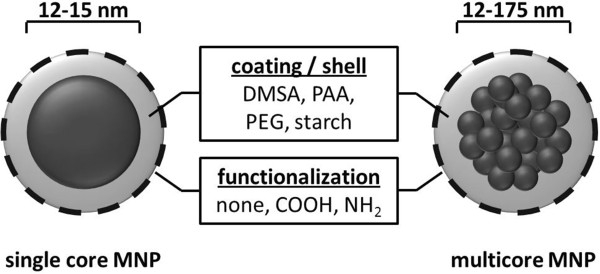
Figure 1
Figure 1
Scheme of idealistic single core and multicore MNP with different core sizes, coatings, and functionalizations.
Figure 2
Figure 2
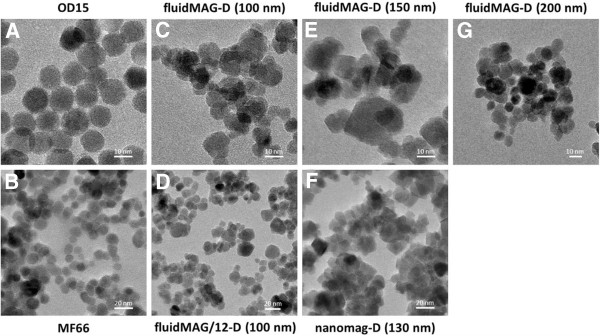
TEM micrographs revealing different core characteristics of investigated magnetite MNP. TEM micrographs of OD15 (A), MF66 (B), fluidMAG-D (100 nm) (C), fluidMAG/12-D (100 nm) (D), fluidMAG-D (150 nm) (E), nanomag-D (130 nm) (F), and fluidMAG-D (200 nm) (G) MNP. Magnification = ×75000 (B, D, F). Magnification = ×160000 (A, C, E, G).
Figure 3
Figure 3
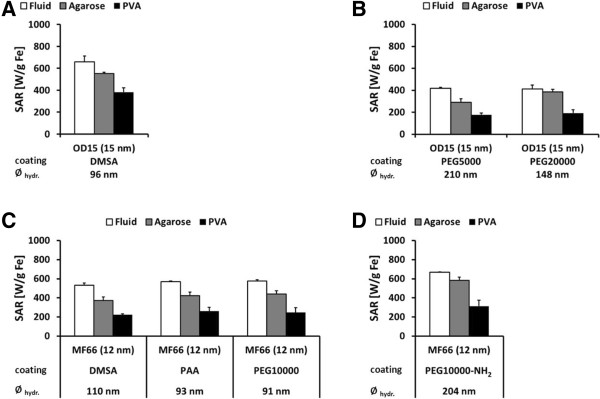
Immobilization in PVA decreases the SAR of singlecore MNP OD15 and MF66. Immobilization in PVA decreases the SAR of single-core MNP OD15 and MF66 by a factor of two compared to the respective water suspensions. SAR values of single core MNP in water suspension and immobilized in 1% agarose and 10% PVA. Additionally, hydrodynamic diameters (Øhydr.) for each MNP type are shown. Values in brackets indicate core size determined by TEM micrographs. Error bars indicate standard deviation of three independent measurements. OD15 coated with dimercaptosuccinic acid (DMSA) (A); OD15 coated with polyethylenglycol (PEG) exhibiting different molecular weights (B); MF66 coated with DMSA, polyacrylic acid (PAA), and PEG10000 (C); and MF66 coated with PEG10000-NH2(D).
Figure 4
Figure 4
Immobilization in polyvinyl alcohol decreases specific absorption rate (SAR) of multicore MNP fluidMAG-D by a factor of two. SAR values of multicore MNP in water suspension and immobilized in 1% agar and 10% PVA. Additionally, hydrodynamic diameters (Øhydr.) for each MNP type are shown. Values in brackets indicate core size determined by TEM micrographs. Error bars indicate standard deviation of three independent measurements. fluidMAG-D coated with starch (A) and starch-coated 100-nm fluidMAG-D MNP with differently clustered cores (B).
Figure 5
Figure 5
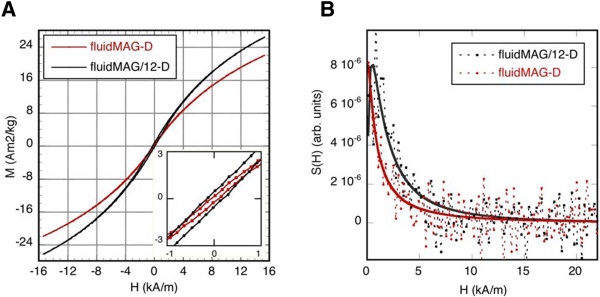
Quasistatic magnetic measurements of immobilized MNP reveal differences in the magnetic behavior. Minor magnetization loops of fluidMAG-D and fluidMAG/12-D MNP (A). Insert: Magnification of the origin of ordinates reveals differences in hysteresis. Switching field distribution S(H) of fluidMAG-D and fluidMAG/12-D MNP (B). Measurement points were fitted using log-normal-fit function.
Figure 6
Figure 6
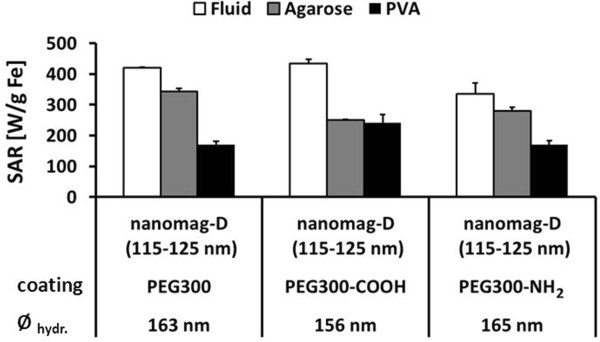
Immobilization in polyvinyl alcohol decreases SAR of multicore nanomag-D MNP by a factor of two. SAR values of multicore nanomag-D MNP with differently functionalized PEG300 in water suspension and immobilized in 1% agar and 10% PVA. Additionally, hydrodynamic diameters (Øhydr.) for each MNP type are shown. Values in brackets indicate core size determined by TEM micrographs. Error bars indicate standard deviation of three independent measurements.

References

    1. Dutz S, Hergt R. Magnetic nanoparticle heating and heat transfer on a microscale: basic principles, realities and physical limitations of hyperthermia for tumour therapy. Int J Hyperthermia. 2013;29:790–800. doi: 10.3109/02656736.2013.822993. - DOI - PubMed
    1. Kossatz S, Ludwig R, Dähring H, Ettelt V, Rimkus G, Marciello M, Salas G, Patel V, Teran FJ, Hilger I. High therapeutic efficiency of magnetic hyperthermia in xenograft models achieved with moderate temperature dosages in the tumor area. Pharm Res. 2014. - PMC - PubMed
    1. Dewey WC. Arrhenius relationships from the molecule and cell to the clinic. Int J Hyperthermia. 2009;25:3–20. doi: 10.1080/02656730902747919. - DOI - PubMed
    1. Hildebrandt B, Wust P, Ahlers O, Dieing A, Sreenivasa G, Kerner T, Felix R, Riess H. The cellular and molecular basis of hyperthermia. Crit Rev Oncol Hematol. 2002;43:33–56. doi: 10.1016/S1040-8428(01)00179-2. - DOI - PubMed
    1. Rampersaud EN, Vujaskovic Z, Inman BA. Hyperthermia as a treatment for bladder cancer. Oncol York. 2010;24:1149–1155. - PubMed