


An alternative treatment for anxiety: a systematic review of human trial results reported for the Ayurvedic herb ashwagandha (Withania somnifera)
- PMID: 25405876
- PMCID: PMC4270108
- DOI: 10.1089/acm.2014.0177
An alternative treatment for anxiety: a systematic review of human trial results reported for the Ayurvedic herb ashwagandha (Withania somnifera)
Abstract
Objective: To assess existing reported human trials of Withania somnifera (WS; common name, ashwagandha) for the treatment of anxiety.
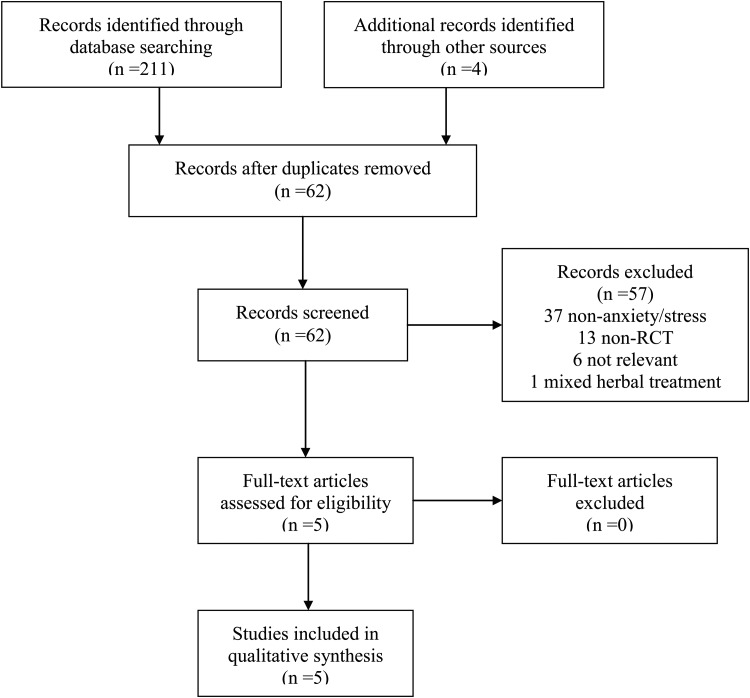
Design: Systematic review of the literature, with searches conducted in PubMed, SCOPUS, CINAHL, and Google Scholar by a medical librarian. Additionally, the reference lists of studies identified in these databases were searched by a research assistant, and queries were conducted in the AYUSH Research Portal. Search terms included "ashwagandha," "Withania somnifera," and terms related to anxiety and stress. Inclusion criteria were human randomized controlled trials with a treatment arm that included WS as a remedy for anxiety or stress. The study team members applied inclusion criteria while screening the records by abstract review.
Intervention: Treatment with any regimen of WS.
Outcome measures: Number and results of studies identified in the review.
Results: Sixty-two abstracts were screened; five human trials met inclusion criteria. Three studies compared several dosage levels of WS extract with placebos using versions of the Hamilton Anxiety Scale, with two demonstrating significant benefit of WS versus placebo, and the third demonstrating beneficial effects that approached but did not achieve significance (p=0.05). A fourth study compared naturopathic care with WS versus psychotherapy by using Beck Anxiety Inventory (BAI) scores as an outcome; BAI scores decreased by 56.5% in the WS group and decreased 30.5% for psychotherapy (p<0.0001). A fifth study measured changes in Perceived Stress Scale (PSS) scores in WS group versus placebo; there was a 44.0% reduction in PSS scores in the WS group and a 5.5% reduction in the placebo group (p<0.0001). All studies exhibited unclear or high risk of bias, and heterogenous design and reporting prevented the possibility of meta-analysis.
Conclusions: All five studies concluded that WS intervention resulted in greater score improvements (significantly in most cases) than placebo in outcomes on anxiety or stress scales. Current evidence should be received with caution because of an assortment of study methods and cases of potential bias.
Figures
References
-
- Kessler RC, Berglund P, Demler O, et al. Lifetime prevalence and age-of-onset distributions of DSM-IV disorders in the National Comorbidity Survey Replication. Arch Gen Psychiatry 2005;62:593–602 - PubMed
-
- Provino R. The role of adaptogens in stress management. Aust J Med Herbal 2010;22:41–49
-
- Mishra L-C, Singh BB, Dagenais S. Scientific basis for the therapeutic use of Withania somnifera (Ashwagandha): a review. Altern Med Rev 2000;5:334–346 - PubMed
Publication types
MeSH terms
Substances
Grants and funding
LinkOut - more resources
Full Text Sources
Other Literature Sources
Medical
Miscellaneous
