. 2014 Nov 19;369(1656):20130574.
doi: 10.1098/rstb.2013.0574.

Avian scavengers and the threat from veterinary pharmaceuticals

Affiliations

Avian scavengers and the threat from veterinary pharmaceuticals

Richard J Cuthbert et al. Philos Trans R Soc Lond B Biol Sci. .

Abstract

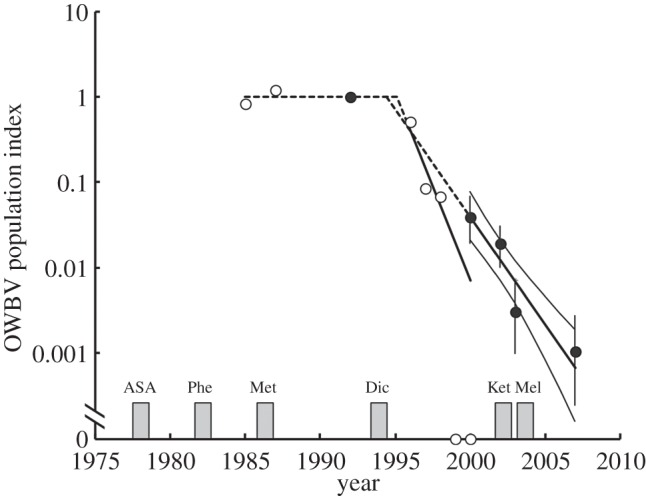
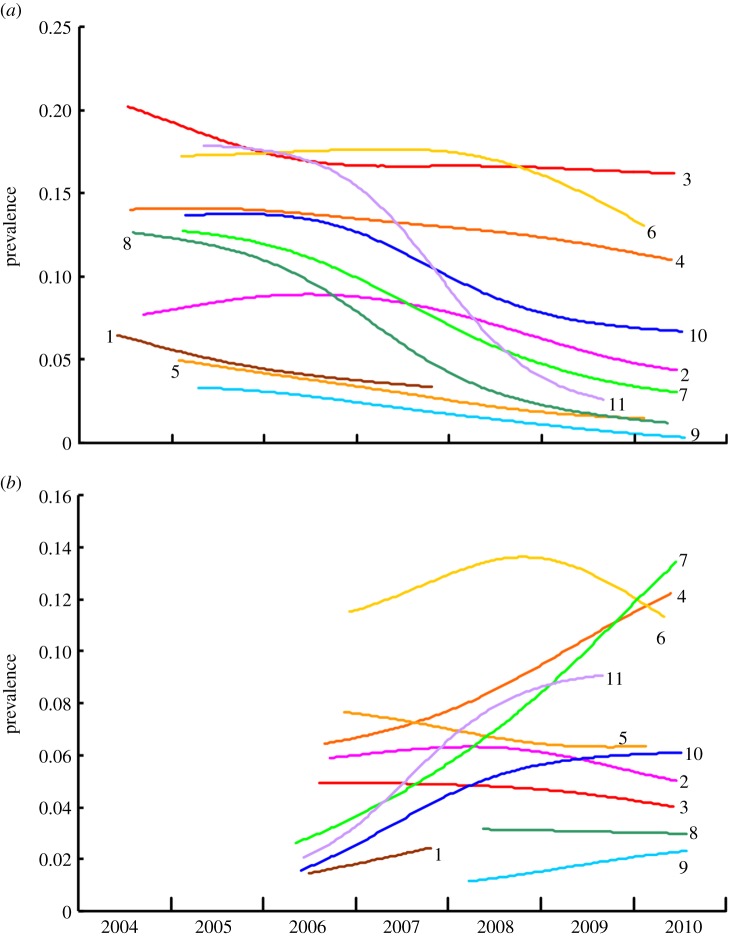
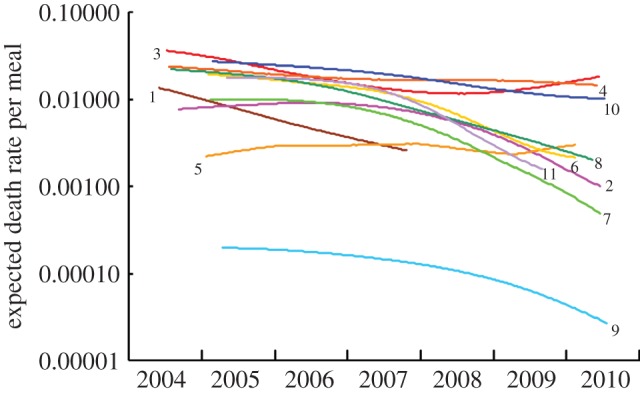
Veterinary use of the non-steroidal anti-inflammatory drug diclofenac on domesticated ungulates caused populations of resident Gyps vultures in the Indian sub-continent to collapse. The birds died when they fed on carrion from treated animals. Veterinary diclofenac was banned in 2006 and meloxicam was advocated as a 'vulture-safe' alternative. We examine the effectiveness of the 2006 ban, whether meloxicam has replaced diclofenac, and the impact of these changes on vultures. Drug residue data from liver samples collected from ungulate carcasses in India since 2004 demonstrate that the prevalence of diclofenac in carcasses in 2009 was half of that before the ban and meloxicam prevalence increased by 44%. The expected vulture death rate from diclofenac per meal in 2009 was one-third of that before the ban. Surveys at veterinary clinics show that diclofenac use in India began in 1994, coinciding with the onset of rapid Gyps declines ascertained from measured rates of declines. Our study shows that one pharmaceutical product has had a devastating impact on Asia's vultures. Large-scale research and survey were needed to detect, diagnose and quantify the problem and measure the response to remedial actions. Given these difficulties, other effects of pharmaceuticals in the environment may remain undetected.

Keywords: Gyps vultures; diclofenac; meloxicam; non-steroidal anti-inflammatory drugs; pharmaceuticals; scavengers.


Figures

Figure 1.
Figure 1.
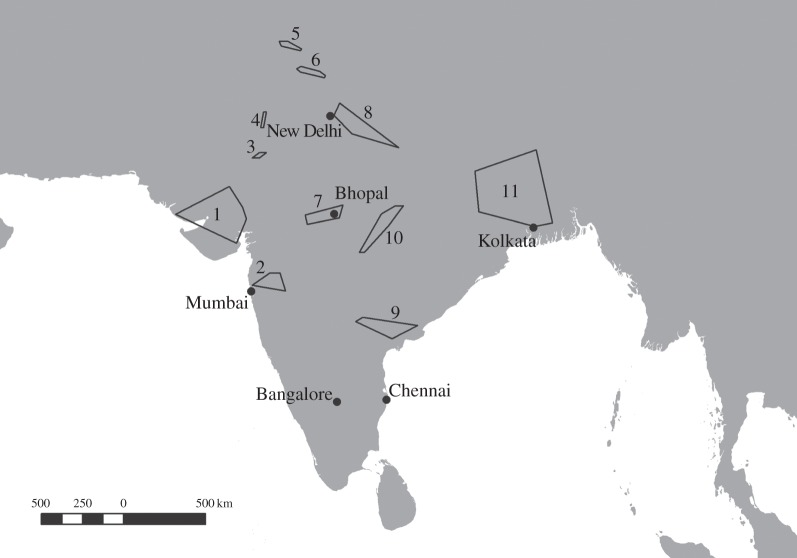
Map of the Indian sub-continent showing convex polygons around the outermost locations of each of 11 site-clusters where liver samples were collected from domesticated ungulates. Numbers denote the site-cluster codes used in tables 2 and 3 and the electronic supplementary material, table S1.
Figure 2.
Figure 2.
Median year of first veterinary use of metamizole (Met, analgin), acetylsalicylic acid (ASA, aspirin), diclofenac (Dic), ketoprofen (Ket), meloxicam (Mel) and phenylbutazone (Phe) (bars). Also shown are population indices for OWBV at Keoladeo National Park (unfilled circles) and from nationwide surveys (filled circles), and the log-linear Poisson regression models fitted to the data for the period of exponential population decline. Thick lines show the regression models with the period for which the model was fitted being indicated by the continuous part of the line. The dashed part of the line indicates the backwards extrapolations. Data from both surveys were standardized to have a mean value of 1.0 prior to the start of the declines. Error bars (vertical lines) around road transect point estimates and the thin curves on either side of the road transect regression are 95% bootstrap CIs.
Figure 3.
Figure 3.
Smoothed curves representing changes over time in the corrected prevalence of (a) diclofenac and (b) meloxicam in liver samples from domesticated ungulates for 11 site-clusters, indicated by numerals adjacent to the curves. Curves are shown for periods that include the central 80% of sample collection dates for each site-cluster.
Figure 4.
Figure 4.
Smoothed curves showing trends in the expected death rate per meal caused by diclofenac poisoning of oriental white-backed vultures exposed to the prevalence and concentration of the drug measured in carcasses of domesticated ungulates between 2004 and 2010. Results are shown for 11 site-clusters, indicated by numerals adjacent to the curves. The interval between meals F is assumed to be 3 days. Note the logarithmic scale. Curves are shown for periods that include the central 80% of sample collection dates for each cluster.
Figure 5.
Figure 5.
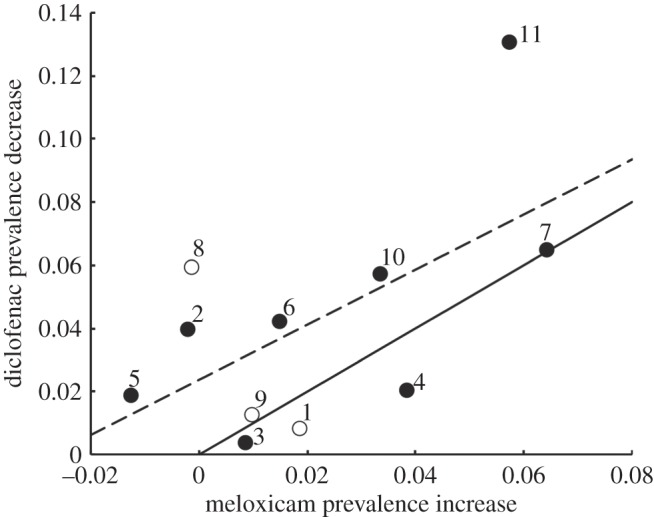
Decrease in the corrected prevalence of diclofenac between end-2006 and mid-2009 in relation to the increase in the corrected prevalence of meloxicam. Points represent site-clusters as indicated by numerals adjacent to points. Clusters for which the central 80% of sample collection dates completely overlapped the period from the end-2006 to mid-2009 are shown by solid points. For three clusters, shown by open circles, the central 80% of sample collection dates did not overlap the period of interest and an extrapolation was made using smoothing. The solid line represents equality between the decrease in prevalence of diclofenac and the increase in prevalence of meloxicam. The dashed line shows the ordinary least-squares regression fitted to data for all 11 site-clusters: diclofenac decrease = 0.0237 + 0.8731 × meloxicam increase.

References

    1. Arnold KE, Brown AR, Ankley GT, Sumpter JP. 2014. Medicating the environment: assessing risks of pharmaceuticals to wildlife and ecosystems. Phil. Trans. R. Soc. B 369, 20130569 ( 10.1098/rstb.2013.0569) - DOI - PMC - PubMed
    1. Corcoran J, Winter MJ, Tyler CR. 2010. Pharmaceuticals in the aquatic environment: a critical review of the evidence for health effects in fish. Crit. Rev. Toxicol. 40, 287–304. ( 10.3109/10408440903373590) - DOI - PubMed
    1. Ankley GT, Brooks BW, Huggett DB, Sumpter JP. 2007. Repeating history: pharmaceuticals in the environment. Environ. Sci. Technol. 41, 8211–8217. ( 10.1021/es072658j) - DOI - PubMed
    1. Kidd KA, Blanchfield PJ, Mills KH, Palace VP, Evans RE, Lazorchak JM, Flick RW. 2007. Collapse of a fish population after exposure to a synthetic estrogen. Proc. Natl Acad. Sci. USA 104, 8897–8901. ( 10.1073/pnas.0609568104) - DOI - PMC - PubMed
    1. Brown AR, Gunnarsson L, Kristiansson E, Tyler CR. 2014. Assessing variation in the potential susceptibility of fish to pharmaceuticals, considering evolutionary differences in their physiology and ecology. Phil. Trans. R. Soc. B 369, 20130576 ( 10.1098/rstb.2013.0576) - DOI - PMC - PubMed

Publication types

LinkOut - more resources