. 2014 Nov 19;369(1656):20130576.
doi: 10.1098/rstb.2013.0576.

Assessing variation in the potential susceptibility of fish to pharmaceuticals, considering evolutionary differences in their physiology and ecology

Affiliations

Assessing variation in the potential susceptibility of fish to pharmaceuticals, considering evolutionary differences in their physiology and ecology

A R Brown et al. Philos Trans R Soc Lond B Biol Sci. .

Abstract

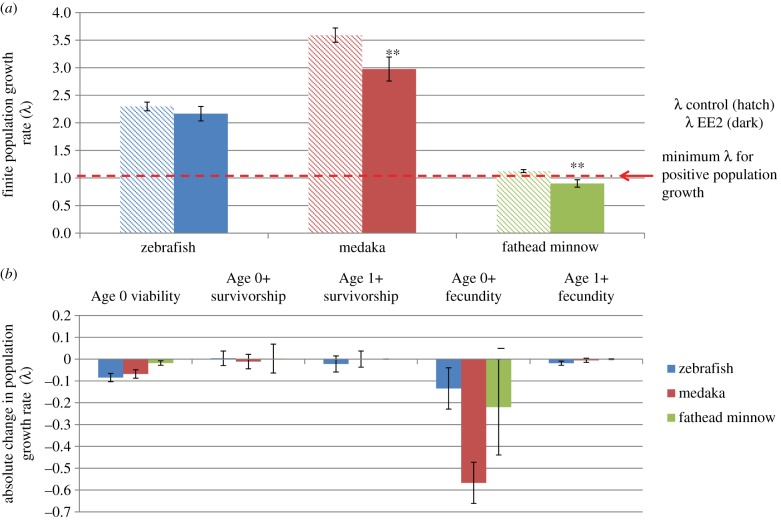
Fish represent the planet's most diverse group of vertebrates and they can be exposed to a wide range of pharmaceuticals. For practical reasons, extrapolation of pharmaceutical effects from 'model' species to other fish species is adopted in risk assessment. Here, we critically assess this approach. First, we show that between 65% and 86% of human drug targets are evolutionarily conserved in 12 diverse fish species. Focusing on nuclear steroid hormone receptors, we further show that the sequence of the ligand binding domain that plays a key role in drug potency is highly conserved, but there is variation between species. This variation for the oestrogen receptor, however, does not obviously account for observed differences in receptor activation. Taking the synthetic oestrogen ethinyloestradiol as a test case, and using life-table-response experiments, we demonstrate significant reductions in population growth in fathead minnow and medaka, but not zebrafish, for environmentally relevant exposures. This finding contrasts with zebrafish being ranked as more ecologically susceptible, according to two independent life-history analyses. We conclude that while most drug targets are conserved in fish, evolutionary divergence in drug-target activation, physiology, behaviour and ecological life history make it difficult to predict population-level effects. This justifies the conventional use of at least a 10× assessment factor in pharmaceutical risk assessment, to account for differences in species susceptibility.

Keywords: drug target; orthologue; physiology; population ecology; species; susceptibility.


Figures

Figure 1.
Figure 1.
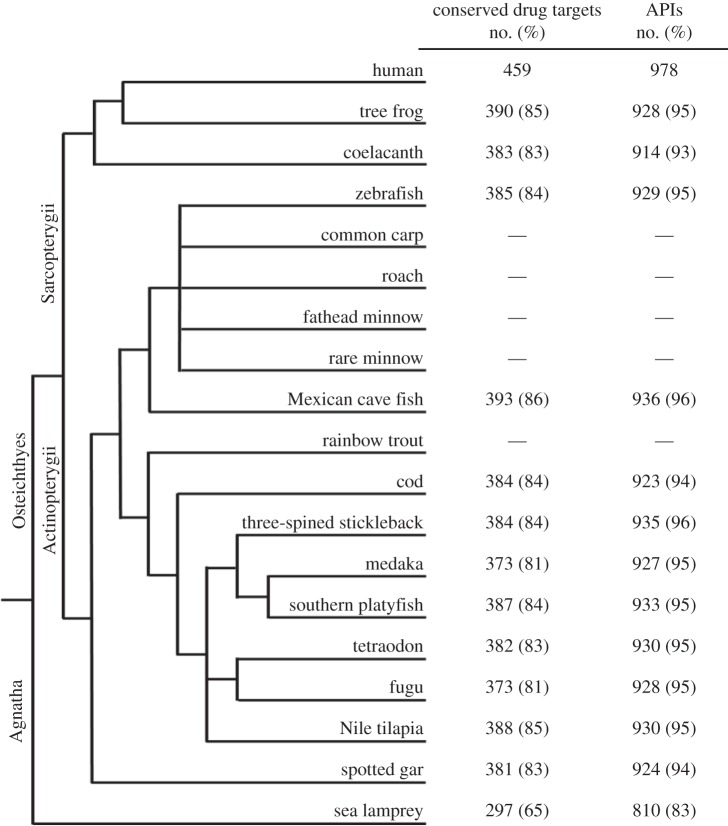
Species tree illustrating the taxonomic relationships (based on NCBI taxonomy) between all species included in this study. The total number (no.) of conserved human drug targets for each of the 12 fish species with fully sequenced genomes and complete gene builds is presented, together with the number of active pharmaceutical ingredients (API) with at least one drug target orthologue.
Figure 2.
Figure 2.
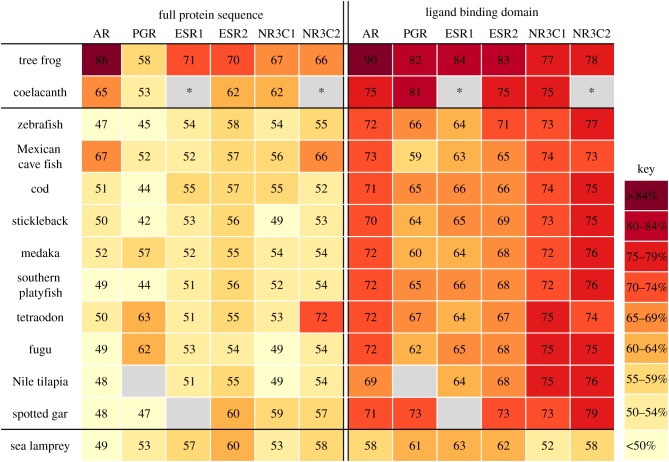
Sequence similarities (%) between six human nuclear steroid hormone receptors and their corresponding orthologues in 13 species. Sequence similarities of the full sequences are presented on the left and similarities of the ligand binding domains are presented on the right. AR, androgen receptor; PGR, progesterone receptor; ESR1, oestrogen receptor 1 (α); ESR2, oestrogen receptor 2 (β); NR3C1, nuclear receptor subfamily 3, group C, member 1 (glucocorticoid receptor); NR3C2, nuclear receptor subfamily 3, group C, member 2 (mineralocorticoid receptor). Percentage similarities are emphasized using a coloured heat map. Empty cells indicate that evidence for an orthologue is lacking in current genome versions and gene builds. Asterisk denotes missing value owing to errors in current gene build. (Online version in colour.)
Figure 3.
Figure 3.
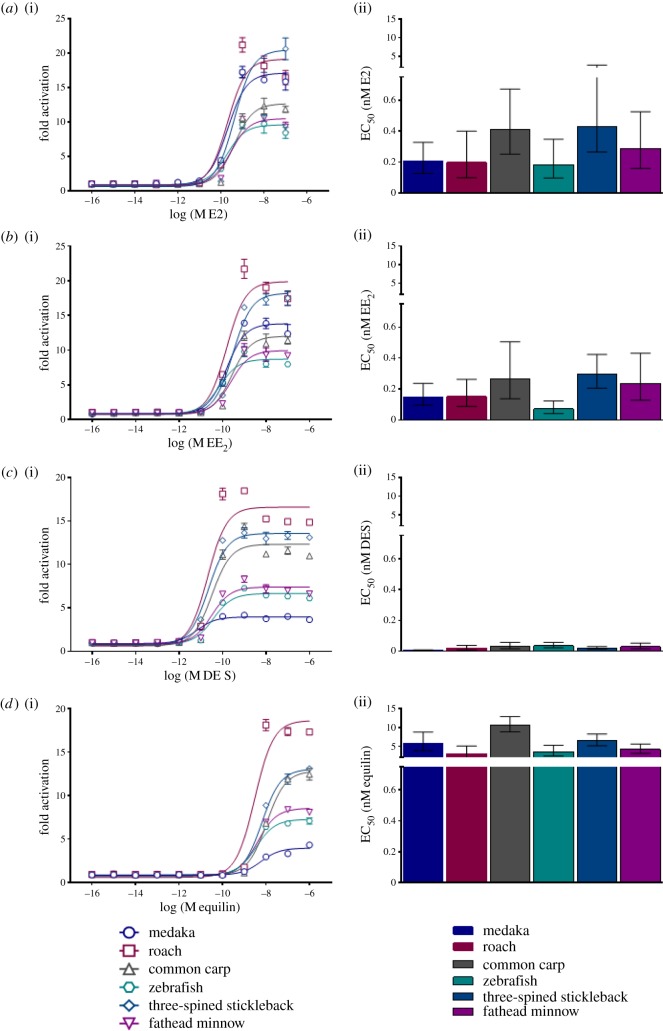
Fish oestrogen receptor (ESR1) responses in transactivation assays induced by oestrogenic pharmaceuticals. (a) 17β-Oestradiol (E2), (b) 17α-ethinyloestradiol (EE2), (c) diethylstilboestrol (DES), (d) equilin. Receptor transactivation data are shown in terms of fold-activation (i) and EC50 (ii). Fold-activation represents the difference in receptor activity (non versus pharmaceutical exposure) of ESR1 from six selected fish species transfected into human HEK293 cells [32]. Receptor activity was quantified using a dual luciferase reporter assay. EC50 is the effective concentration (nM) corresponding with 50% of maximum ESR1 transactivation. Data are presented as mean ± s.e.m. from three independent assays, each consisting of three technical replicates per concentration tested. (Online version in colour.)
Figure 4.
Figure 4.
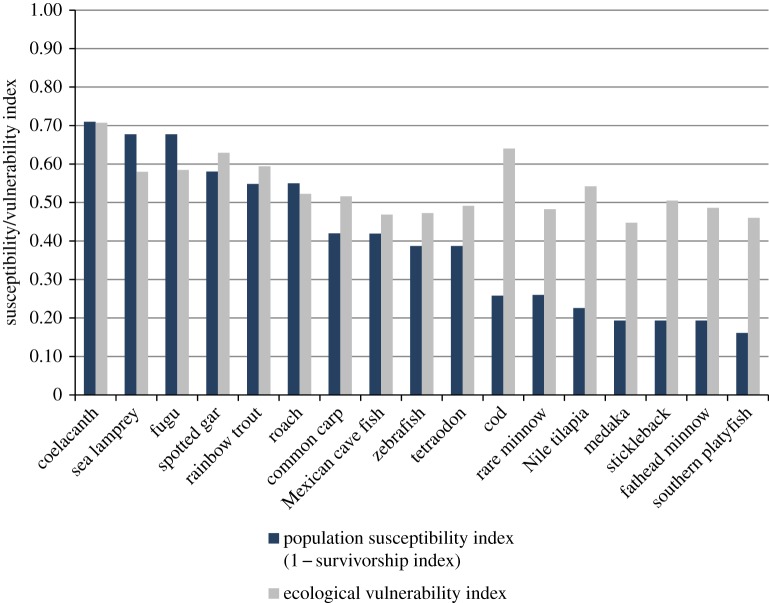
Potential susceptibility of fish populations to environmental (chemical) stress. Population susceptibility index (1 − population survivorship index, Spromberg & Birge [38]) was calculated using a scoring system based on spawning frequency, parental care, lifespan, recruitment, niche specificity. Ecological vulnerability index (De Lange et al. [39]) was based on broader life-history data. Data were obtained mainly from www.fish.base.org/ and www.fishtraits.info/ (see electronic supplementary material, table S5). (Online version in colour.)
Figure 5.
Figure 5.
(a) Mean (s.e.m.) projected finite population growth in model fish species following lifetime exposure (embryo to adult) to 1 ng l−1 ethinyloestradiol (EE2) compared with control populations with no chemical exposure. (b) Contribution of each vital rate to reductions in finite population growth rate. Mean of n = 100 stochastic matrix projections and standard error of the mean (SEM) shown. **p < 0.001 according to the Kruskal–Wallis test comparing ranked projections of finite population growth in EE2 exposed populations versus non-exposed (control) populations of model fish species. (Online version in colour.)

References

    1. Knox C, et al. 2011. DrugBank 3.0: a comprehensive resource for ‘Omics’ research on drugs. Nucleic Acids Res. 39(Suppl. 1), D1035–D1041. ( 10.1093/nar/gkq1126) - DOI - PMC - PubMed
    1. National Institutes of Health 2014. Therapeutic drug levels: medline plus See http://www.nlm.nih.gov/medlineplus/ency/article/003430.htm (accessed January 2014).
    1. Gunnarsson L, Jauhiainen A, Kristiansson E, Nerman O, Larsson DG. 2008. Evolutionary conservation of human drug targets in organisms used for environmental risk assessments. Environ. Sci. Technol. 42, 5807–5813. ( 10.1021/es8005173) - DOI - PubMed
    1. Kostich MS, Lazorchak JM. 2008. Risks to aquatic organisms posed by human pharmaceutical use. Sci. Total Environ. 389, 329–339. ( 10.1016/j.scitotenv.2007.09.008) - DOI - PubMed
    1. Lalone CA, et al. 2013. Molecular target sequence similarity as a basis for species extrapolation to assess the ecological risk of chemicals with known modes of action. Aquat. Toxicol. 144–145, 141–154. ( 10.1016/j.aquatox.2013.09.004) - DOI - PubMed

Publication types

Substances

LinkOut - more resources