Multicenter Study
. 2014 Nov 18;9(11):e112767.
doi: 10.1371/journal.pone.0112767. eCollection 2014.

Multicenter epidemiological study to assess the population of CKD patients in Greece: results from the PRESTAR study

Affiliations
Multicenter Study

Multicenter epidemiological study to assess the population of CKD patients in Greece: results from the PRESTAR study

Konstantinos Sombolos et al. PLoS One. .

Abstract

Background: Chronic Kidney Disease (CKD) is a relatively common condition not only associated with increased morbidity and mortality but also fuelling End Stage Renal Disease (ESRD). Among developed nations, Greece has one of the highest ESRD incidence rates, yet there is limited understanding of the epidemiology of earlier stages of CKD.

Methods: Cross-sectional survey of pre-dialysis CKD outpatients in nephrology clinics in the National Health Care system between October 2009 and October 2010. Demographics, cause of CKD, blood pressure, level of renal function, duration of CKD and nephrology care, and specialty of referral physician were collected and analyzed. Different methods for estimating renal function (Cockroft-Gault [CG], CKD-Epi and MDRD) and staging CKD were assessed for agreement.

Results: A total of 1,501 patients in 9 centers were enrolled. Diabetic nephropathy was the most common nephrologist assigned cause of CKD (29.7%). In total, 36.5% of patients had self-referred to the nephrologist; patients with diabetes or serum creatinine above 220 µmol/l (eGFR<40 ml/min/1.73 m2) were more likely to have been referred by a physician. Agreement between MDRD and CKD-Epi, but not between CG, the other estimating equations, was excellent. There was substantial heterogeneity with respect to renal diagnoses, referral patterns and blood pressure among participating centers.

Conclusions: In this first epidemiologic assessment of CKD in Greece, we documented delayed referral and high rates of self-referral among patients with CKD. eGFR reporting, currently offered by a limited number of laboratories, may facilitate detection of CKD at an earlier, more treatable stage.


Conflict of interest statement

Competing Interests: Drs. SK, DT, JB, DV, KS, VV, PV, CI, and ED are clinician investigators responsible for enrolling patients and collecting the data; they all received investigator fees for their participation in PRESTAR. Dr. KX is a former Abbott (now AbbVie) employee and may own Abbott/AbbVie stock, while Dr. CA was an Abbott Laboratories Hellas (now AbbVie Pharmaceuticals SA) Medical Affairs contractor. Abbott Laboratories funded this study. There are no patents, products in development or marketed products to declare. This does not alter the authors' adherence to all the PLOS ONE policies on sharing data and materials.

Figures

Figure 1
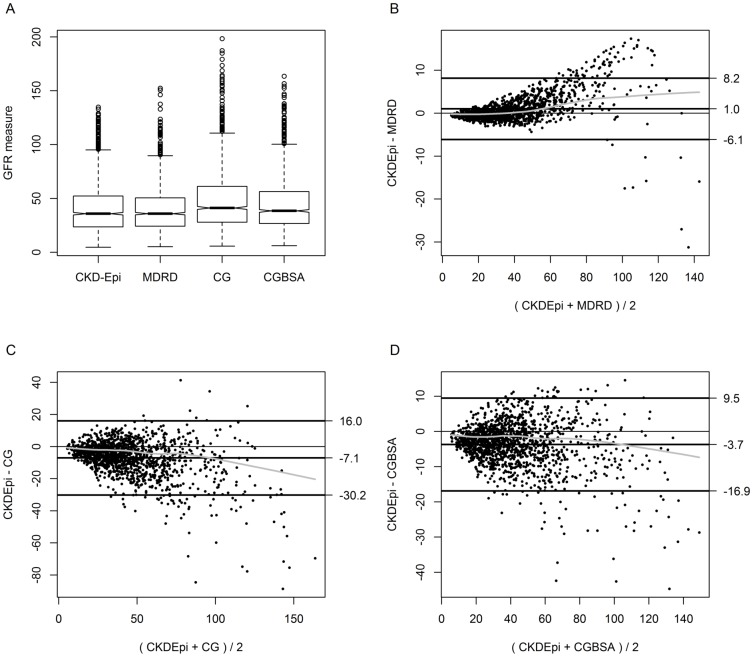
Figure 1. Estimating equations for renal function in the PreSTAR study (A) Box whisker plots of individual estimates based on the CKD Epi (CKD-Epi), MDRD, Cockroft Gault (CG) and Cockroft Gault normalized to Body Surface Area (CGBSA).
The thick horizontal line is the median estimate, the bottom and top of each box are the 25th and 75th percentiles, the thin horizontal lines are the most extreme data points within 1.5 times the interquartile range, while the outliers are shown as circles. (B–D) Bland Altman (BA) plot of the MDRD (B), CG(C) and CGBSA against CKD-Epi (D). Each BA plot shows the difference between the two levels of renal function (y-axis) against their average (x-axis) for each patient. The three thick black lines demarcate the bias and the upper and lower limits of agreement, while the thin horizontal line is the zero bias line. In each plot, the gray line is a non-parametric estimate of the constancy of the bias across the range of possible values.
Figure 2
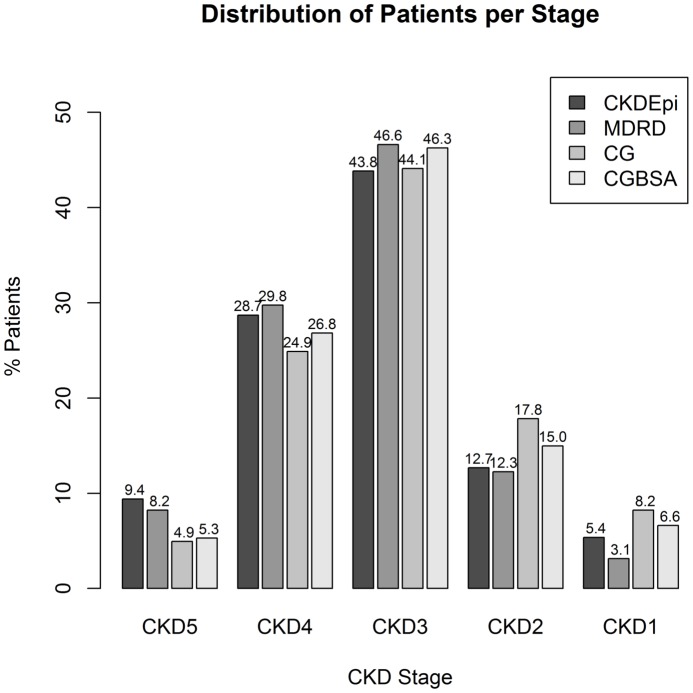
Figure 2. Distribution of stages of CKD in PRESTAR according to different estimating equations, CKD-Epi, MDRD, Cockroft Gault (CG), CG normalized to Body Surface Area (CGBSA).
Figure 3
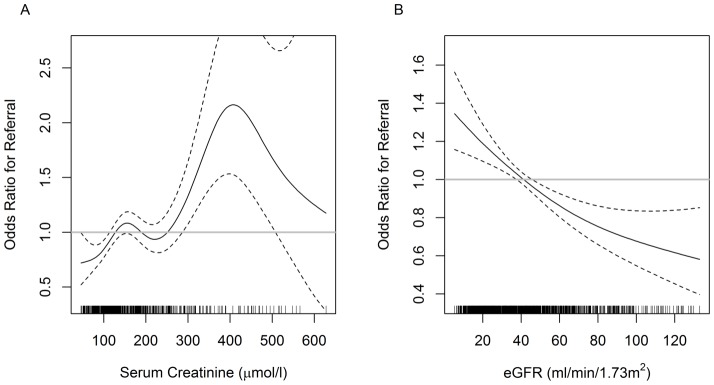
Figure 3. Adjusted odds of a patient having been referred to a nephrologist by a specialist in relation to serum creatinine (A) and eGFR (CKD-Epi), (B) during the study visit.
Models were adjusted for age, gender, race, presence of diabetic renal disease, center, systolic and diastolic blood pressure and time the patient had been under nephrology care. Solid black line: estimated adjusted odds ratio, dashed black lines: associated pointwise 95% confidence internal, gray horizontal line: corresponds to an odds ratio of one.
Figure 4
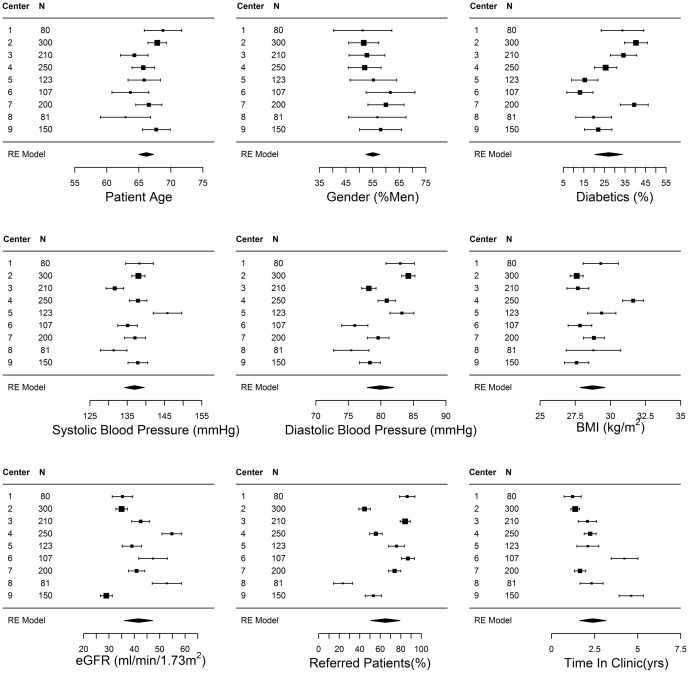
Figure 4. Center wise variations in patient demographics, blood pressure, renal function, diabetes and percentage of referred patients (Could number of patients in each center be added as a footnote?).

References

    1. Yang M, Fox CH, Vassalotti J, Choi M (2011) Complications of progression of CKD. Adv Chronic Kidney Dis 18: 400–405 10.1053/j.ackd.2011.10.001 - DOI - PubMed
    1. Locatelli F, Vecchio LD, Pozzoni P (2002) The importance of early detection of chronic kidney disease. Nephrol Dial Transplant 17 Suppl 11: 2–7. - PubMed
    1. Stenvinkel P (2010) Chronic kidney disease: a public health priority and harbinger of premature cardiovascular disease. J Intern Med 268: 456–467 10.1111/j.1365-2796.2010.02269.x - DOI - PubMed
    1. Campbell KH, Smith SG, Hemmerich J, Stankus N, Fox C, et al. (2011) Patient and provider determinants of nephrology referral in older adults with severe chronic kidney disease: a survey of provider decision making. BMC Nephrol 12: 47 10.1186/1471-2369-12-47 - DOI - PMC - PubMed
    1. Kinchen KS, Sadler J, Fink N, Brookmeyer R, Klag MJ, et al. (2002) The timing of specialist evaluation in chronic kidney disease and mortality. Ann Intern Med 137: 479–486. - PubMed

Publication types