


Manifestations and implications of uncertainty for improving healthcare systems: an analysis of observational and interventional studies grounded in complexity science
- PMID: 25407138
- PMCID: PMC4239371
- DOI: 10.1186/s13012-014-0165-1
Manifestations and implications of uncertainty for improving healthcare systems: an analysis of observational and interventional studies grounded in complexity science
Abstract
Background: The application of complexity science to understanding healthcare system improvement highlights the need to consider interdependencies within the system. One important aspect of the interdependencies in healthcare delivery systems is how individuals relate to each other. However, results from our observational and interventional studies focusing on relationships to understand and improve outcomes in a variety of healthcare settings have been inconsistent. We sought to better understand and explain these inconsistencies by analyzing our findings across studies and building new theory.
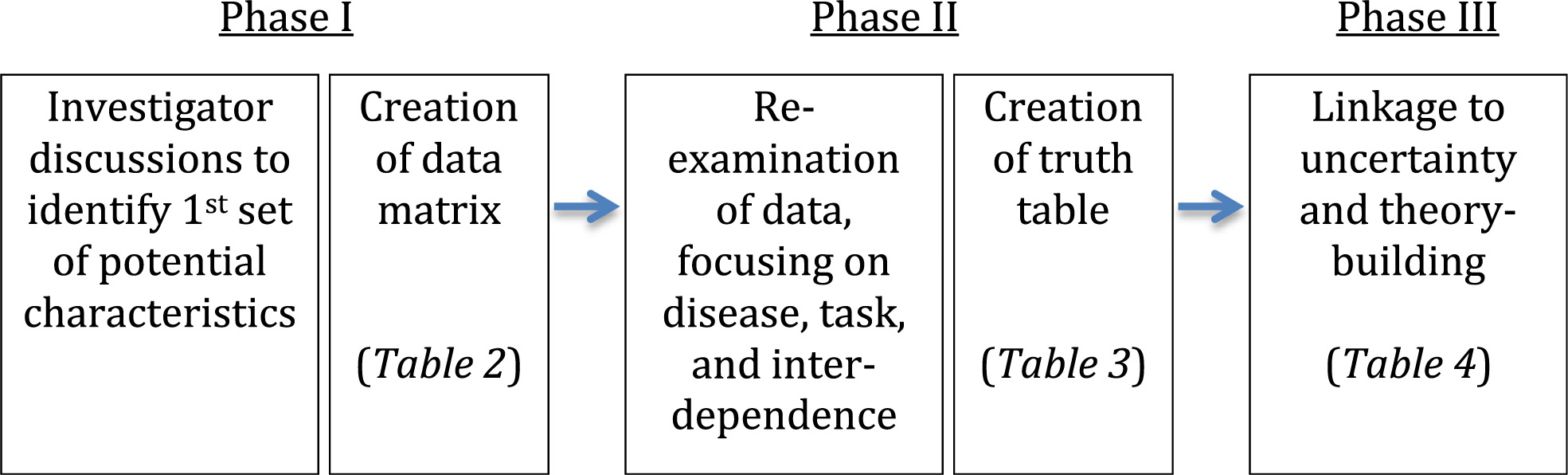
Methods: We analyzed eight observational and interventional studies in which our author team was involved as the basis of our analysis, using a set theoretical qualitative comparative analytic approach. Over 16 investigative meetings spanning 11 months, we iteratively analyzed our studies, identifying patterns of characteristics that could explain our set of results. Our initial focus on differences in setting did not explain our mixed results. We then turned to differences in patient care activities and tasks being studied and the attributes of the disease being treated. Finally, we examined the interdependence between task and disease.
Results: We identified system-level uncertainty as a defining characteristic of complex systems through which we interpreted our results. We identified several characteristics of healthcare tasks and diseases that impact the ways uncertainty is manifest across diverse care delivery activities. These include disease-related uncertainty (pace of evolution of disease and patient control over outcomes) and task-related uncertainty (standardized versus customized, routine versus non-routine, and interdependencies required for task completion).
Conclusions: Uncertainty is an important aspect of clinical systems that must be considered in designing approaches to improve healthcare system function. The uncertainty inherent in tasks and diseases, and how they come together in specific clinical settings, will influence the type of improvement strategies that are most likely to be successful. Process-based efforts appear best-suited for low-uncertainty contexts, while relationship-based approaches may be most effective for high-uncertainty situations.
References
-
- Balasubramanian BA, Chase SM, Nutting PA, Cohen DJ, Ohman Strickland PA, Crosson JC, Miller WL, Crabtree BF. Using learning teams for reflective adaptation: insights from a team-based change management strategy in primary care. Ann Fam Med. 2010;8:425–432. doi: 10.1370/afm.1159. - DOI - PMC - PubMed
-
- Shaw EK, Ohman-Strickland PA, Piasecki A, Hudson SV, Ferrante JM, McDaniel RR, Nutting PA, Crabtree BF. Effects of facilitated team meetings and learning collaboratives on colorectal cancer screening rates in primary care practices: a cluster randomized trial. Ann Fam Med. 2013;11:220–228. doi: 10.1370/afm.1505. - DOI - PMC - PubMed
Publication types
MeSH terms
LinkOut - more resources
Full Text Sources
Other Literature Sources
Medical
