


How acute total sleep loss affects the attending brain: a meta-analysis of neuroimaging studies
- PMID: 25409102
- PMCID: PMC4288604
- DOI: 10.5665/sleep.4404
How acute total sleep loss affects the attending brain: a meta-analysis of neuroimaging studies
Abstract
Study objectives: Attention is a cognitive domain that can be severely affected by sleep deprivation. Previous neuroimaging studies have used different attention paradigms and reported both increased and reduced brain activation after sleep deprivation. However, due to large variability in sleep deprivation protocols, task paradigms, experimental designs, characteristics of subject populations, and imaging techniques, there is no consensus regarding the effects of sleep loss on the attending brain. The aim of this meta-analysis was to identify brain activations that are commonly altered by acute total sleep deprivation across different attention tasks.
Design: Coordinate-based meta-analysis of neuroimaging studies of performance on attention tasks during experimental sleep deprivation.
Methods: The current version of the activation likelihood estimation (ALE) approach was used for meta-analysis. The authors searched published articles and identified 11 sleep deprivation neuroimaging studies using different attention tasks with a total of 185 participants, equaling 81 foci for ALE analysis.
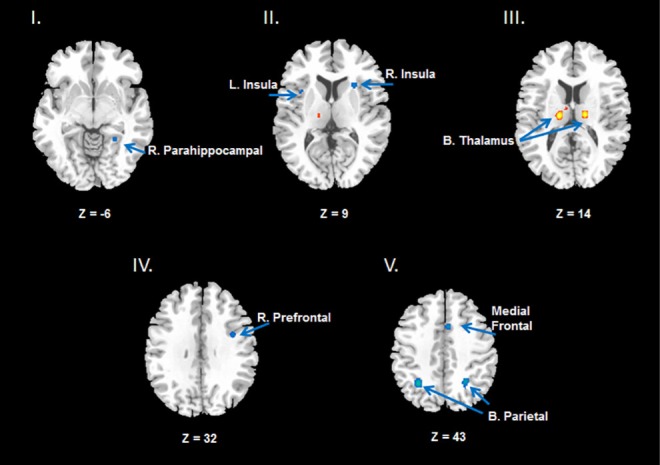
Results: The meta-analysis revealed significantly reduced brain activation in multiple regions following sleep deprivation compared to rested wakefulness, including bilateral intraparietal sulcus, bilateral insula, right prefrontal cortex, medial frontal cortex, and right parahippocampal gyrus. Increased activation was found only in bilateral thalamus after sleep deprivation compared to rested wakefulness.
Conclusion: Acute total sleep deprivation decreases brain activation in the fronto-parietal attention network (prefrontal cortex and intraparietal sulcus) and in the salience network (insula and medial frontal cortex). Increased thalamic activation after sleep deprivation may reflect a complex interaction between the de-arousing effects of sleep loss and the arousing effects of task performance on thalamic activity.
Keywords: attention; fmri; fronto-parietal network; meta-analysis; salience network; sleep deprivation; thalamus.
© 2015 Associated Professional Sleep Societies, LLC.
Figures
Similar articles
-
Functional brain alterations in acute sleep deprivation: An activation likelihood estimation meta-analysis.Sleep Med Rev. 2019 Aug;46:64-73. doi: 10.1016/j.smrv.2019.03.008. Epub 2019 Mar 28. Sleep Med Rev. 2019. PMID: 31063939 Free PMC article.
-
A coordinate-based meta-analysis comparing brain activation between attention deficit hyperactivity disorder and total sleep deprivation.Sleep. 2019 Mar 1;42(3):zsy251. doi: 10.1093/sleep/zsy251. Sleep. 2019. PMID: 30541103 Free PMC article.
-
Sleep deprivation impairs object-selective attention: a view from the ventral visual cortex.PLoS One. 2010 Feb 5;5(2):e9087. doi: 10.1371/journal.pone.0009087. PLoS One. 2010. PMID: 20140099 Free PMC article. Clinical Trial.
-
Functional imaging of working memory after 24 hr of total sleep deprivation.J Neurosci. 2004 May 12;24(19):4560-7. doi: 10.1523/JNEUROSCI.0007-04.2004. J Neurosci. 2004. PMID: 15140927 Free PMC article.
-
The "handwriting brain": a meta-analysis of neuroimaging studies of motor versus orthographic processes.Cortex. 2013 Nov-Dec;49(10):2772-87. doi: 10.1016/j.cortex.2013.05.011. Epub 2013 Jun 12. Cortex. 2013. PMID: 23831432 Review.
Cited by
-
Proceedings of the Sleep and Epilepsy Workgroup: Section 2 Comorbidities: Sleep Related Comorbidities of Epilepsy.Epilepsy Curr. 2021 Apr 12;21(3):15357597211004549. doi: 10.1177/15357597211004549. Online ahead of print. Epilepsy Curr. 2021. PMID: 33843327 Free PMC article.
-
Association between striatal dopamine D2/D3 receptors and brain activation during visual attention: effects of sleep deprivation.Transl Psychiatry. 2016 May 31;6(5):e828. doi: 10.1038/tp.2016.93. Transl Psychiatry. 2016. PMID: 27244237 Free PMC article.
-
Regional cerebral hypoperfusion after acute sleep deprivation: A STROBE-compliant study of arterial spin labeling fMRI.Medicine (Baltimore). 2019 Jan;98(2):e14008. doi: 10.1097/MD.0000000000014008. Medicine (Baltimore). 2019. PMID: 30633191 Free PMC article.
-
Gallic Acid Ameliorates Cognitive Impairment Caused by Sleep Deprivation through Antioxidant Effect.Exp Neurobiol. 2023 Aug 31;32(4):285-301. doi: 10.5607/en23015. Exp Neurobiol. 2023. PMID: 37749929 Free PMC article.
-
The effects of sleep deprivation on the processing of emotional facial expressions in young adults with and without ADHD.Sci Rep. 2021 Jul 9;11(1):14241. doi: 10.1038/s41598-021-93641-7. Sci Rep. 2021. PMID: 34244583 Free PMC article. Clinical Trial.
References
-
- James W. The principles of psychology. Vol. 1. New York: Henry Holt; 1890. pp. 403–4.
-
- Sturm W, de Simone A, Krause BJ, et al. Functional anatomy of intrinsic alertness: evidence for a fronto-parietal-thalamic-brainstem network in the right hemisphere. Neuropsychologia. 1999;37:797–805. - PubMed
-
- Sturm W, Willmes K. On the functional neuroanatomy of intrinsic and phasic alertness. NeuroImage. 2001;14:S76–84. - PubMed
-
- Durmer JS, Dinges DF. Neurocognitive consequences of sleep deprivation. Semin Neurol. 2005;25:117–29. - PubMed
-
- Lim J, Dinges DF. Sleep deprivation and vigilant attention. Ann N Y Acad Sci. 2008;1129:305–22. - PubMed
Publication types
MeSH terms
Grants and funding
LinkOut - more resources
Full Text Sources
Other Literature Sources
