


Tongue stiffness is lower in patients with obstructive sleep apnea during wakefulness compared with matched control subjects
- PMID: 25409103
- PMCID: PMC4355893
- DOI: 10.5665/sleep.4566
Tongue stiffness is lower in patients with obstructive sleep apnea during wakefulness compared with matched control subjects
Abstract
Study objectives: This study aimed to determine whether tongue stiffness (shear modulus) in patients with obstructive sleep apnea (OSA) is different for controls matched for age, sex, and body mass index (BMI), and to investigate the effect of continuous positive airway pressure (CPAP) on stiffness.
Design: Controlled experimental study.
Setting: Medical research institute.
Participants: Patients with OSA and age-, sex-, and BMI-matched healthy controls.
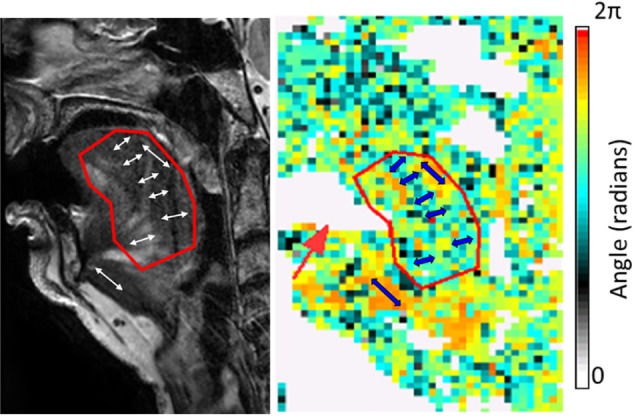
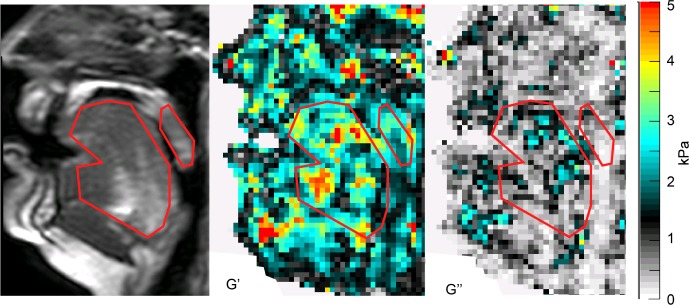
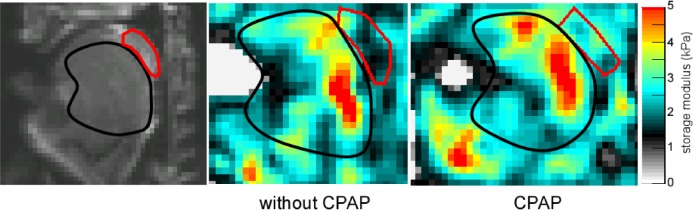
Measurements: Magnetic resonance elastography was performed in nine patients with OSA (apnea-hypopnea index (AHI) > 15 events/h) and seven controls (AHI < 10 events/h) matched for age, sex, and BMI. Six of these OSA subjects were also scanned while 10 cmH2O CPAP was applied. Mean isotropic shear modulus and anisotropic shear moduli parallel and perpendicular to the muscle fascicles in the tongue were calculated.
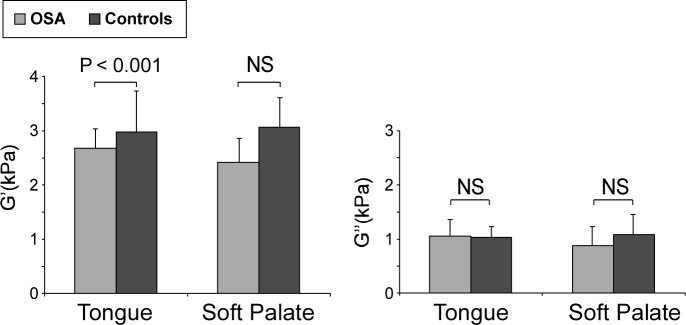
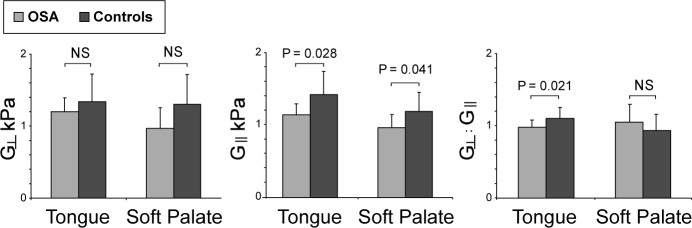
Results: Tongue shear modulus in patients with OSA was lower than that in matched controls (2.68 ± 0.35 (mean ± standard deviation) kPa versus 2.98 ± 0.44 kPa, P < 0.001). Shear modulus decreased with increasing AHI (R = -0.496, P = 0.043), but not age, BMI, or percentage tongue fat. Anisotropic analysis revealed that reduction in stiffness was greatest parallel to the muscle fibers. CPAP had no significant effect on tongue shear modulus.
Conclusions: In awake subjects with obstructive sleep apnea, the tongue is less stiff than in similar healthy subjects and this difference occurs in the muscle fiber direction. CPAP did not significantly reduce tongue stiffness. Thus, any change in neural drive to genioglossus during wakefulness is insufficient to restore normal tongue stiffness.
Keywords: collapsibility; elastography; obstructive sleep apnea.
© 2015 Associated Professional Sleep Societies, LLC.
Figures
References
-
- Younes M. Contributions of upper airway mechanics and control mechanisms to severity of obstructive apnea. Am J Respir Crit Care Med. 2003;168:645–58. - PubMed
-
- Patil S, Schneider H, Marx J, Gladmon E, Schwartz A, Smith P. Neuromechanical control of upper airway patency during sleep. J Appl Physiol. 2007;102:547–56. - PubMed
-
- Longobardo GS, Evangelisti CJ, Cherniack NS. Analysis of the interplay between neurochemical control of respiration and upper airway mechanics producing upper airway obstruction during sleep in humans. Exp Physiol. 2007;93:271–87. - PubMed
-
- Zohar Y, Sabo R, Strauss M, Schwartz A, Gal R, Oksenberg A. Oropharyngeal fatty infiltration in obstructive sleep apnea patients: a histologic study. Ann Otol Rhinol Laryngol. 1998;107:170–4. - PubMed
-
- Boyd JH, Petrof BJ, Hamid Q, Fraser R, Kimoff RJ. Upper airway muscle inflammation and denervation changes in obstructive sleep apnea. Am J Respir Crit Care Med. 2004;170:541–6. - PubMed
Publication types
MeSH terms
LinkOut - more resources
Full Text Sources
Other Literature Sources
