Editorial
doi: 10.1056/NEJMe1413061.
Epub 2014 Nov 19.
Somatic mutations and immunotherapy outcome with CTLA-4 blockade in melanoma
Affiliations
- PMID: 25409261
- PMCID: PMC4456677
- DOI: 10.1056/NEJMe1413061
Item in Clipboard
Editorial
Somatic mutations and immunotherapy outcome with CTLA-4 blockade in melanoma
N Engl J Med.
.
No abstract available
Figures
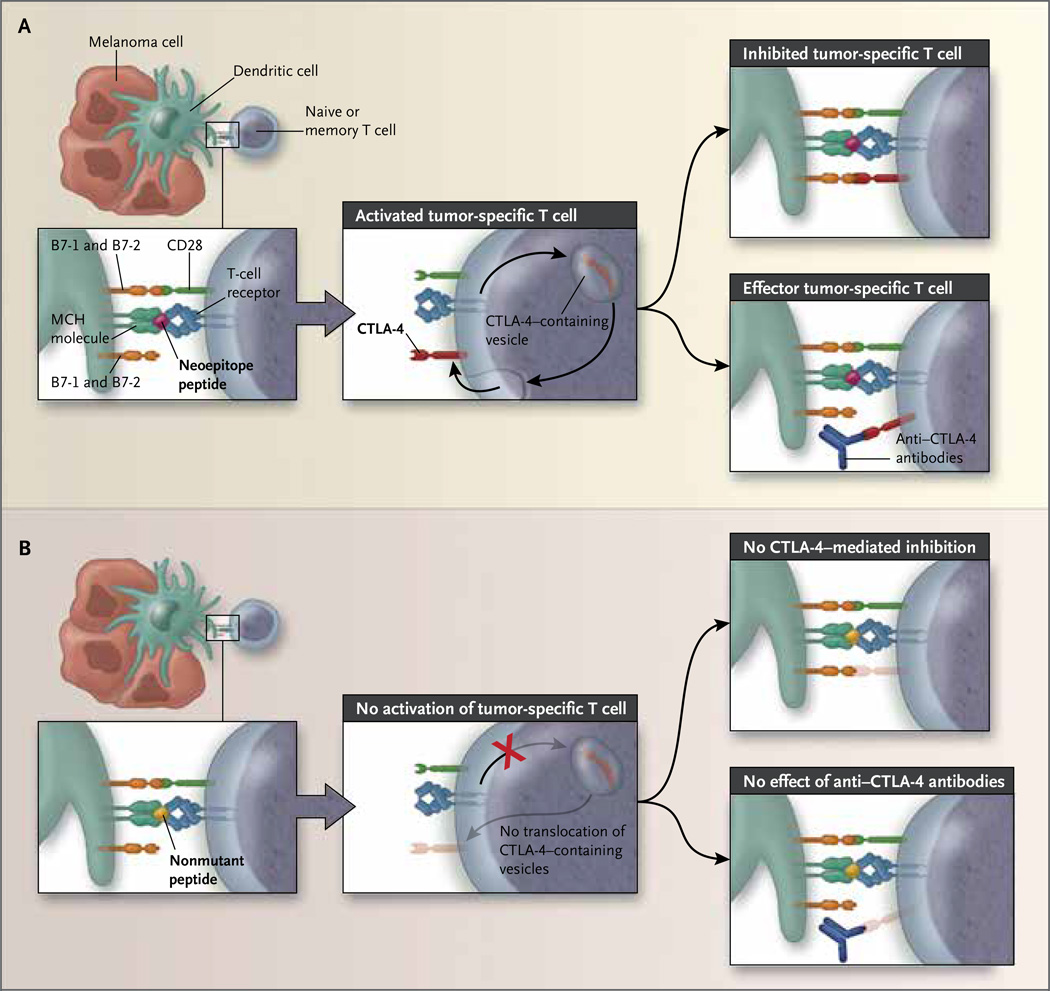
Recognition of epitopes by T-cell receptors can be mediated by consensus
tetrapeptides in immunogenic peptides. As shown in Panel A, mutant tetrapeptides
that bind major histocompatibility complex (MHC) class I molecules with high
affinity induce activation of antigen-specific naive or memory T cells that
recognize this tumor-specific antigen, leading to translocation of cytotoxic
T-lymphocyte antigen 4 (CTLA-4)–containing vesicles to the immunologic
synapse and up-regulation of CTLA-4 expression on the cell surface. Ligation of
CTLA-4 by B7-1 and B7-2 mediates an inhibitory signal in these tumor-specific T
cells. Under these conditions, anti–CTLA-4 antibodies prevent CTLA-4
ligation and CTLA-4–mediated inhibition, resulting in the generation of
functional tumor-specific effector T cells, which induce anti-tumor responses.
As shown in Panel B, in the absence of such mutations, nonmutant tetrapeptides
corresponding to the nonmutated counterparts of immunogenic somatic neoepitopes
have lower affinity for MHC class I molecules and do not induce activation of
antigen-specific naive or memory T cells that recognize this tumor-specific
antigen. Under these conditions, CTLA-4–containing vesicles do not
translocate to the immunologic synapse, CTLA-4 expression is not up-regulated,
and anti–CTLA-4 antibodies confer no clinical benefit.
Comment on
-
Genetic basis for clinical response to CTLA-4 blockade in melanoma.N Engl J Med. 2014 Dec 4;371(23):2189-2199. doi: 10.1056/NEJMoa1406498. Epub 2014 Nov 19. N Engl J Med. 2014. PMID: 25409260 Free PMC article.
References
-
- Lynch TJ, Bell DW, Sordella R, et al. Activating mutations in the epidermal growth factor receptor underlying responsiveness of non�small-cell lung cancer to gefitinib. N Engl J Med. 2004;350:2129–2139. - PubMed
Publication types
MeSH terms
Substances
Grants and funding
LinkOut - more resources
Full Text Sources
Other Literature Sources
Medical