


Central adaptation to repeated galvanic vestibular stimulation: implications for pre-flight astronaut training
- PMID: 25409443
- PMCID: PMC4237321
- DOI: 10.1371/journal.pone.0112131
Central adaptation to repeated galvanic vestibular stimulation: implications for pre-flight astronaut training
Abstract
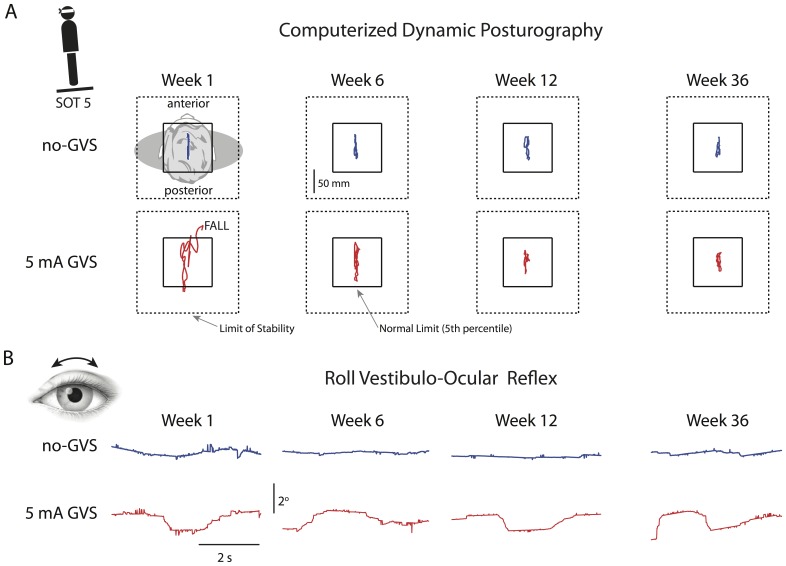
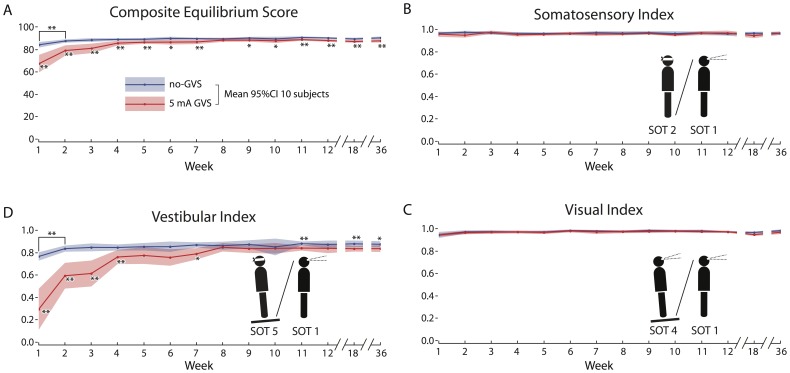
Healthy subjects (N = 10) were exposed to 10-min cumulative pseudorandom bilateral bipolar Galvanic vestibular stimulation (GVS) on a weekly basis for 12 weeks (120 min total exposure). During each trial subjects performed computerized dynamic posturography and eye movements were measured using digital video-oculography. Follow up tests were conducted 6 weeks and 6 months after the 12-week adaptation period. Postural performance was significantly impaired during GVS at first exposure, but recovered to baseline over a period of 7-8 weeks (70-80 min GVS exposure). This postural recovery was maintained 6 months after adaptation. In contrast, the roll vestibulo-ocular reflex response to GVS was not attenuated by repeated exposure. This suggests that GVS adaptation did not occur at the vestibular end-organs or involve changes in low-level (brainstem-mediated) vestibulo-ocular or vestibulo-spinal reflexes. Faced with unreliable vestibular input, the cerebellum reweighted sensory input to emphasize veridical extra-vestibular information, such as somatosensation, vision and visceral stretch receptors, to regain postural function. After a period of recovery subjects exhibited dual adaption and the ability to rapidly switch between the perturbed (GVS) and natural vestibular state for up to 6 months.
Conflict of interest statement
Figures

References
-
- Goldberg JM, Smith CE, Fernandez C (1984) Relation between discharge regularity and responses to externally applied galvanic currents in vestibular nerve afferents of the squirrel monkey. Journal of neurophysiology 51: 1236–1256. - PubMed
-
- Kim J, Curthoys IS (2004) Responses of primary vestibular afferents to galvanic vestibular stimulation (GVS) in the anaesthetised guinea pig. Brain Res Bull 64: 265–271. - PubMed
-
- Kleine JF, Guldin WO, Clarke AH (1999) Variable otolith contribution to the galvanically induced vestibulo-ocular reflex. Neuroreport 10: 1143–1148. - PubMed
-
- McCrea R, Gdowski G, luan H (2001) Current concepts of vestibular nucleus function. Ann NY Acad Sci 942: 328–344. - PubMed
-
- Fitzpatrick RC, Day BL (2004) Probing the human vestibular system with galvanic stimulation. J Appl Physiol 96: 2301–2316. - PubMed
Publication types
MeSH terms
LinkOut - more resources
Full Text Sources
Other Literature Sources
Medical
