. 2014 Nov 20:8:129.
doi: 10.1186/s12918-014-0129-8.

Topology analysis and visualization of Potyvirus protein-protein interaction network

Affiliations

Topology analysis and visualization of Potyvirus protein-protein interaction network

Gabriel Bosque et al. BMC Syst Biol. .

Abstract

Background: One of the central interests of Virology is the identification of host factors that contribute to virus infection. Despite tremendous efforts, the list of factors identified remains limited. With omics techniques, the focus has changed from identifying and thoroughly characterizing individual host factors to the simultaneous analysis of thousands of interactions, framing them on the context of protein-protein interaction networks and of transcriptional regulatory networks. This new perspective is allowing the identification of direct and indirect viral targets. Such information is available for several members of the Potyviridae family, one of the largest and more important families of plant viruses.

Results: After collecting information on virus protein-protein interactions from different potyviruses, we have processed it and used it for inferring a protein-protein interaction network. All proteins are connected into a single network component. Some proteins show a high degree and are highly connected while others are much less connected, with the network showing a significant degree of dissortativeness. We have attempted to integrate this virus protein-protein interaction network into the largest protein-protein interaction network of Arabidopsis thaliana, a susceptible laboratory host. To make the interpretation of data and results easier, we have developed a new approach for visualizing and analyzing the dynamic spread on the host network of the local perturbations induced by viral proteins. We found that local perturbations can reach the entire host protein-protein interaction network, although the efficiency of this spread depends on the particular viral proteins. By comparing the spread dynamics among viral proteins, we found that some proteins spread their effects fast and efficiently by attacking hubs in the host network while other proteins exert more local effects.

Conclusions: Our findings confirm that potyvirus protein-protein interaction networks are highly connected, with some proteins playing the role of hubs. Several topological parameters depend linearly on the protein degree. Some viral proteins focus their effect in only host hubs while others diversify its effect among several proteins at the first step. Future new data will help to refine our model and to improve our predictions.


Figures
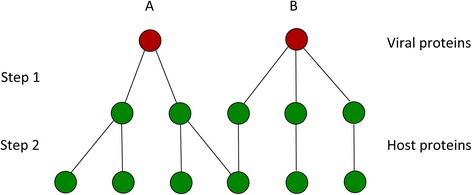
Figure 1
Figure 1
Examples of steps of interactions. Step is the measure used to define distance between proteins. In this example A would establish 2 interactions in step 1 and 4 in step 2. B has 3 in step 1 and 3 in step 2.
Figure 2
Figure 2
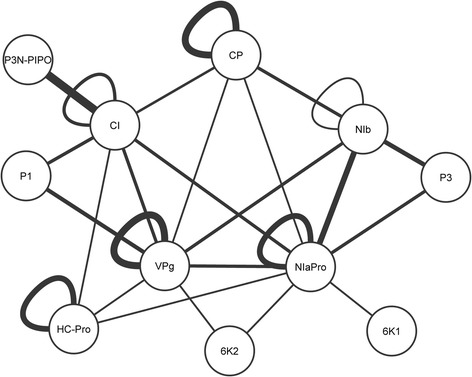
Global interaction network. Visual representation of the most relevant protein-protein interactions in the Potyvirus genus.
Figure 3
Figure 3
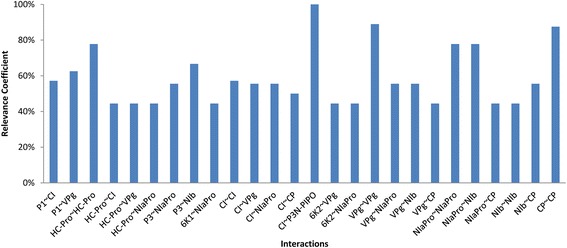
Relevance coefficient of all interactions of the global interaction network.
Figure 4
Figure 4
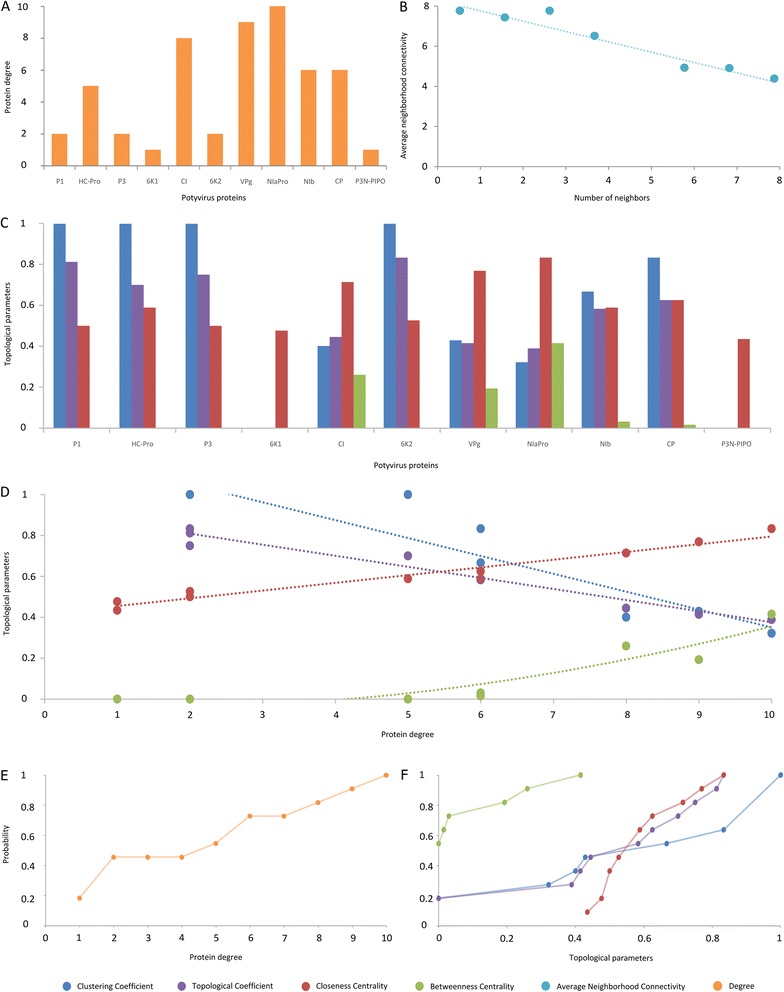
Protein connectivity and topological analysis of the global interaction network (GLIN). (A) Degree of each potyvirus protein. (B) Average neighborhood connectivity distribution. (C) Topological parameters of each protein. (D) Topological parameters of proteins related with their degree. 6 K1 and P3N-PIPO data for the clustering and topological coefficients were removed from the representation (commented in the text). (E) Degree cumulative probability distribution. It shows the probability that a protein has a determined degree or lower. (F) Cumulative probability distribution of topological parameters.
Figure 5
Figure 5
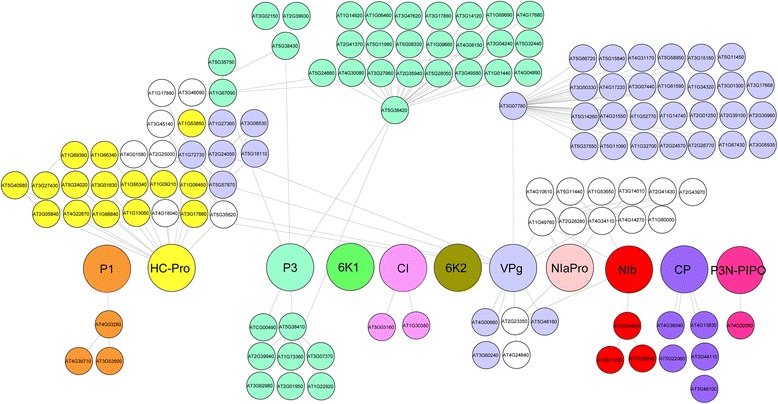
Potyvirus - A. thaliana VHPI network (VHPIN). Proteins and their host neighbors are grouped by colors. White color is assigned to host proteins connected to several viral proteins during the same step. For instance, host protein At2G23350 (located just below VPg protein) is represented white because is linked directly to two different viral proteins: VPg and NIb.
Figure 6
Figure 6
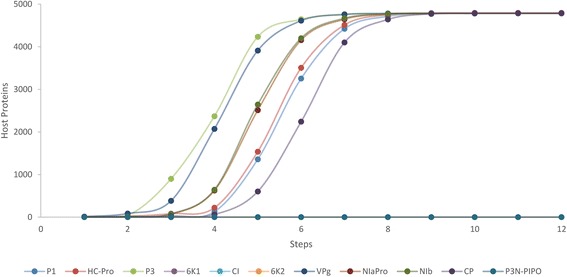
A. thaliana interactome coverage. It shows the protein-protein interactions occurring from each potyvirus protein and going across the whole plant network.
Figure 7
Figure 7
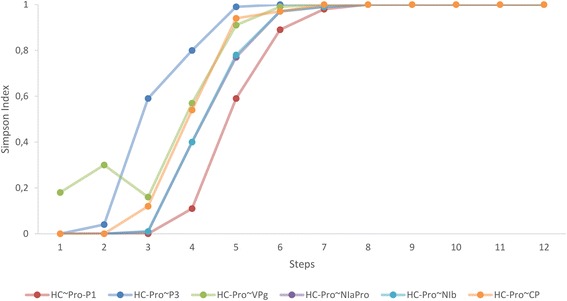
Simpson index evolution for HC-Pro. All possible combinations between HC-Pro and other viral proteins that propagate through the network. Differences in speed and shape of the spreading patterns for each pair can be easily observed. Straight lines link the values of the SI for each step representing how it varies while the protein pair effect propagates through the network.
Figure 8
Figure 8
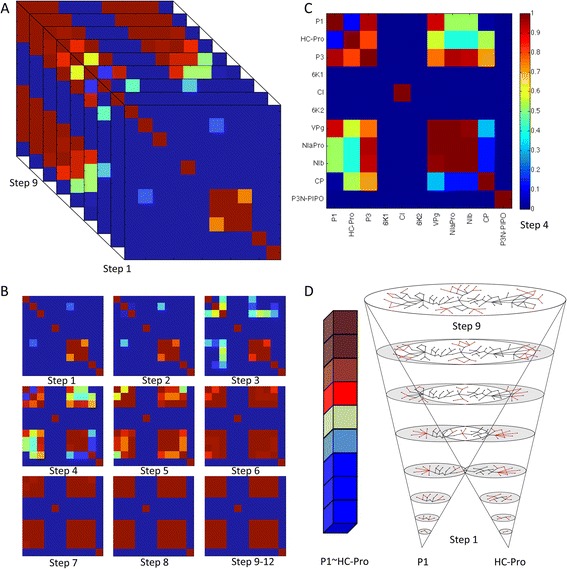
Voxel representation of the Simpson index. (A) Voxel representation of the Simpson index for the viral proteins across the HHPIN. (B) Consecutive pixel representations of the SI for the twelve steps that form the HHPIN. (C) Pixel representation for step 4. Viral proteins are shown in X and Y axes and relevance coefficient color legend is displayed on the right side vertical axis. (D) Evolution of the SI for the P1 ~ HC-Pro interaction across the entire HHPIN. A schematic cone of possible interactions is displayed as well to visually represent the networks growing from the viral proteins (step 1) until the end of the HHPIN.

References

    1. Gibbs A, Ohshima K. Potyviruses and the digital revolution. Annu Rev Phytopathol. 2010;48:205–223. doi: 10.1146/annurev-phyto-073009-114404. - DOI - PubMed
    1. Spence NJ, Phiri NA, Hughes SL, Mwaniki A, Simons S, Oduor G, Chacha D, Kuria A, Ndirangu S, Kibata GN, Marris GC. Economic impact of turnip mosaic virus, cauliflower mosaic virus and beet mosaic virus in three Kenyan vegetables. Plant Pathol. 2007;56:317–323. doi: 10.1111/j.1365-3059.2006.01498.x. - DOI
    1. Ward CW, Shukla DD. Taxonomy of potyviruses: current problems and some solutions. Intervirology. 1991;32:269–296. - PubMed
    1. Riechmann JL, Laín S, García JA. Highlights and prospects of potyvirus molecular biology. J Gen Virol. 1992;73(Pt 1):1–16. doi: 10.1099/0022-1317-73-1-1. - DOI - PubMed
    1. Elena SF, Rodrigo G. Towards an integrated molecular model of plant–virus interactions. Curr Opin Virol. 2012;2:719–724. doi: 10.1016/j.coviro.2012.09.004. - DOI - PubMed

Publication types

MeSH terms

Substances