Utility of the combination of serum highly-sensitive C-reactive protein level at discharge and a risk index in predicting readmission for acute exacerbation of COPD
- PMID: 25410837
- PMCID: PMC4263330
- DOI: 10.1590/s1806-37132014000500005
Utility of the combination of serum highly-sensitive C-reactive protein level at discharge and a risk index in predicting readmission for acute exacerbation of COPD
Abstract
Objective: Frequent readmissions for acute exacerbations of COPD (AECOPD) are an independent risk factor for increased mortality and use of health-care resources. Disease severity and C-reactive protein (CRP) level are validated predictors of long-term prognosis in such patients. This study investigated the utility of combining serum CRP level with the Global Initiative for Chronic Obstructive Lung Disease (GOLD) exacerbation risk classification for predicting readmission for AECOPD.
Methods: This was a prospective observational study of consecutive patients hospitalized for AECOPD at Peking University Third Hospital, in Beijing, China. We assessed patient age; gender; smoking status and history (pack-years); lung function; AECOPD frequency during the last year; quality of life; GOLD risk category (A-D; D indicating the greatest risk); and serum level of high-sensitivity CRP at discharge (hsCRP-D).
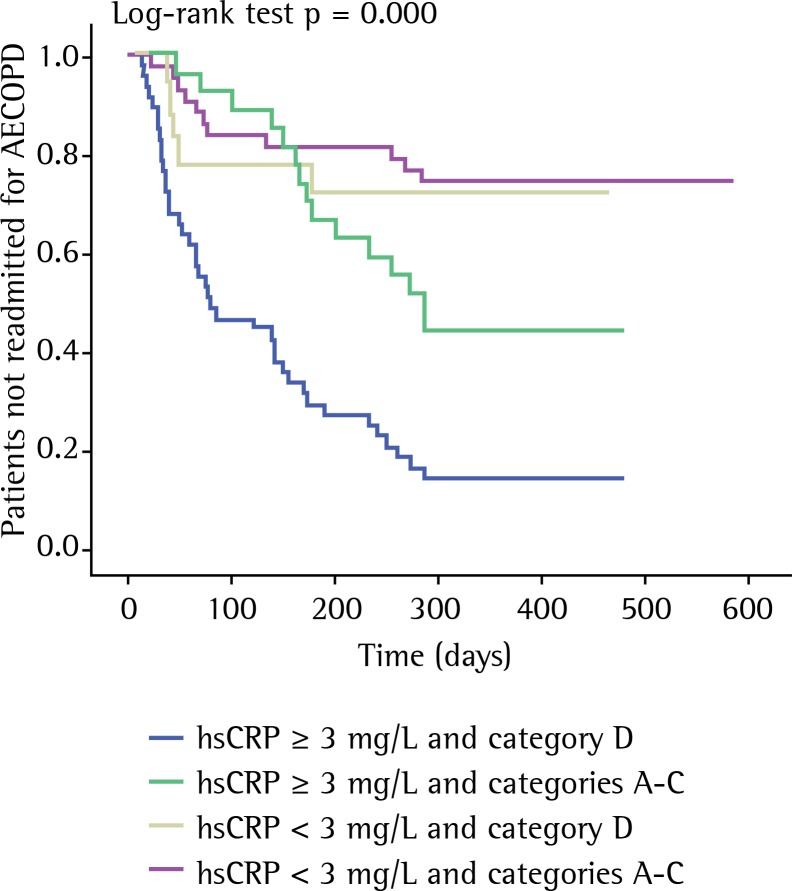
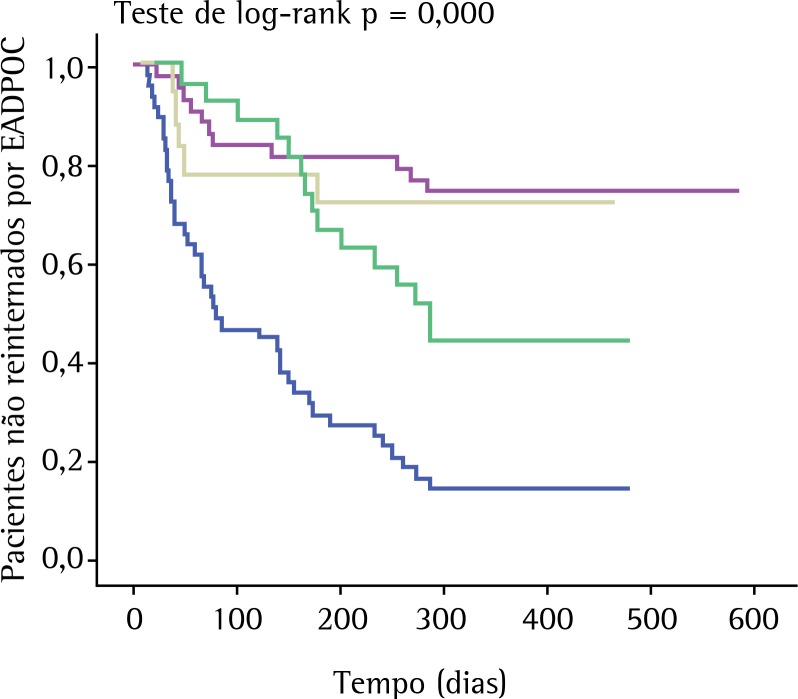
Results: The final sample comprised 135 patients. Of those, 71 (52.6%) were readmitted at least once during the 12-month follow-up period. The median (interquartile) time to readmission was 78 days (42-178 days). Multivariate analysis revealed that serum hsCRP-D ≥ 3 mg/L and GOLD category D were independent predictors of readmission (hazard ratio = 3.486; 95% CI: 1.968-6.175; p < 0.001 and hazard ratio = 2.201; 95% CI: 1.342-3.610; p = 0.002, respectively). The ordering of the factor combinations by cumulative readmission risk, from highest to lowest, was as follows: hsCRP-D ≥ 3 mg/L and GOLD category D; hsCRP-D ≥ 3 mg/L and GOLD categories A-C; hsCRP-D < 3 mg/L and GOLD category D; hsCRP-D < 3 mg/L and GOLD categories A-C.
Conclusions: Serum hsCRP-D and GOLD classification are independent predictors of readmission for AECOPD, and their predictive value increases when they are used in combination.
Figures
References
-
- Global Initiative for Chronic Obstructive Lung Disease . Global strategy for the diagnosis, management, and prevention of chronic obstructive pulmonary disease. Bethesda: Global Initiative for Chronic Obstructive Lung Disease; 2011. - PubMed
-
- Halpern MT, Stanford RH, Borker R. The burden of COPD in the U.S.A.: results from the Confronting COPD survey. Respir Med. 2003;97 Suppl C:S81–S89. http://dx.doi.org/10.1016/S0954-6111(03)80028-8 - DOI - PubMed
-
- Garcia-Aymerich J, Farrero E, Felez MA, Izquierdo J, Marrades RM, Anto JM, et al. Risk factors of readmission to hospital for a COPD exacerbation: a prospective study. Thorax. 2003;58(2):100–105. http://dx.doi.org/10.1136/thorax.58.2.100 - DOI - PMC - PubMed
-
- Soler-Cataluna JJ, Martinez-Garcia MA, Roman Sanchez P, Salcedo E, Navarro M, Ochando R. Severe acute exacerbations and mortality in patients with chronic obstructive pulmonary disease. Thorax. 2005;60(11):925–931. http://dx.doi.org/10.1136/thx.2005.040527 - DOI - PMC - PubMed
-
- Roberts CM, Lowe D, Bucknall CE, Ryland I, Kelly Y, Pearson MG. Clinical audit indicators of outcome following admission to hospital with acute exacerbation of chronic obstructive pulmonary disease. Thorax. 2002;57(2):137–141. http://dx.doi.org/10.1136/thorax.57.2.137 - DOI - PMC - PubMed
Publication types
MeSH terms
Substances
LinkOut - more resources
Full Text Sources
Other Literature Sources
Medical
Research Materials
Miscellaneous