Review
. 2015 Jan;92(1):25.
doi: 10.1095/biolreprod.114.121368. Epub 2014 Nov 19.

Dynamic reciprocity between cells and their microenvironment in reproduction

Affiliations
Review

Dynamic reciprocity between cells and their microenvironment in reproduction

Jeffrey T Thorne et al. Biol Reprod. 2015 Jan.

Abstract

Dynamic reciprocity (DR) refers to the ongoing, bidirectional interaction between cells and their microenvironment, specifically the extracellular matrix (ECM). The continuous remodeling of the ECM exerts mechanical force on cells and modifies biochemical mediators near the cell membrane, thereby initiating cell-signaling cascades that produce changes in gene expression and cell behavior. Cellular changes, in turn, affect the composition and organization of ECM components. These continuous interactions are the fundamental principle behind DR, and its critical role throughout development and adult tissue homeostasis has been extensively investigated. While DR in the mammary gland has been well described, we provide direct evidence that similar dynamic interactions occur in other areas of reproductive biology as well. In order to establish the importance of DR in the adaptive functioning of the female reproductive tract, we present our most current understanding of DR in reproductive tissues, exploring the mammary gland, ovary, and uterus. In addition to explaining normal physiological function, investigating DR may shed new light into pathologic processes that occur in these tissues and provide an exciting opportunity for novel therapeutic intervention.

Keywords: breast; dynamic reciprocity (DR); extracellular matrix (ECM); fibroids; folliculogenesis; mechanotransduction (MT); ovary; ovulation; pathogenesis; uterine leiomyoma.


Figures

FIG. 1
FIG. 1
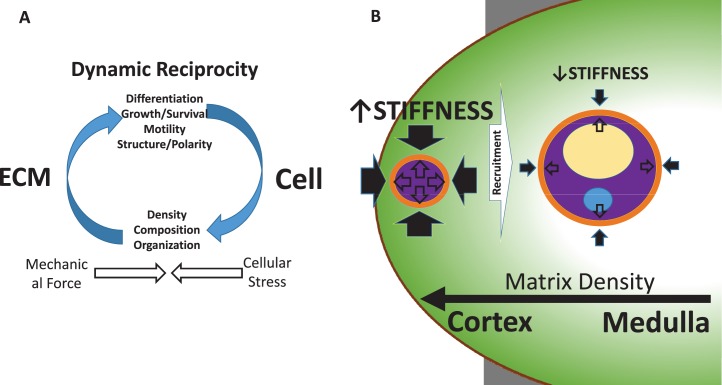
A) Schematic diagram of the bidirectional interaction between the cell and its environment, specifically the ECM, demonstrating the concept of DR. Mechanical force from the ECM is sensed by the cell and leads to changes in cell structure and function. These changes, in combination with mechanical signaling, can alter gene expression and epigenetic remodeling of the cell nucleus, leading to changes in ECM content, composition, and organization and an overall remodeling of the matrix. Cells sense the mechanical force and counter it with intracellular contractile tension, creating cellular stress. In this manner, force-generated mechanochemical signaling affects both the cell and its environment. B) An example of DR in folliculogenesis. Mechanical forces (closed arrows) in the stiff outer ovarian cortex act on the primordial follicle, contributing to its quiescent state. Tensional forces (open arrows) within the follicle counter this. Recruitment to the more pliable inner medulla relieves the mechanical strain and permits the follicle to proceed through folliculogenesis. Factors that determine progression from the cortex to the medulla are unknown. Arrow size is proportional to the amount of perceived force.
FIG. 2
FIG. 2
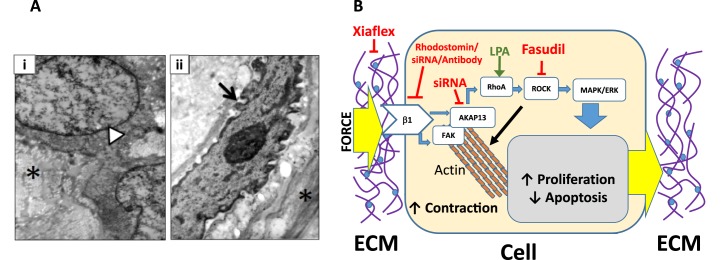
A) Electron microscopy images of myometrial and fibroid tissue. i) Normal myometrial SMC with a large, smooth nucleus (white arrow head), surrounded by tightly packed, organized collagen fibrils (asterisk) seen in cross-section. Original magnification ×11 500 (adjusted to magnification ×15 500 for image). ii) Image of a myofibroblast from a uterine fibroid. Note the angular and notched nucleus (black arrow) and condensed chromatin within the nucleus. Extracellular matrix features disordered collagen fibrils in the fibroid tissue (asterisk). Magnification ×15 500. B) A schematic representation of DR in fibroid cells. Mechanical stress is sensed by the fibroid cell that internalizes the signal and changes how the cell interacts with the ECM, altering the composition and organization of the external microenvironment. Integrin β1 signals the stiffness of the ECM, leading to activation of downstream-signaling events. FAK initiates actin polymerization resulting in cell contraction. AKAP13 activates RhoA, which in turn interacts with ROCK and activates the MAPK/ERK-signaling cascade, resulting in changes in cell proliferation, decreased apoptosis, and upregulation of genes involved in ECM composition and remodeling. Agents that perturb/stimulate the pathway are also listed (see text for explanation).

References

    1. Leppert PC. Tissue remodeling in the female reproductive tract—a complex process becomes more complex: the role of Hox genes Biol Reprod 2012. 86 98. - PubMed
    1. Leppert PC, Yu SY. Apoptosis in the cervix of pregnant rats in association with cervical softening. Gynecol Obstet Invest. 1994;37:150–154. - PubMed
    1. Takamoto N, Leppert PC, Yu SY. Cell death and proliferation and its relation to collagen degradation in uterine involution of rat. Connect Tissue Res. 1998;37:163–175. - PubMed
    1. Woessner JF, Brewer TH. Formation and breakdown of collagen and elastic in the human uterus during pregnancy and postpartum involution. Biochem J. 1963;89:75–82. - PMC - PubMed
    1. Bissell MJ, Hall HG, Parry G. How does the extracellular matrix direct gene expression? J Theor Biol. 1982;99:31–68. - PubMed

Publication types