. 2014 Nov 12;14(1):115.
doi: 10.1186/s12935-014-0115-7. eCollection 2014.

Cancer genomic research at the crossroads: realizing the changing genetic landscape as intratumoral spatial and temporal heterogeneity becomes a confounding factor

Affiliations

Cancer genomic research at the crossroads: realizing the changing genetic landscape as intratumoral spatial and temporal heterogeneity becomes a confounding factor

Shengwen Calvin Li et al. Cancer Cell Int. .

Abstract

The US National Cancer Institute (NCI) and the National Human Genome Research Institute (NHGRI) created the Cancer Genome Atlas (TCGA) Project in 2006. The TCGA's goal was to sequence the genomes of 10,000 tumors to identify common genetic changes among different types of tumors for developing genetic-based treatments. TCGA offered great potential for cancer patients, but in reality has little impact on clinical applications. Recent reports place the past TCGA approach of testing a small tumor mass at a single time-point at a crossroads. This crossroads presents us with the conundrum of whether we should sequence more tumors or obtain multiple biopsies from each individual tumor at different time points. Sequencing more tumors with the past TCGA approach of single time-point sampling can neither capture the heterogeneity between different parts of the same tumor nor catch the heterogeneity that occurs as a function of time, error rates, and random drift. Obtaining multiple biopsies from each individual tumor presents multiple logistical and financial challenges. Here, we review current literature and rethink the utility and application of the TCGA approach. We discuss that the TCGA-led catalogue may provide insights into studying the functional significance of oncogenic genes in reference to non-cancer genetic background. Different methods to enhance identifying cancer targets, such as single cell technology, real time imaging of cancer cells with a biological global positioning system, and cross-referencing big data sets, are offered as ways to address sampling discrepancies in the face of tumor heterogeneity. We predict that TCGA landmarks may prove far more useful for cancer prevention than for cancer diagnosis and treatment when considering the effect of non-cancer genes and the normal genetic background on tumor microenvironment. Cancer prevention can be better realized once we understand how therapy affects the genetic makeup of cancer over time in a clinical setting. This may help create novel therapies for gene mutations that arise during a tumor's evolution from the selection pressure of treatment.


Figures
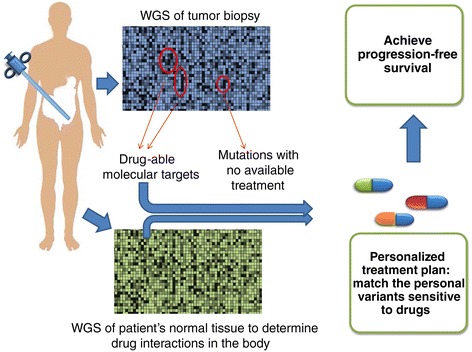
Figure 1
Figure 1
The genome doctor’s diagnostics and treatment flow chart. The genome sequencing comparison of the paired tissue samples of a patient’s cancer with the same patient’s normal healthy organ is thoroughly analyzed to determine the target-based and personalized profiles of cancer treatment and cancer management for a lifetime.
Figure 2
Figure 2
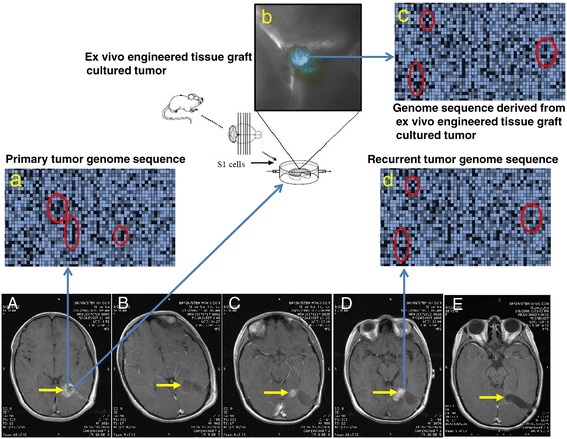
Co-evolution of tumor (primary versus recurrent) with therapeutic-modified microenvironment in-patient in parallel with an ex vivo engineered tissue graft cultured tumor for time-dependent changes. MRI images show that tumor diagnostics, resection, recurrence and yet another resection of a young female glioblastoma patient during treatment of surgery, radiation, and chemotherapy. (Yellow arrows: Tumor mass). A: pre-operation (post-biopsy), axial view showing diagnostics, and appearance of the tumor. B: Immediate postsurgery, axial view showing removal of the tumor. C: 3-month post-surgery, axial view showing recurrence of the tumor. D: 4-month post-surgery, axial view showing the growth of the recurrent tumor. E: second post-surgery and gamma knife, axial view showing removal of the tumor. Note that the genome sequence (a) obtained from the primary tumor (A) is compared with the genome sequence (d) obtained from the recurrent tumor (D) to determine the genetic mutations evolved under the therapeutic pressure. The genome sequence (d) obtained from the recurrent tumor (D) is compared with the genome sequence (c) derived from an ex vivo engineered tissue graft [91,99]-cultured tumor (b) to determine if the ex vivo models the genetic and epigenetic changes in-patient. Such a correlation, if established, can be used to predict the therapeutic-driven changes of intratumor spatial and temporal genetic and epigenetic information. Note that a mouse-derived ex vivo model may be replaced by using a patient-specific engineered tissue graft to screen for personalized treatment.
Figure 3
Figure 3
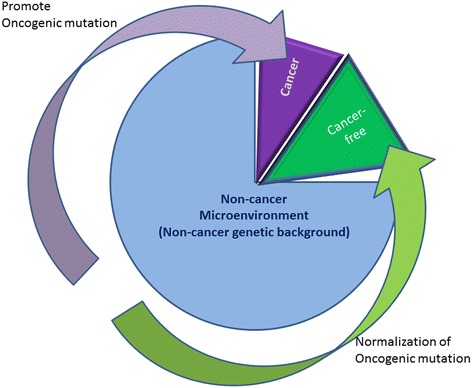
Effects of non-cancer genetic background (cancer microenvironment) on cancer initiation and progression. Certain patients (5% of population, e.g., Li-Fraumeni syndrome, p53, Retinoblastoma) always acquire cancer and certain patients (5% of population are cancer-free) exclude cancer. The rest 90% of population can undergo either cancer initiation or cancer-free depending on their non-genetic background because oncogenic mutation (cancer variant carriers) may not be sufficient to drive cancer initiation. The non-genetic background determines that certain patients are susceptible to cancer risk factors such as smoking, HPV, UV, food addiction, heavy metals, free radicals; these risk factors may initiate cancer for vulnerable patients. Management of these risk factors (related non-cancer genetic background) may either promote cancer or suppress cancer initiation – whole genome sequencing can help predict these risk factors thereby preventing cancer – the prevention can benefit the rest 90% population.

References

    1. Hanahan D, Coussens LM. Accessories to the crime: functions of cells recruited to the tumor microenvironment. Cancer Cell. 2012;21(3):309–322. doi: 10.1016/j.ccr.2012.02.022. - DOI - PubMed
    1. Hanauer DA, Rhodes DR, Sinha-Kumar C, Chinnaiyan AM. Bioinformatics approaches in the study of cancer. Curr Mol Med. 2007;7(1):133–141. doi: 10.2174/156652407779940431. - DOI - PubMed
    1. Heng HH. Cancer genome sequencing: the challenges ahead. Bioessays. 2007;29(8):783–794. doi: 10.1002/bies.20610. - DOI - PubMed
    1. LaFramboise T, Dewal N, Wilkins K, Pe’er I, Freedman ML. Allelic selection of amplicons in glioblastoma revealed by combining somatic and germline analysis. PLoS Genet. 2010;6(9):e1001086. doi: 10.1371/journal.pgen.1001086. - DOI - PMC - PubMed
    1. Gerlinger M, Rowan AJ, Horswell S, Larkin J, Endesfelder D, Gronroos E, Martinez P, Matthews N, Stewart A, Tarpey P, Varela I, Phillimore B, Begum S, McDonald NQ, Butler A, Jones D, Raine K, Latimer C, Santos CR, Nohadani M, Eklund AC, Spencer-Dene B, Clark G, Pickering L, Stamp G, Gore M, Szallasi Z, Downward J, Futreal PA, Swanton C. Intratumor heterogeneity and branched evolution revealed by multiregion sequencing. N Engl J Med. 2012;366(10):883–892. doi: 10.1056/NEJMoa1113205. - DOI - PMC - PubMed