Genetics, receptor binding property, and transmissibility in mammals of naturally isolated H9N2 Avian Influenza viruses
- PMID: 25411973
- PMCID: PMC4239090
- DOI: 10.1371/journal.ppat.1004508
Genetics, receptor binding property, and transmissibility in mammals of naturally isolated H9N2 Avian Influenza viruses
Erratum in
-
Correction: Genetics, Receptor Binding Property, and Transmissibility in Mammals of Naturally Isolated H9N2 Avian Influenza Viruses.PLoS Pathog. 2020 Jan 8;16(1):e1008284. doi: 10.1371/journal.ppat.1008284. eCollection 2020 Jan. PLoS Pathog. 2020. PMID: 31914139 Free PMC article.
Abstract
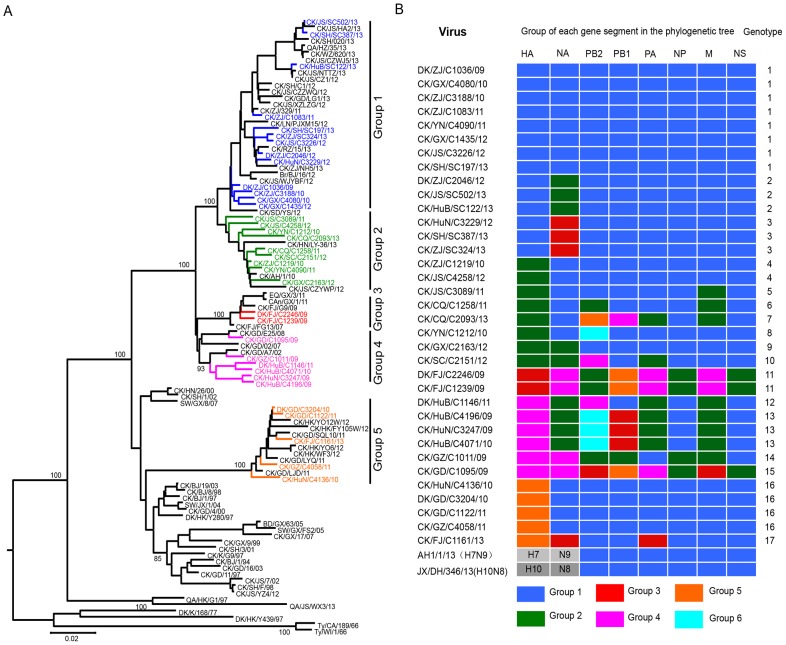
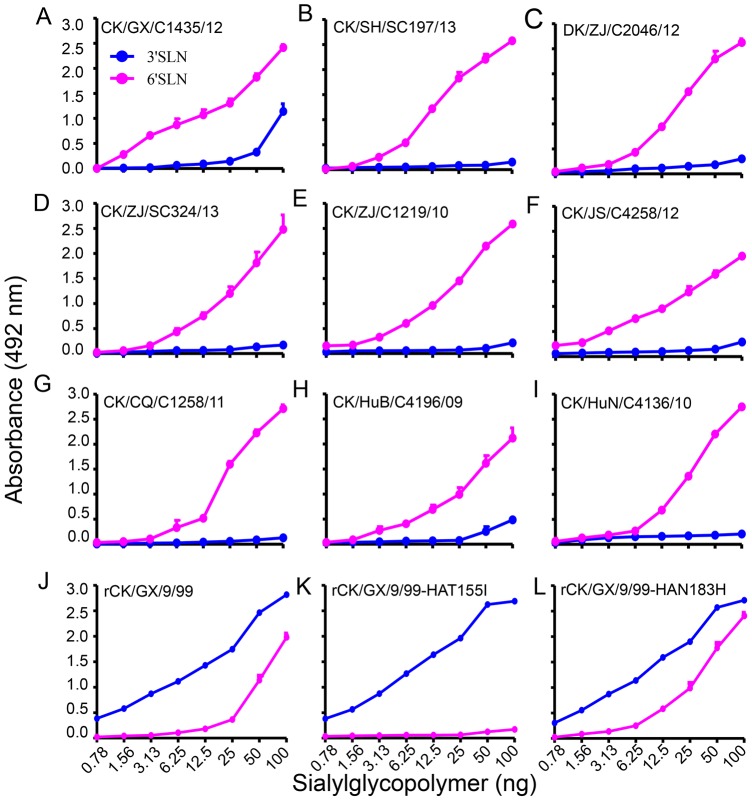
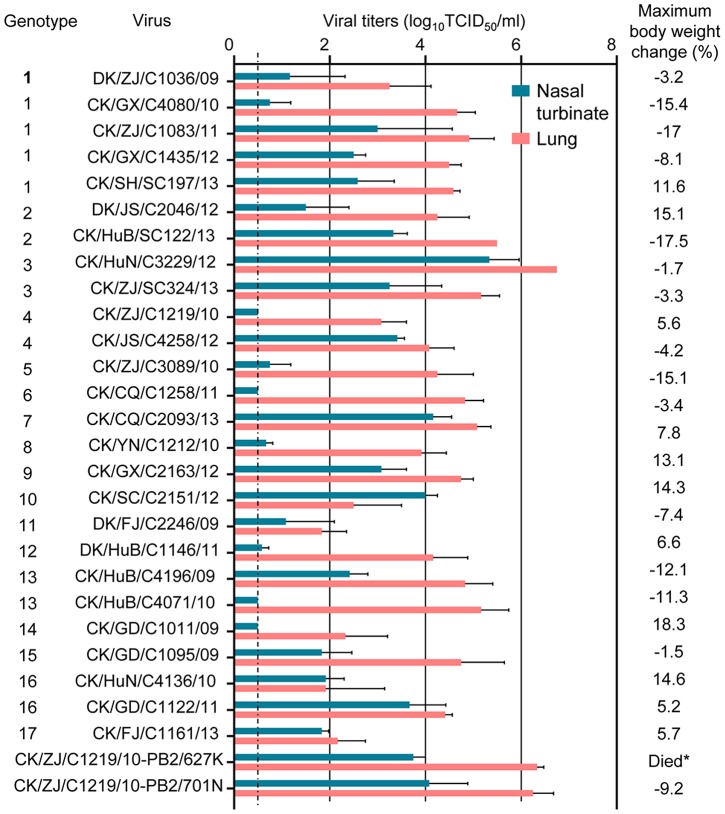
H9N2 subtype influenza viruses have been detected in different species of wild birds and domestic poultry in many countries for several decades. Because these viruses are of low pathogenicity in poultry, their eradication is not a priority for animal disease control in many countries, which has allowed them to continue to evolve and spread. Here, we characterized the genetic variation, receptor-binding specificity, replication capability, and transmission in mammals of a series of H9N2 influenza viruses that were detected in live poultry markets in southern China between 2009 and 2013. Thirty-five viruses represented 17 genotypes on the basis of genomic diversity, and one specific "internal-gene-combination" predominated among the H9N2 viruses. This gene combination was also present in the H7N9 and H10N8 viruses that have infected humans in China. All of the 35 viruses preferentially bound to the human-like receptor, although two also retained the ability to bind to the avian-like receptor. Six of nine viruses tested were transmissible in ferrets by respiratory droplet; two were highly transmissible. Some H9N2 viruses readily acquired the 627K or 701N mutation in their PB2 gene upon infection of ferrets, further enhancing their virulence and transmission in mammals. Our study indicates that the widespread dissemination of H9N2 viruses poses a threat to human health not only because of the potential of these viruses to cause an influenza pandemic, but also because they can function as "vehicles" to deliver different subtypes of influenza viruses from avian species to humans.
Conflict of interest statement
The authors have declared that no competing interests exist.
Figures


References
-
- WHO (2014) Cumulative number of confirmed human cases for avian influenza A (H5N1) reported to WHO, 2003–2014. Available: http://www.who.int/influenza/human_animal_interface/EN_GIP_20140124Cumul.... Accessed 24 January 2014.
-
- Zhang Y, Zhang Q, Kong H, Jiang Y, Gao Y, et al. (2013) H5N1 hybrid viruses bearing 2009/H1N1 virus genes transmit in guinea pigs by respiratory droplet. Science 340: 1459–1463. - PubMed
Publication types
MeSH terms
Associated data
- Actions
- Actions
- Actions
- Actions
- Actions
- Actions
- Actions
- Actions
- Actions
- Actions
- Actions
- Actions
- Actions
- Actions
- Actions
- Actions
- Actions
- Actions
- Actions
- Actions
- Actions
- Actions
- Actions
- Actions
- Actions
- Actions
- Actions
- Actions
- Actions
- Actions
- Actions
- Actions
- Actions
- Actions
- Actions
- Actions
- Actions
- Actions
- Actions
- Actions
- Actions
- Actions
- Actions
- Actions
- Actions
- Actions
- Actions
- Actions
- Actions
- Actions
- Actions
- Actions
- Actions
- Actions
- Actions
- Actions
- Actions
- Actions
- Actions
- Actions
- Actions
- Actions
- Actions
- Actions
- Actions
- Actions
- Actions
- Actions
- Actions
- Actions
- Actions
- Actions
- Actions
- Actions
- Actions
- Actions
- Actions
- Actions
- Actions
- Actions
- Actions
- Actions
- Actions
- Actions
- Actions
- Actions
- Actions
- Actions
- Actions
- Actions
- Actions
- Actions
- Actions
- Actions
- Actions
- Actions
- Actions
- Actions
- Actions
- Actions
- Actions
- Actions
- Actions
- Actions
- Actions
- Actions
- Actions
- Actions
- Actions
- Actions
- Actions
- Actions
- Actions
- Actions
- Actions
- Actions
- Actions
- Actions
- Actions
- Actions
- Actions
- Actions
- Actions
- Actions
- Actions
- Actions
- Actions
- Actions
- Actions
- Actions
- Actions
- Actions
- Actions
- Actions
- Actions
- Actions
- Actions
- Actions
- Actions
- Actions
- Actions
- Actions
- Actions
- Actions
- Actions
- Actions
- Actions
- Actions
- Actions
- Actions
- Actions
- Actions
- Actions
- Actions
- Actions
- Actions
- Actions
- Actions
- Actions
- Actions
- Actions
- Actions
- Actions
- Actions
- Actions
- Actions
- Actions
- Actions
- Actions
- Actions
- Actions
- Actions
- Actions
- Actions
- Actions
- Actions
- Actions
- Actions
- Actions
- Actions
- Actions
- Actions
- Actions
- Actions
- Actions
- Actions
- Actions
- Actions
- Actions
- Actions
- Actions
- Actions
- Actions
- Actions
- Actions
- Actions
- Actions
- Actions
- Actions
- Actions
- Actions
- Actions
- Actions
- Actions
- Actions
- Actions
- Actions
- Actions
- Actions
- Actions
- Actions
- Actions
- Actions
- Actions
- Actions
- Actions
- Actions
- Actions
- Actions
- Actions
- Actions
- Actions
- Actions
- Actions
- Actions
- Actions
- Actions
- Actions
- Actions
- Actions
- Actions
- Actions
- Actions
- Actions
- Actions
- Actions
- Actions
- Actions
- Actions
- Actions
- Actions
- Actions
- Actions
- Actions
- Actions
- Actions
- Actions
- Actions
- Actions
- Actions
- Actions
- Actions
- Actions
- Actions
- Actions
- Actions
- Actions
- Actions
- Actions
- Actions
- Actions
- Actions
- Actions
- Actions
- Actions
- Actions
- Actions
- Actions
- Actions
- Actions
- Actions
- Actions
- Actions
- Actions
- Actions
- Actions
- Actions
- Actions
- Actions
- Actions
LinkOut - more resources
Full Text Sources
Other Literature Sources
Medical