


Progress toward poliomyelitis eradication--Nigeria, January 2013-September 2014
- PMID: 25412063
- PMCID: PMC5779513
Progress toward poliomyelitis eradication--Nigeria, January 2013-September 2014
Abstract
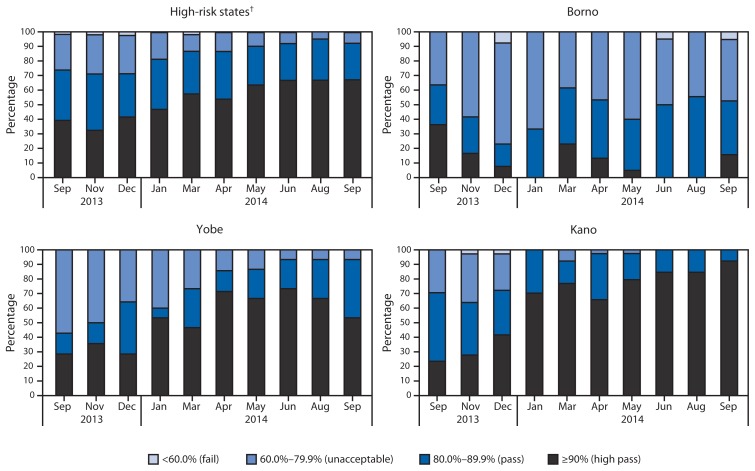
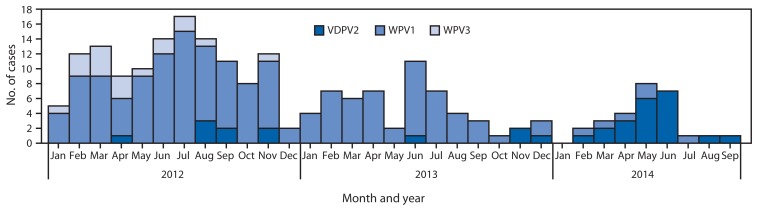
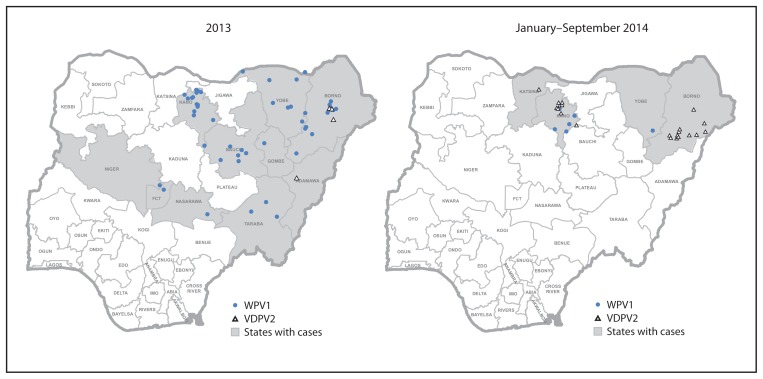
In 1988, the World Health Assembly resolved to interrupt wild poliovirus (WPV) transmission worldwide. By 2013, only three countries remained that had never interrupted WPV transmission: Afghanistan, Nigeria, and Pakistan. Since 2003, northern Nigeria has been a reservoir for WPV reintroduction into 26 previously polio-free countries. In May 2014, the World Health Organization declared the international spread of polio a Public Health Emergency of International Concern. Nigeria's main strategic goal is to interrupt WPV type 1 (WPV1) transmission by the end of 2014, which is also a main objective of the Global Polio Eradication Initiative's Polio Eradication and Endgame Strategic Plan for 2013-2018. This report updates previous reports (4-6) and describes polio eradication activities and progress in Nigeria during January 2013-September 30, 2014. Only six WPV cases had been reported in 2014 through September 30 compared with 49 reported cases during the same period in 2013. The quality of supplemental immunization activities (SIAs) improved during this period; the proportion of local government areas (LGAs) within 11 high-risk states with estimated oral poliovirus vaccine (OPV) campaign coverage at or above the 90% threshold increased from 36% to 67%. However, the number of reported circulating vaccine-derived poliovirus type 2 (cVDPV2) cases increased from four in 2013 to 21 to date in 2014, and surveillance gaps are suggested by genomic sequence analysis and continued detection of WPV1 by environmental surveillance. Interrupting all poliovirus circulation in Nigeria is achievable with continued attention to stopping cVDPV2 transmission, improving the quality of acute flaccid paralysis (AFP) surveillance, increasing vaccination coverage by strengthened routine immunization services, continuing support from all levels of government, and undertaking special initiatives to provide vaccination to children in conflict-affected areas in northeastern Nigeria.
Figures
References
-
- National Primary Healthcare Development Agency. Nigeria polio eradication emergency plan 2014. Abuja, Nigeria: National Primary Healthcare Development Agency; 2014. Available at http://www.polioeradication.org/Portals/0/Document/InfectedCountries/Nig....
-
- Global Polio Eradication Initiative. The polio eradication and endgame strategic plan 2013–2018. Geneva, Switzerland: 2013. Available at http://www.polioeradication.org/resourcelibrary/strategyandwork.aspx.
-
- CDC. Progress toward poliomyelitis eradication—Nigeria, January 2011–August 2012. MMWR Morb Mortal Wkly Rep. 2012;61:899–904. - PubMed
MeSH terms
Substances
Grants and funding
LinkOut - more resources
Full Text Sources
Medical
