


EdAl-2 (Educació en Alimentació) programme: reproducibility of a cluster randomised, interventional, primary-school-based study to induce healthier lifestyle activities in children
- PMID: 25412862
- PMCID: PMC4244435
- DOI: 10.1136/bmjopen-2014-005496
EdAl-2 (Educació en Alimentació) programme: reproducibility of a cluster randomised, interventional, primary-school-based study to induce healthier lifestyle activities in children
Abstract
Objectives: To assess the reproducibility of an educational intervention EdAl-2 (Educació en Alimentació) programme in 'Terres de l'Ebre' (Spain), over 22 months, to improve lifestyles, including diet and physical activity (PA).
Design: Reproduction of a cluster randomised controlled trial.
Setting: Two semi-rural town-group primary-school clusters were randomly assigned to the intervention or control group.
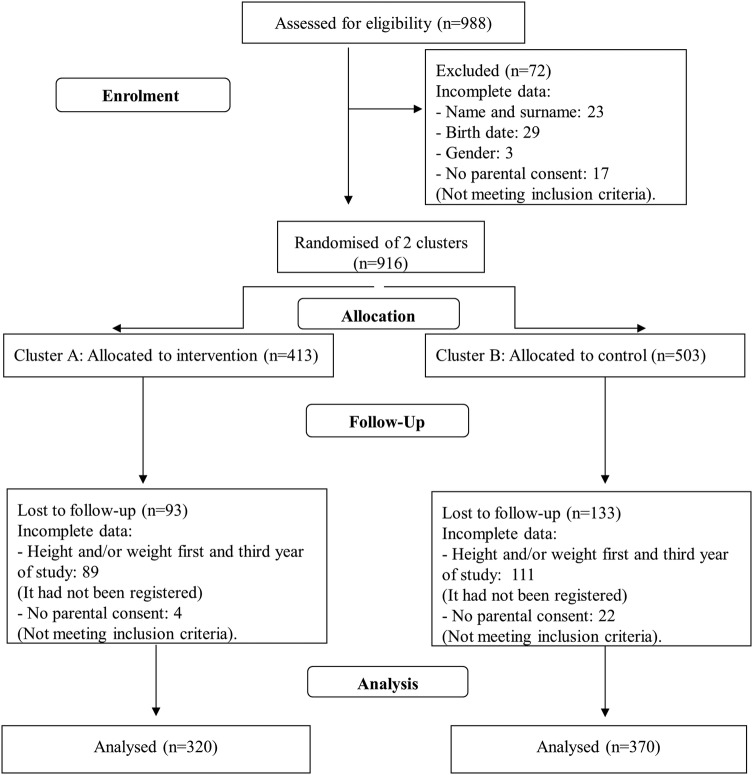
Participants: Pupils (n=690) of whom 320 constituted the intervention group (1 cluster) and 370 constituted the control group (1 cluster). Ethnicity was 78% Western European. The mean age (±SD) was 8.04±0.6 years (47.7% females) at baseline. Inclusion criteria for clusters were towns from the southern part of Catalonia having a minimum of 500 children aged 7-8 year; complete data for participants, including name, gender, date and place of birth, and written informed consent from parents or guardians.
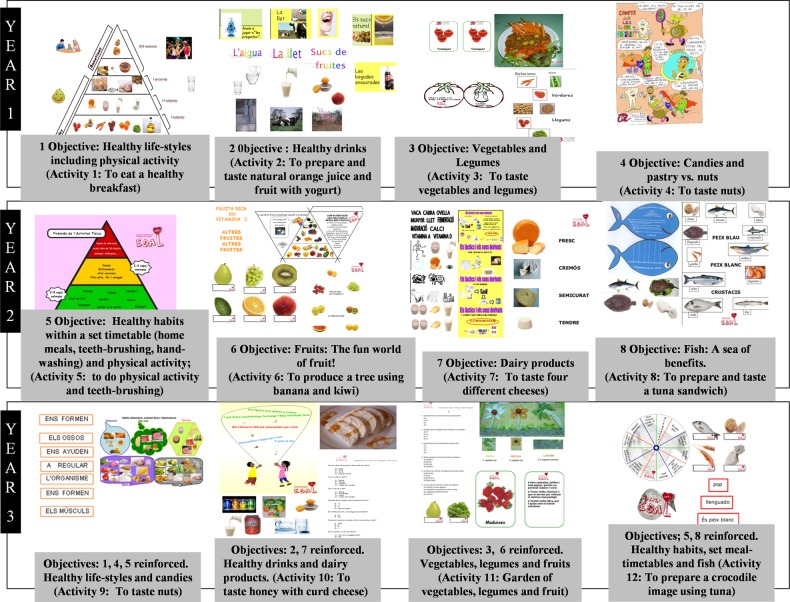
Intervention: The intervention focused on eight lifestyle topics covered in 12 activities (1 h/activity/session) implemented by health promoting agents in the primary school over three academic years.
Primary and secondary outcomes: The primary outcome was obesity (OB) prevalence and the secondary outcomes were body mass index (BMI) collected every year and dietary habits and lifestyles collected by questionnaires filled in by parents at baseline and end-of-study.
Results: At 22 months, the OB prevalence and BMI values were similar in intervention and control groups. Relative to children in control schools, the percentage of boys in the intervention group who performed ≥4 after-school PA h/week was 15% higher (p=0.027), whereas the percentage of girls in both groups remained similar. Also, 16.6% more boys in the intervention group watched ≤2 television (TV) h/day (p=0.009), compared to controls; and no changes were observed in girls in both groups.
Conclusions: Our school-based intervention is feasible and reproducible by increasing after-school PA (to ≥4 h/week) in boys. Despite this improvement, there was no change in BMI and prevalence of OB.
Trial registration number: Clinical Trials NCT01362023.
Keywords: PAEDIATRICS; PREVENTIVE MEDICINE; PRIMARY CARE; PUBLIC HEALTH.
Published by the BMJ Publishing Group Limited. For permission to use (where not already granted under a licence) please go to http://group.bmj.com/group/rights-licensing/permissions.
Figures
References
-
- Organización para la Cooperación y el Desarrollo Económicos (OCDE): Obesity update 2012.
-
- World Health Organization. The Challenge of obesity in the WHO European region and the strategies for response Denmark, 2007.
-
- Ahrens W, Bammann K, Siani A, et al. ; IDEFICS Consortium. The IDEFICS cohort: design, characteristics and participation in the baseline survey. Int J Obes (Lond) 2011;35(Suppl 1):S3–15. - PubMed
-
- Martos-Moreno GA, Argente J. Paediatric obesities: from childhood to adolescence. An Pediatr (Barc) 2011;75:63e1–23. - PubMed
Publication types
MeSH terms
Associated data
LinkOut - more resources
Full Text Sources
Other Literature Sources
Medical
Research Materials
Miscellaneous
