


Comprehensive breast reconstruction in an academic surgical practice: an evaluation of the financial impact
- PMID: 25415083
- PMCID: PMC4784958
- DOI: 10.1097/PRS.0000000000000757
Comprehensive breast reconstruction in an academic surgical practice: an evaluation of the financial impact
Abstract
Background: This study assessed the financial implications of providing all forms of breast reconstruction at a single academic institution with insurance as the primary mode of reimbursement.
Methods: Billing records of 152 patients who underwent postmastectomy breast reconstruction offered at the University of Michigan for the 2012 fiscal year were reviewed. Professional and facility revenue, cost, and earnings for the first stage of reconstruction were calculated by applying actual collections and charges. Similar financial data were compiled for a subset of 49 patients who went on to complete reconstruction.
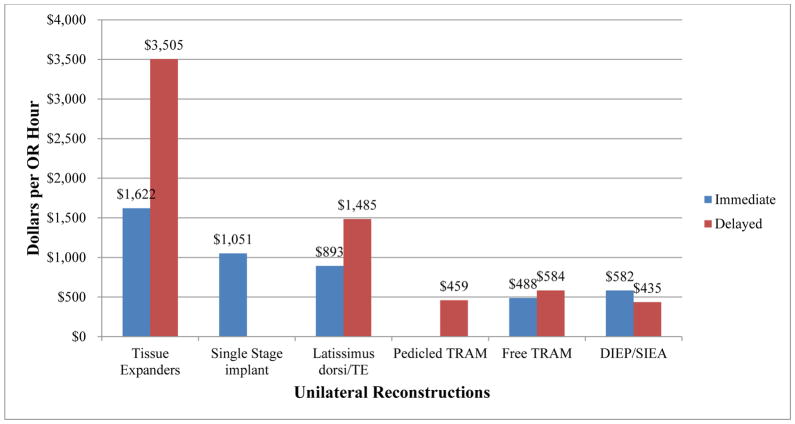
Results: The professional revenue and expenses allocated to breast reconstruction were $647,437 and $591,184, respectively (8.7 percent margin). Health care system facility revenue and costs were $2,762,797 and $2,773,131, respectively (-0.4 percent margin). Physician reimbursement by surgical time was highest for delayed tissue expander placement ($3505 per operating room hour). Abdominal free flap reconstructions resulted in greater professional revenue for the first stage of reconstruction ($7801 versus $2961) and for completed reconstructions ($14,943 versus $7703) relative to implant reconstructions. The facility also did better fiscally after the first stage of abdominally based reconstruction compared with implant reconstructions (10 percent versus -10.4 percent margin).
Conclusions: Postmastectomy breast reconstruction for this academic surgical practice remains fiscally profitable. Implant-based reconstruction compared with abdominal flap reconstruction produces greater revenue per operative hour but ultimately generates less total revenue and results in financial losses for the facility. Abdominally based perforator flap reconstruction reimbursed through standard insurance plans can be financially advantageous for the academic surgical practice and health care system.
Figures
Comment in
-
Understanding the Economic Value of Plastic Surgery to a Health Care System.Plast Reconstr Surg. 2015 Sep;136(3):408e-409e. doi: 10.1097/PRS.0000000000001520. Plast Reconstr Surg. 2015. PMID: 26034900 No abstract available.
References
-
- Jemal A, Siegel R, Xu J, Ward E. Cancer statistics, 2010. CA Cancer J Clin. 2010;60:277–300. - PubMed
-
- Hernandez-Boussard T, Zeidler K, Barzin A, Lee G, Curtin C. Breast reconstruction national trends and healthcare implications. Breast J. 2013;19:463–9. - PubMed
-
- Wilkins EG, Cederna PS, Lowery JC, et al. Prospective analysis of psychosocial outcomes in breast reconstruction: one-year postoperative results from the Michigan Breast Reconstruction Outcome Study. Plast Reconstr Surg. 2000;106:1014–25. discussion 26–7. - PubMed
-
- Stevens LA, McGrath MH, Druss RG, Kister SJ, Gump FE, Forde KA. The psychological impact of immediate breast reconstruction for women with early breast cancer. Plast Reconstr Surg. 1984;73:619–28. - PubMed
-
- Rowland JH, Holland JC, Chaglassian T, Kinne D. Psychological response to breast reconstruction. Expectations for and impact on postmastectomy functioning. Psychosomatics. 1993;34:241–50. - PubMed
Publication types
MeSH terms
Grants and funding
LinkOut - more resources
Full Text Sources
Other Literature Sources
Medical
