


Mitochondrial integrity in a neonatal bovine model of right ventricular dysfunction
- PMID: 25416385
- PMCID: PMC4338944
- DOI: 10.1152/ajplung.00270.2014
Mitochondrial integrity in a neonatal bovine model of right ventricular dysfunction
Abstract
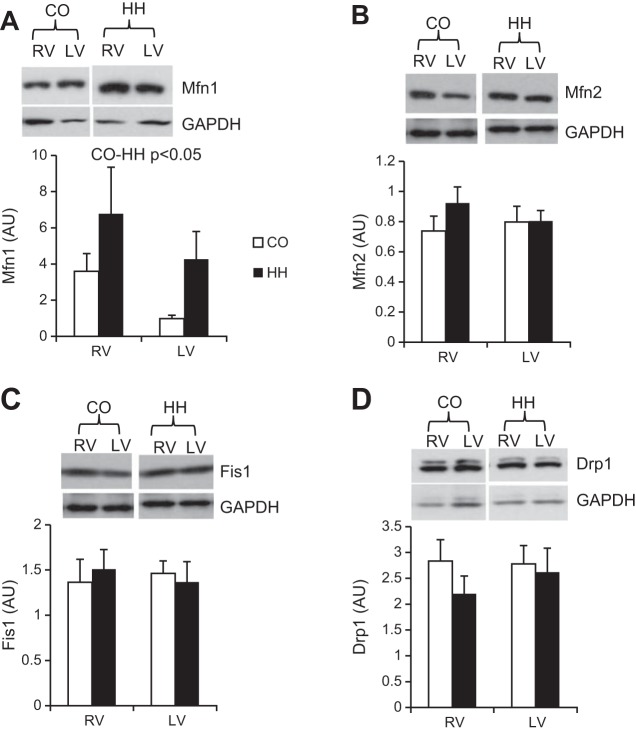
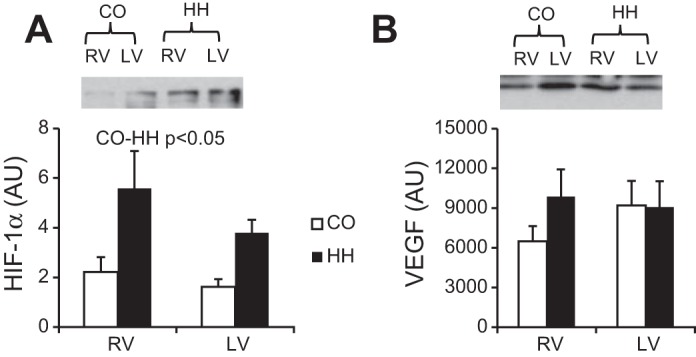
Right ventricular (RV) function is a key determinant of survival in patients with both RV and left ventricular (LV) failure, yet the mechanisms of RV failure are poorly understood. Recent studies suggest cardiac metabolism is altered in RV failure in pulmonary hypertension (PH). Accordingly, we assessed mitochondrial content, dynamics, and function in hearts from neonatal calves exposed to hypobaric hypoxia (HH). This model develops severe PH with concomitant RV hypertrophy, dilation, and dysfunction. After 2 wk of HH, pieces of RV and LV were obtained along with samples from age-matched controls. Comparison with control assesses the effect of hypoxia, whereas comparison between the LV and RV in HH assesses the additional impact of RV overload. Mitochondrial DNA was unchanged in HH, as was mitochondrial content as assessed by electron microscopy. Immunoblotting for electron transport chain subunits revealed a small increase in mitochondrial content in HH in both ventricles. Mitochondrial dynamics were largely unchanged. Activity of individual respiratory chain complexes was reduced (complex I) or unchanged (complex V) in HH. Key enzymes in the glycolysis pathway were upregulated in both HH ventricles, alongside upregulation of hypoxia-inducible factor-1α protein. Importantly, none of the changes in expression or activity were different between ventricles, suggesting the changes are in response to HH and not RV overload. Upregulation of glycolytic modulators without chamber-specific mitochondrial dysfunction suggests that mitochondrial capacity and activity are maintained at the onset of PH, and the early RV dysfunction in this model results from mechanisms independent of the mitochondria.
Keywords: cardiac; mitochondria; pulmonary hypertension; right ventricle.
Copyright © 2015 the American Physiological Society.
Figures



References
-
- Allard MF, Schonekess BO, Henning SL, English DR, Lopaschuk GD. Contribution of oxidative metabolism and glycolysis to ATP production in hypertrophied hearts. Am J Physiol Heart Circ Physiol 267: H742–H750, 1994. - PubMed
-
- Bakerman PR, Stenmark KR, Fisher JH. α-Skeletal actin mRNA increases in acute right ventricular hypertrophy. Am J Physiol Lung Cell Mol Physiol 258: L173–L178, 1990. - PubMed
-
- Beer M, Seyfarth T, Sandstede J, Landschutz W, Lipke C, Kostler H, von Kienlin M, Harre K, Hahn D, Neubauer S. Absolute concentrations of high-energy phosphate metabolites in normal, hypertrophied, and failing human myocardium measured noninvasively with (31)P-SLOOP magnetic resonance spectroscopy. J Am Coll Cardiol 40: 1267–1274, 2002. - PubMed
-
- Chandel NS, Schumacker PT. Cellular oxygen sensing by mitochondria: old questions, new insight. J Appl Physiol 88: 1880–1889, 2000. - PubMed
Publication types
MeSH terms
Substances
Grants and funding
LinkOut - more resources
Full Text Sources
Other Literature Sources
Medical
