Review
. 2014 Dec;35(12):1473-84.
doi: 10.1038/aps.2014.101. Epub 2014 Nov 24.

Translational toxicology and rescue strategies of the hERG channel dysfunction: biochemical and molecular mechanistic aspects

Affiliations
Review

Translational toxicology and rescue strategies of the hERG channel dysfunction: biochemical and molecular mechanistic aspects

Kai-ping Zhang et al. Acta Pharmacol Sin. 2014 Dec.

Abstract

The human ether-à-go-go related gene (hERG) potassium channel is an obligatory anti-target for drug development on account of its essential role in cardiac repolarization and its close association with arrhythmia. Diverse drugs have been removed from the market owing to their inhibitory activity on the hERG channel and their contribution to acquired long QT syndrome (LQTS). Moreover, mutations that cause hERG channel dysfunction may induce congenital LQTS. Recently, an increasing number of biochemical and molecular mechanisms underlying hERG-associated LQTS have been reported. In fact, numerous potential biochemical and molecular rescue strategies are hidden within the biogenesis and regulating network. So far, rescue strategies of hERG channel dysfunction and LQTS mainly include activators, blockers, and molecules that interfere with specific links and other mechanisms. The aim of this review is to discuss the rescue strategies based on hERG channel toxicology from the biochemical and molecular perspectives.


Figures
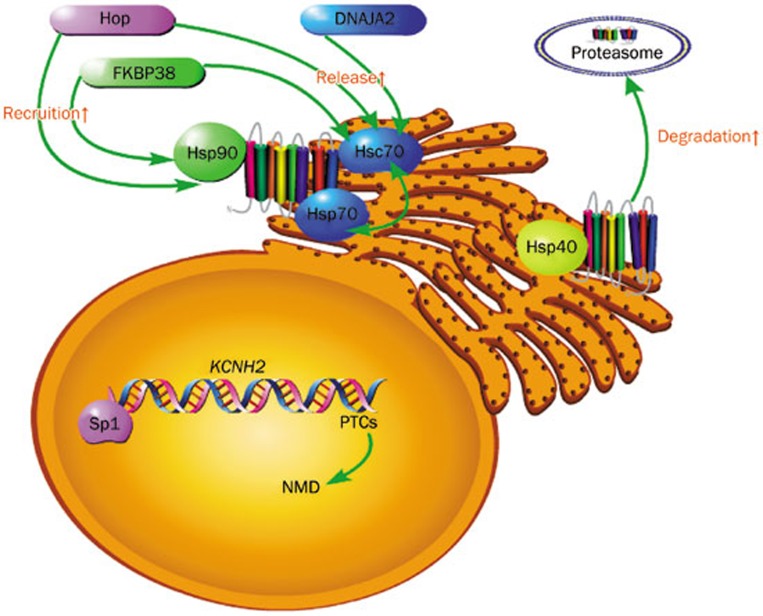
Figure 1
Figure 1
Biological regulations of hERG in nucleus and at ER. Transcription of the hERG channel (KCNH2 gene) is under the regulation of transcription factor Sp1 and the NMD mechanism. Hsc70 and Hsp70 at ER are responsible for early folding of hERG while Hsp90 in the cytoplasm is responsible for late folding. Hop, DNAJA2, and FKBP38 assist hERG release from Hsc70. Hop and FKBP38 aid hERG to recruit Hsp90 for its maturation. Hsp40 promotes degradation of hERG in the proteasome.
Figure 2
Figure 2
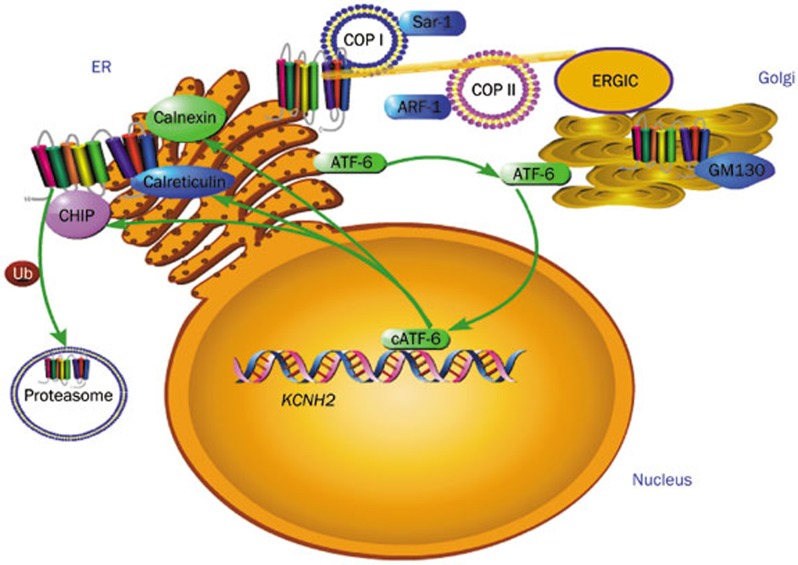
Quality control of hERG at ER. Normal hERG is coated in COPII (regulated by ARF-1) to forwardly traffick to the Golgi and interact with GM130. Abnormal hERG is coated in COPI (regulation by Sar-1) and backwardly trafficked to the ER; accumulation of abnormal hERG (especially unfolded hERG) will activate UPR; ATF-6 will shuffle from the ER to the Golgi, ATF-6 is cut to form cleaved-ATF-6 and to travel into the nucleus and upregulate calnexin and calreticulin to assist hERG folding; cATF-6 can, however, promote interaction between hERG and CHIP, then hERG is recognized and marked with ubiquitin to signal its degradation in the proteasome.
Figure 3
Figure 3
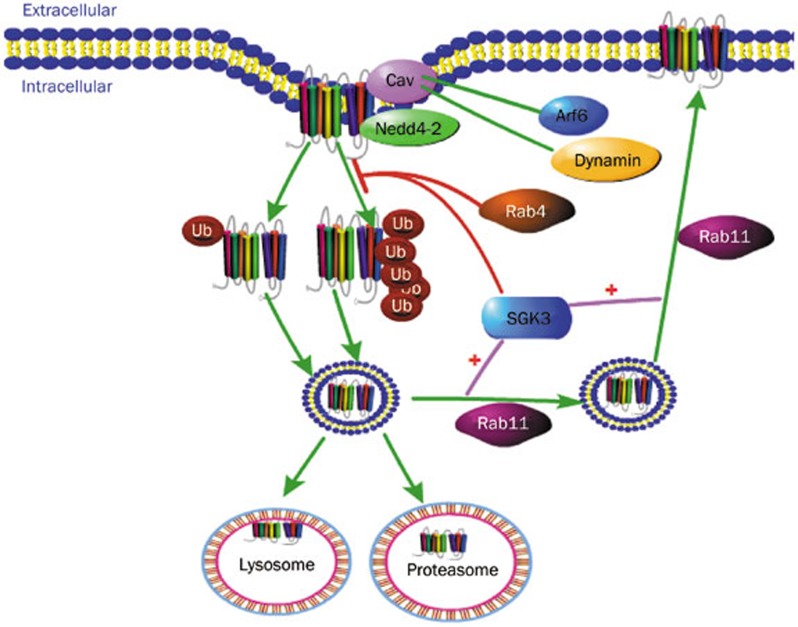
Endocytosis and recycling of hERG on cell membrane. Caveolin and Nedd4-2 both co-localize with hERG on the cell membrane. Instability of caveolin or Nedd4-2-dependent ubiquitination increases endocytosis of hERG. Caveolin-related endocytosis is Arf6-dependent and dynamin-dependent. Mono-ubiquitinized and multi-ubiquitinized hERG is degraded in the lysosome and proteasome, respectively. Rab11 promotes recyling of hERG back to cell membrane. Rab4 and SGK3 both decrease Nedd4-2-dependent ubiqtuination of hERG and SGK3 meanwhile promotes Rab11-dependent reclycing of hERG.
Figure 4
Figure 4
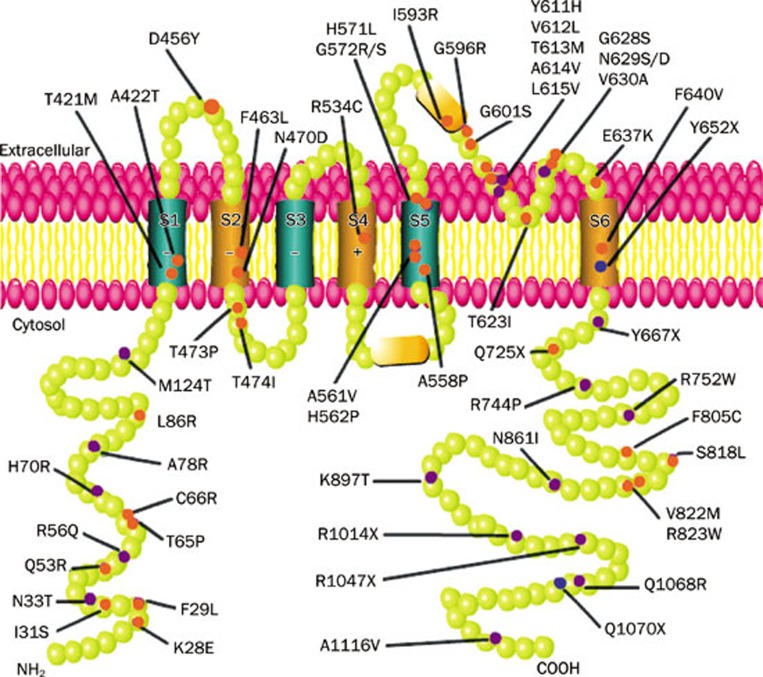
Schematics of LQT2 mutations. Each green ball represents an amino acid. Each purple, orange and blue point represents one mutation. In addition, the orange points represent mutations showing hERG channel trafficking deficiency and the blue points represent mutations being monitored by the NMD mechanism.

References

    1. Vandenberg JI, Perry MD, Perrin MJ, Mann SA, Ke Y, Hill AP. hERG K+ channels: structure, function, and clinical significance. Physiol Rev. 2012;92:1393–478. - PubMed
    1. Sanguinetii MC, Tristani-Firouzi M. hERG potassium channels and cardiac arrhythmia. Nature. 2006;440:463–9. - PubMed
    1. Babcock JJ, Li M. hERG channel function: beyond long QT. Acta Pharmacol Sin. 2013;34:329–35. - PMC - PubMed
    1. Warmke JW, Ganetzky B. A family of potassium channels genes related to eag in Drosophila and mamals. Proc Natl Acad Sci U S A. 1994;91:3438–43. - PMC - PubMed
    1. Sanguinetti MC, Jiang CG, Curran ME, Keating MT. A mechanistic link between an inherited and an acquired cardiac arrhythmia: HERG encodes the Ikr potassium channel. Cell. 1995;81:299–307. - PubMed

Publication types

MeSH terms

Substances

LinkOut - more resources