. 2014 Nov 7;15(11):490.
doi: 10.1186/s13059-014-0490-3.

Evolution of extensively drug-resistant Mycobacterium tuberculosis from a susceptible ancestor in a single patient

Evolution of extensively drug-resistant Mycobacterium tuberculosis from a susceptible ancestor in a single patient

Vegard Eldholm et al. Genome Biol. .

Abstract

Background: Mycobacterium tuberculosis is characterized by a low mutation rate and a lack of genetic recombination. Yet, the rise of extensively resistant strains paints a picture of a microbe with an impressive adaptive potential. Here we describe the first documented case of extensively drug-resistant tuberculosis evolved from a susceptible ancestor within a single patient.

Results: Genome sequences of nine serial M. tuberculosis isolates from the same patient uncovered a dramatic turnover of competing lineages driven by the emergence, and subsequent fixation or loss of single nucleotide polymorphisms. For most drugs, resistance arose through independent emergence of mutations in more than one clone, of which only one ultimately prevailed as the clone carrying it expanded, displacing the other clones in the process. The vast majority of mutations identified over 3.5 years were either involved in drug resistance or hitchhiking in the genetic background of these. Additionally, RNA-sequencing of isolates grown in the absence of drug challenge revealed that the efflux-associated iniBAC operon was up-regulated over time, whereas down-regulated genes include those involved in mycolic acid synthesis.

Conclusions: We observed both rapid acquisitions of resistance to antimicrobial compounds mediated by individual mutations as well as a gradual increase in fitness in the presence of antibiotics, likely driven by stable gene expression reprogramming. The rapid turnover of resistance mutations and hitchhiking neutral mutations has major implications for inferring tuberculosis transmission events in situations where drug resistance evolves within transmission chains.


Figures
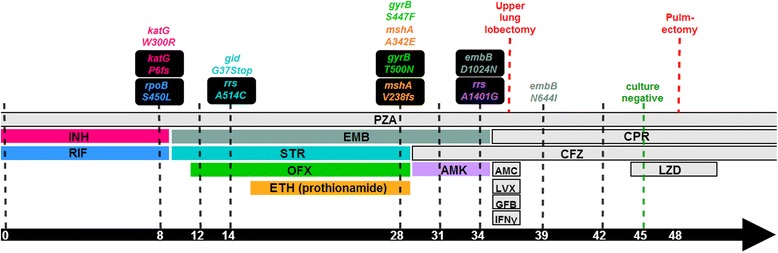
Figure 1
Figure 1
Time-line of clinical interventions and drug resistance acquisition. Drug regimen is indicated by horizontal bars. Black dashed lines indicate available clinical isolates. Above the dashed lines, the first instances of resistance-conferring mutations identified in the corresponding clinical isolates are indicated. The mutations are colored to match the drug to which it confers resistance. Black boxes indicate mutations that were ultimately fixed (>85% of reads in SF9), whereas non-boxed mutations indicate transient mutations. INH, isoniazid; RIF, rifampicin; PZA, pyrazinamide; EMB, ethambutol; STR, streptomycin; OFX, ofloxacin; ETH, ethionamide; CFZ, clofazimine; AMK, amikacin; AMC, amoxicillin/clavulanate; LVX, levofloxacin; GFB, gemfibrozil; IFNγ, gamma interferon; CPR, capreomycin; LZD, linezolid. Frameshift mutations are denoted as fs.
Figure 2
Figure 2
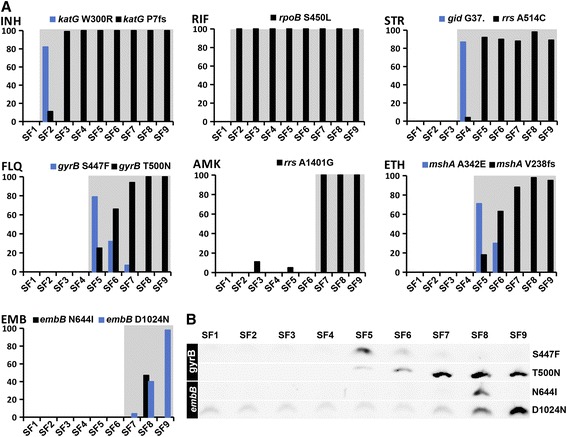
Frequency of resistance mutations in serial isolates. (A) Frequency of resistance mutations in sequencing reads from serial isolates. Grey background shading indicates that the isolate was resistant to the given drug on the BD BACTEC 460 platform using standard critical concentrations, with the exception of EMB where the shading indicates resistance at 2 μg/ml on the BD MGIT 960 platform (see main text for details). The FLQ resistant isolates were resistant to both ofloxacin and ciprofloxacin. (B) PCR verification of selected resistance mutations, separated and visualized on agarose gel.
Figure 3
Figure 3
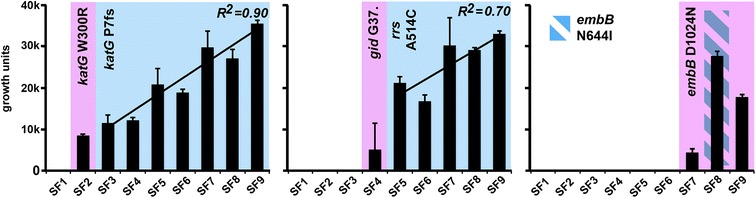
Growth efficiency in the presence of antibiotics of clinical isolates harboring different resistance mutations. Growth in antibiotics relative to untreated controls (from the left: INH, STR, EMB). See main text for details. Color shading indicates the specific resistance mutation present in each isolate. Isolate SF8 contains a mixture of two populations with two different embB mutations.
Figure 4
Figure 4
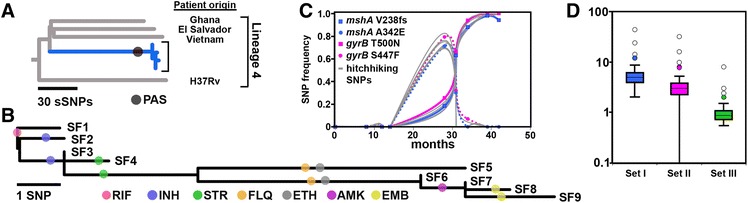
Intra-patient evolution and mutation rates. (A) Phylogenetic placement of patient isolates relative to the most closely related isolates from a global M. tuberculosis collection (46). A thyA P17L mutation possibly conferring para-aminosalicylic acid (PAS) resistance was acquired some time on the branch leading to the patient isolates. sSNP, synonymous SNP. (B) Detailed phylogeny of patient isolates with resistance-conferring mutations mapped on the branches. (C) Example of hitchhiking SNPs. Frequency of SNPs conferring resistance to FLQ (gyrB) and ETH (mshA) in sequencing reads over time (months) as well as hitchhiking SNPs (grey shading) with correlation coefficients >0.9 relative to any gyrB or mshA resistance SNP. (D) Box plot of calculated pairwise mutation rates per year between any pair of isolates using three different SNP exclusion criteria: Set I, all SNPs included; Set II, resistance mutations excluded; Set III, resistance mutations and hitchhiking SNPs excluded.
Figure 5
Figure 5
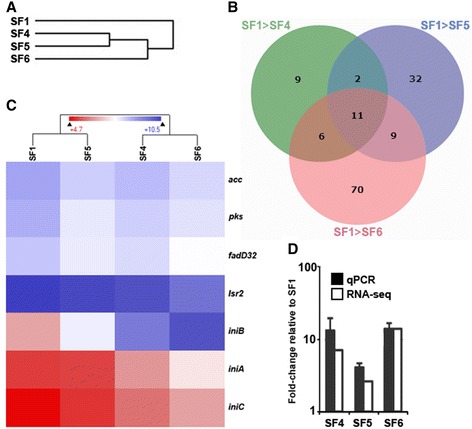
Differential gene expression in serial isolates. (A) Hierarchical clustering of total gene expression. (B) Venn diagram of differentially expressed genes in SF4, SF5 and SF6 relative to SF1. (C) Hierarchical clustering of interesting genes and operons (high and low expression indicated by blue and red coloring, respectively). (D) Fold change of iniB expression relative to SF1. qPCR, quantitative PCR.

References

    1. David HL. Probability distribution of drug-resistant mutants in unselected populations of Mycobacterium tuberculosis. Appl Microbiol. 1970;20:810–814. - PMC - PubMed
    1. Ford CB, Shah RR, Maeda MK, Gagneux S, Murray MB, Cohen T, Johnston JC, Gardy J, Lipsitch M, Fortune SM. Mycobacterium tuberculosis mutation rate estimates from different lineages predict substantial differences in the emergence of drug-resistant tuberculosis. Nat Genet. 2013;45:784–790. doi: 10.1038/ng.2656. - DOI - PMC - PubMed
    1. Klopper M, Warren RM, Hayes C, van Pittius NCG, Streicher EM, Müller B, Sirgel FA, Chabula-Nxiweni M, Hoosain E, Coetzee G, David van Helden P, Victor TC, Trollip AP. Emergence and spread of extensively and totally drug-resistant tuberculosis, South Africa. Emerg Infect Dis. 2013;19:449–455. doi: 10.3201/eid1903.120246. - DOI - PMC - PubMed
    1. Udwadia ZF, Amale RA, Ajbani KK, Rodrigues C. Totally drug-resistant tuberculosis in India. Clin Infect Dis. 2012;54:579–581. doi: 10.1093/cid/cir889. - DOI - PubMed
    1. WHO: Weekly Epidemiological Record No 45. Volume 81. 2006, 425–432 [http://www.who.int/wer/2006/wer8145/en/]

Publication types

MeSH terms

Substances