


Testing Set-Point Theory in a Swiss National Sample: Reaction and Adaptation to Major Life Events
- PMID: 25419036
- PMCID: PMC4235657
- DOI: 10.1007/s11205-013-0541-2
Testing Set-Point Theory in a Swiss National Sample: Reaction and Adaptation to Major Life Events
Abstract
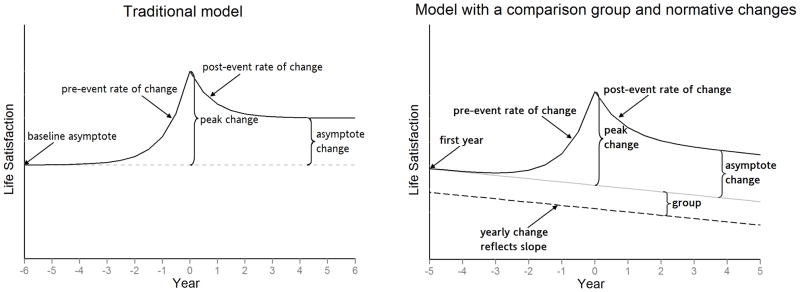
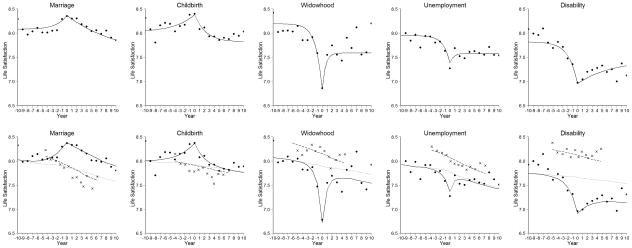
Set-point theory posits that individuals react to the experience of major life events, but quickly adapt back to pre-event baseline levels of subjective well-being in the years following the event. A large, nationally representative panel study of Swiss households was used to examine set-point theory by investigating the extent of adaptation following the experience of marriage, childbirth, widowhood, unemployment, and disability. Our results demonstrate that major life events are associated with marked change in life satisfaction and, for some events (e.g., marriage, disability), these changes are relatively long lasting even when accounting for normative, age related change.
Keywords: Swiss Household Panel; adaptation; happiness; life events; subjective well-being.
Figures
References
-
- Bates D, Maechler M. lme4: Linear mixed-effects models using S4 classes. 2010 R package version 0.999375-35 http://CRAN.R-project/package=lme4.
-
- Blanchflower DG, Oswald AJ. Is well-being U-shaped over the life cycle? Social Science & Medicine. 2008;66:1733–1749. - PubMed
-
- Boyce CJ, Wood AM. Personality prior to disability determines adaptation: Agreeable individuals recover lost life satisfaction faster and more completely. Psychological Science. 2011;22:1397–1402. - PubMed
-
- Boyce CJ, Wood AM, Brown GDA. The dark side of conscientiousness: Conscientious people experience greater drops in life satisfaction following unemployment. Journal of Research in Personality. 2010;44:535–539.
Grants and funding
LinkOut - more resources
Full Text Sources
Other Literature Sources