


Prevalence of mixed pathologies in the aging brain
- PMID: 25419243
- PMCID: PMC4239398
- DOI: 10.1186/s13195-014-0082-1
Prevalence of mixed pathologies in the aging brain
Abstract
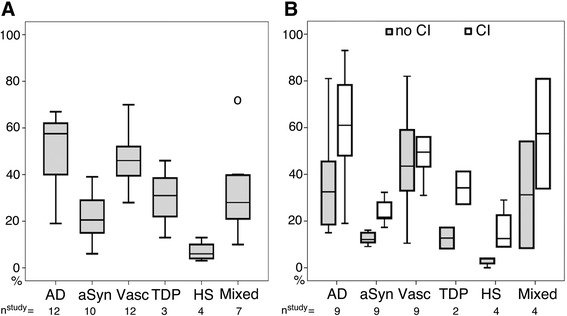
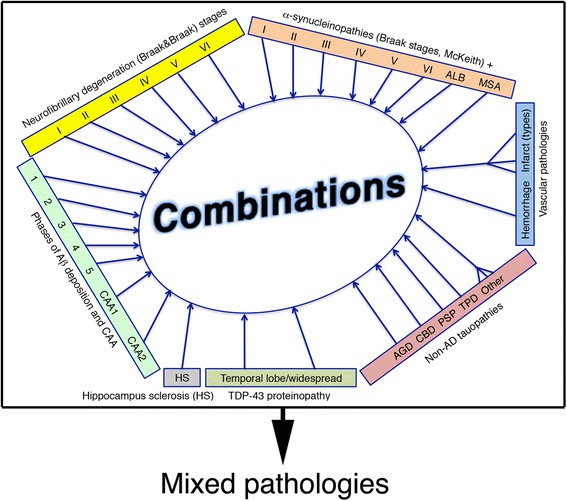
The spectrum of mixed brain pathologies expands beyond accompanying vascular pathology in brains with Alzheimer's disease-related pathology. Co-occurrence of neurodegenerative non-Alzheimer's disease-type proteinopathies is increasingly recognized to be a frequent event in the brains of symptomatic and asymptomatic patients, particularly in older people. Owing to the evolving concept of neurodegenerative diseases, clinical and neuropathological diagnostic criteria have changed during the last decades. Autopsy-based studies differ in the selection criteria and also in the applied staining methods used. The present review summarizes the prevalence of mixed brain pathologies reported in recent community-based studies. In these cohorts, irrespective of the clinical symptoms, the frequency of Alzheimer's disease-related pathology is between 19 and 67%, of Lewy body pathology is between 6 and 39%, of vascular pathologies is between 28 and 70%, of TDP-43 proteinopathy is between 13 and 46%, of hippocampal sclerosis is between 3 and 13% and, finally, of mixed pathologies is between 10 and 74%. Some studies also mention tauopathies. White-matter pathologies are not discussed specifically in all studies, although these lesions may be present in more than 80% of the aging brains. In summary, community-based neuropathology studies have shown that complex constellations of underlying pathologies may lead to cognitive decline, and that the number of possible combinations increases in the aging brain. These observations have implications for the prediction of the prognosis, for the development of biomarkers or therapy targets, or for the stratification of patient cohorts for genome-wide studies or, eventually, for therapy trials.
Figures
References
-
- Ahmed Z, Bigio EH, Budka H, Dickson DW, Ferrer I, Ghetti B, Giaccone G, Hatanpaa KJ, Holton JL, Josephs KA, Powers J, Spina S, Takahashi H, White CL, 3rd, Revesz T, Kovacs GG. Globular glial tauopathies (GGT): consensus recommendations. Acta Neuropathol. 2013;126:537–544. doi: 10.1007/s00401-013-1171-0. - DOI - PMC - PubMed
-
- Kovacs GG, Milenkovic I, Wohrer A, Hoftberger R, Gelpi E, Haberler C, Hönigschnabl S, Reiner-Concin A, Heinzl H, Jungwirth S, Krampla W, Fischer P, Budka H. Non-Alzheimer neurodegenerative pathologies and their combinations are more frequent than commonly believed in the elderly brain: a community-based autopsy series. Acta Neuropathol. 2013;126:365–384. doi: 10.1007/s00401-013-1157-y. - DOI - PubMed
LinkOut - more resources
Full Text Sources
Other Literature Sources
