


A pain research agenda for the 21st century
- PMID: 25419990
- PMCID: PMC4664454
- DOI: 10.1016/j.jpain.2014.09.004
A pain research agenda for the 21st century
Abstract
Chronic pain represents an immense clinical problem. With tens of millions of people in the United States alone suffering from the burden of debilitating chronic pain, there is a moral obligation to reduce this burden by improving the understanding of pain and treatment mechanisms, developing new therapies, optimizing and testing existing therapies, and improving access to evidence-based pain care. Here, we present a goal-oriented research agenda describing the American Pain Society's vision for pain research aimed at tackling the most pressing issues in the field.
Perspective: This article presents the American Pain Society's view of some of the most important research questions that need to be addressed to advance pain science and to improve care of patients with chronic pain.
Keywords: Chronic pain; pain education; pain research; pain treatment; research funding.
Copyright © 2014 American Pain Society. Published by Elsevier Inc. All rights reserved.
Conflict of interest statement
All other authors declare no relevant conflicts of interest.
Figures
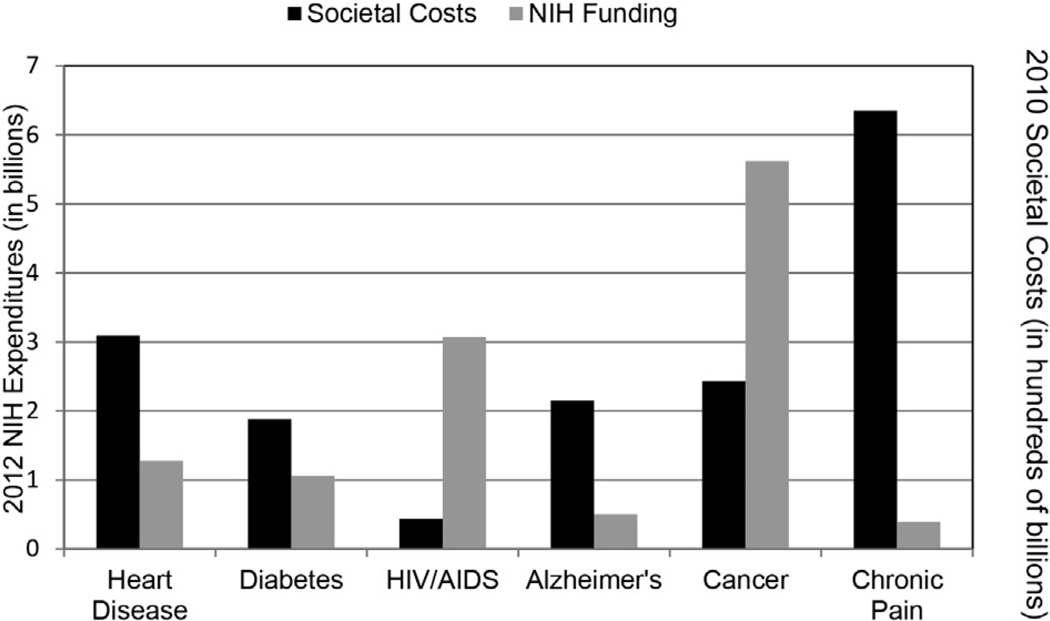
References
-
- Americans talk about pain. Available at: https://www.researchamerica.org/uploads/poll2003pain.pdf.
-
- Anand U, Facer P, Yiangou Y, Sinisi M, Fox M, McCarthy T, Bountra C, Korchev YE, Anand P. Angiotensin II type 2 receptor (AT2 R) localization and antagonist-mediated inhibition of capsaicin responses and neurite outgrowth in human and rat sensory neurons. Eur J Pain. 2013;17:1012–1026. - PMC - PubMed
-
- Anderson KO, Green CR, Payne R. Racial and ethnic disparities in pain: Causes and consequences of unequal care. J Pain. 2009;10:1187–1204. - PubMed
-
- Anttila V, Winsvold BS, Gormley P, Kurth T, Bettella F, McMahon G, Kallela M, Malik R, de Vries B, Terwindt G, Medland SE, Todt U, McArdle WL, Quaye L, Koiranen M, Ikram MA, Lehtimaki T, Stam AH, Ligthart L, Wedenoja J, Dunham I, Neale BM, Palta P, Hamalainen E, Schurks M, Rose LM, Buring JE, Ridker PM, Steinberg S, Stefansson H, Jakobsson F, Lawlor DA, Evans DM, Ring SM, Farkkila M, Artto V, Kaunisto MA, Freilinger T, Schoenen J, Frants RR, Pelzer N, Weller CM, Zielman R, Heath AC, Madden PA, Montgomery GW, Martin NG, Borck G, Gobel H, Heinze A, Heinze-Kuhn K, Williams FM, Hartikainen AL, Pouta A, van den Ende J, Uitterlinden AG, Hofman A, Amin N, Hottenga JJ, Vink JM, Heikkila K, Alexander M, Muller-Myhsok B, Schreiber S, Meitinger T, Wichmann HE, Aromaa A, Eriksson JG, Traynor BJ, Trabzuni D, North American Brain Expression Consortium, UK Brain Expression Consortium. Rossin E, Lage K, Jacobs SB, Gibbs JR, Birney E, Kaprio J, Penninx BW, Boomsma DI, van Duijn C, Raitakari O, Jarvelin MR, Zwart JA, Cherkas L, Strachan DP, Kubisch C, Ferrari MD, van den Maagdenberg AM, Dichgans M, Wessman M, Smith GD, Stefansson K, Daly MJ, Nyholt DR, Chasman DI, Palotie A North American Brain Expresssion Consortium; UK Brain Expression Consortium. International Headache Genetics Consortium: Genome-wide meta-analysis identifies new susceptibility loci for migraine. Nat Genet. 2013;45:912–917. - PMC - PubMed
-
- Baron R, Forster M, Binder A. Subgrouping of patients with neuropathic pain according to pain-related sensory abnormalities: A first step to a stratified treatment approach. Lancet Neurol. 2012;11:999–1005. - PubMed
Publication types
MeSH terms
Grants and funding
LinkOut - more resources
Full Text Sources
Other Literature Sources
Medical
