. 2014 Dec;128(6):676-88.
doi: 10.1037/bne0000018.

Age-related impairments on one hippocampal-dependent task predict impairments on a subsequent hippocampal-dependent task

Affiliations

Age-related impairments on one hippocampal-dependent task predict impairments on a subsequent hippocampal-dependent task

Daniel M Curlik et al. Behav Neurosci. 2014 Dec.

Abstract

Age-related cognitive impairments are particularly prevalent in forms of learning that require a functionally intact hippocampal formation, such as spatial and declarative learning. However, there is notable heterogeneity in the cognitive abilities of aged subjects. To date, few studies have determined whether age-related impairments on one learning task relate to impairments on different learning tasks that engage overlapping cognitive processes. Here, we hypothesized that aged animals that were impaired on 1 hippocampal-dependent behavioral procedure would be impaired on a second hippocampal-dependent procedure. Conversely, aged animals that were unimpaired on 1 hippocampal-dependent task would be unimpaired with a subsequent hippocampal-dependent form of learning. To test these hypotheses, we trained young (2-3 months old) and aged (28-29 months old) F344XBN male rats with trace eyeblink conditioning, followed by the Morris water maze. Half of aged rats were impaired during trace conditioning. Nearly half of aged animals were also impaired during water maze probe testing. Performance during trace conditioning correlated with performance during water maze testing in aged animals. Further analyses revealed that, as a group, aged animals that were impaired on 1 hippocampal-dependent task were impaired on both tasks. Conversely, aged animals that were unimpaired on 1 task were unimpaired on both tasks. Together, these results suggest that aged-related impairments on 1 hippocampal-dependent task predict age-related impairments on a second hippocampal-dependent procedure. These results have implications for assigning personalized therapeutics to ameliorate age-related cognitive decline.


Figures
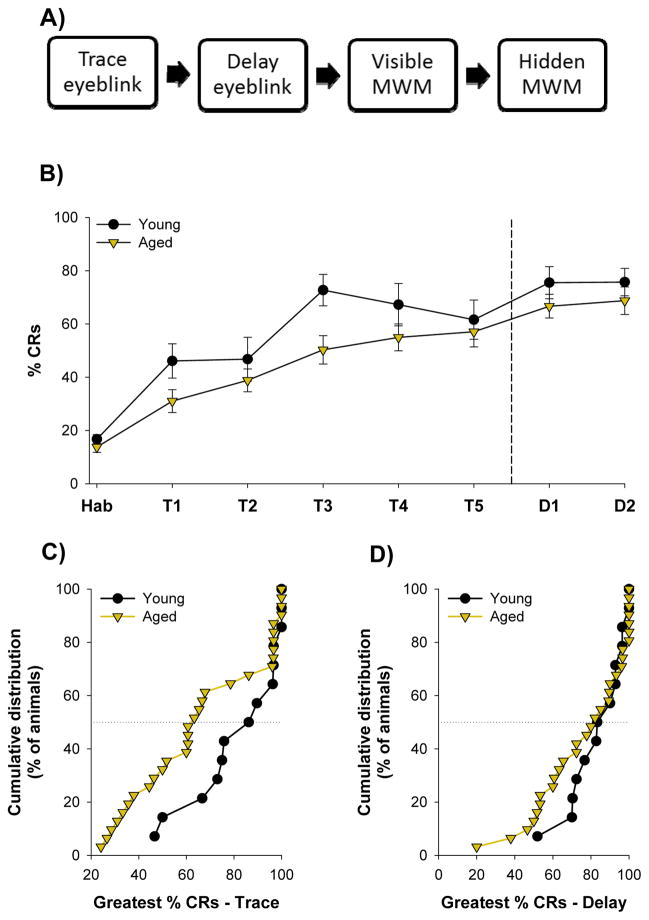
Figure 1
Figure 1
A) Experimental design. All animals were trained with trace eyeblink conditioning followed by delay conditioning. They were then trained with the visible platform version of the Morris water maze, followed by the hidden platform version of the maze. Probe trials were conducted following the third, fourth, and fifth sessions of hidden platform training. B) Young (N=14) and aged (N=31) animals acquired the trace and then delay eyeblink responses. C) Cumulative distributions of the greatest %CRs emitted by each young and aged rat during any one session of trace conditioning. D) Cumulative distributions of the greatest %CRs emitted during any one session of delay conditioning. Vertical dashed line indicates transition from trace to delay conditioning. Horizontal dotted lines indicate median of cumulative distributions. Error bars represent standard error of the mean.
Figure 2
Figure 2
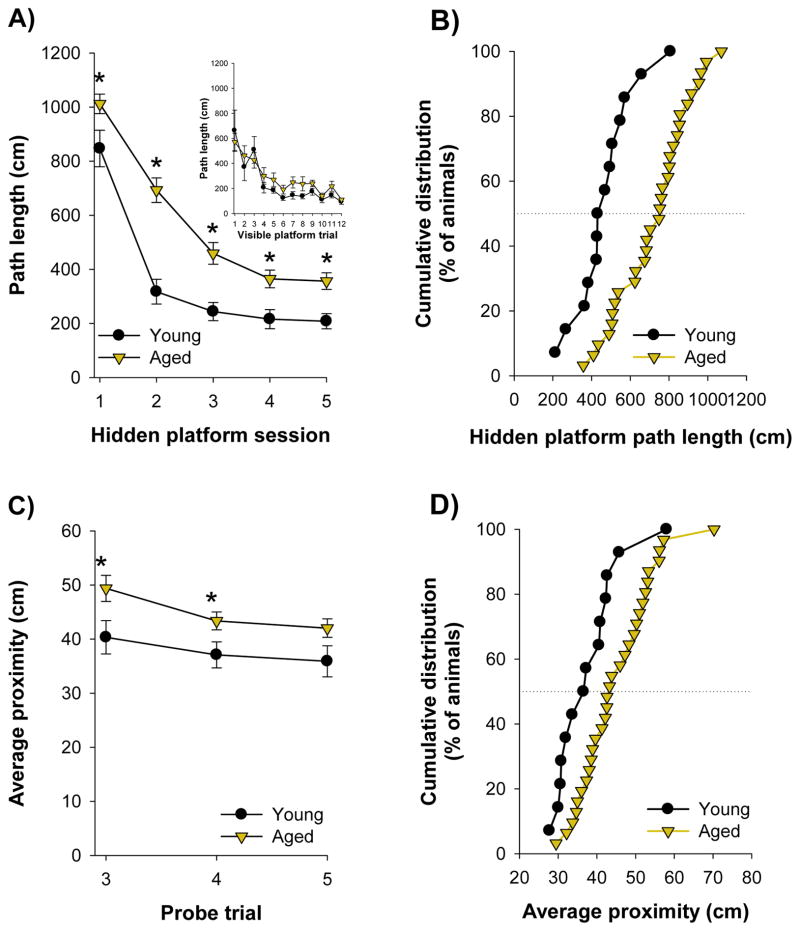
A) Both young and aged rats decreased their path length over the course of hidden platform training. However, young rats consistently had shorter path lengths than aged rats. Inset: Young and aged animals had comparable path lengths during visible platform training. B) Cumulative distributions of mean path length during the last three sessions of hidden platform training. C) A probe trial was conducted at the end of the third, fourth, and fifth session of hidden platform training. Aged animals consistently had larger average proximities than young animals, indicating that aged rats possessed impaired spatial memory for the platform location. D) Distributions of the average proximity across the three probe sessions. Asterisks (*) indicate significantly different from young (p<0.05). Dotted lines indicate median of cumulative distributions. Error bars represent standard error of the mean.
Figure 3
Figure 3
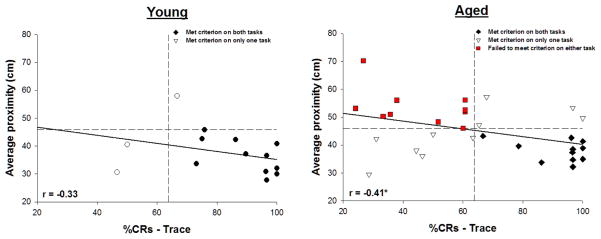
Performance during trace conditioning correlated with spatial memory in aged, but not young, rats. In young rats the greatest percentage of conditioned responses (CRs) emitted by each animal during any session of trace conditioning did not significantly correlate with that animal’s average proximity across the three probe tests (r = −0.33, p≥0.05). However, performance during trace conditioning and water maze testing did significantly correlate in aged animals (r = −0.41, p<0.05). Vertical dashed line indicates criterion for trace conditioning. Horizontal dashed line indicates criterion for water maze testing. Black circles indicate young rats that achieved criterion on both tasks, whereas white circles indicate young rats that achieved criterion on only one task. Diamonds indicate aged rats that achieved criterion on both tasks, triangles indicate aged rats that achieved criterion on only one task, and squares indicate aged rats that failed to achieve criterion on both tasks. A much greater degree of behavioral heterogeneity was observed in aged animals. Asterisk (*) indicates p<0.05.
Figure 4
Figure 4
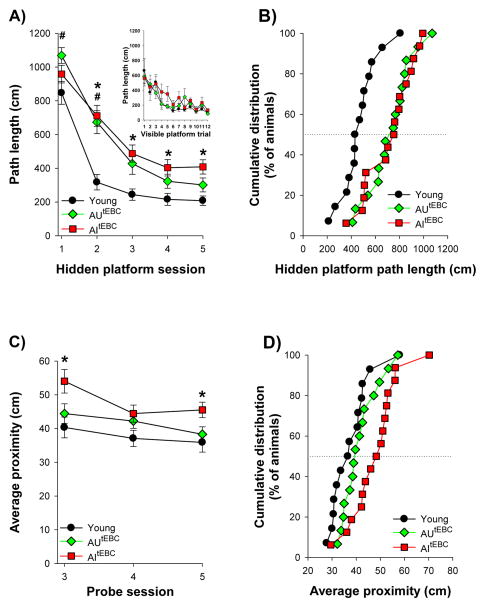
Aged rats were separated into those that were unimpaired (AUtEBC; N=15) or impaired during trace conditioning (AItEBC; N=16). A) Both AUtEBC and AItEBC animals decreased their path length across the five sessions of hidden platform training, whereas young rats consistently had shorter path lengths than either of these groups. Inset: All three groups displayed comparable path lengths during visible platform training. B) Cumulative distributions of average path length during the last three sessions of hidden platform training. C) Average proximity across the three probe tests. There was no difference in average proximity between aged rats that were unimpaired during trace conditioning and young rats. However, aged rats that were impaired during trace conditioning had greater proximity measures than young animals, confirming that these rats were also impaired during water maze probe testing. D) Cumulative distributions of average proximity across the three probe tests. Together, these results reveal that aged rats that were impaired during trace conditioning were also impaired during water maze probe testing. Aged animals that were unimpaired during trace conditioning were unimpaired during probe testing. Dotted lines indicate median of cumulative distributions. Error bars represent standard error of the mean.
Figure 5
Figure 5
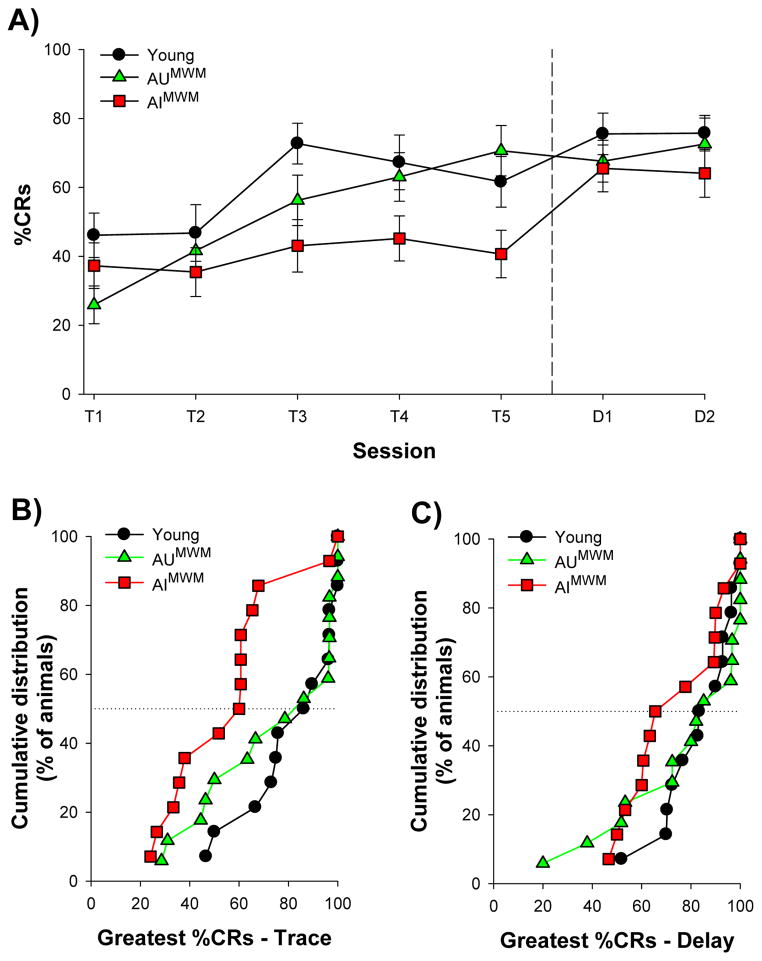
Aged rats were separated into those that were unimpaired (AUMWM; N=17) or impaired (AIMWM; N=14) during water maze probe testing. A) Young rats and aged rats that were unimpaired during probe testing increased the percent of CRs emitted across the five sessions of trace conditioning. Aged rats that were impaired during water maze testing did not increase the percent of CRs emitted during trace conditioning. All three groups emitted a similar percent of CRs during delay conditioning. B) Cumulative distributions of the greatest percent CRs emitted during any session of trace conditioning. The greatest percent CRs emitted by AUMWM rats was comparable to that of young rats. However, AIMWM rats emitted significantly fewer CRs than young animals during trace conditioning. C) Cumulative distributions of the greatest percent CRs emitted during any session of delay conditioning. The greatest percent CRs emitted during delay conditioning did not differ among young, AUMWM, and AIMWM rats. Vertical dashed line indicates transition from trace to delay conditioning. Horizontal dotted lines indicate median of cumulative distributions. Error bars represent standard error of the mean.

References

    1. Ardila A. Normal aging increases cognitive heterogeneity: Analysis of dispersion in WAIS-III scores across age. Archives of Clinical Neuropsychology. 2007;22(8):1003–1011. - PubMed
    1. Beylin AV, Gandhi CC, Wood GE, Talk AC, Matzel LD, Shors TJ. The role of the hippocampus in trace conditioning: temporal discontinuity or task difficulty? Neurobiology of Learning and Memory. 2001;76(3):447–61. - PubMed
    1. Bizon JL, Gallagher M. Production of new cells in the rat dentate gyrus over the lifespan: relation to cognitive decline. European Journal of Neuroscience. 2003;18(1):215–219. - PubMed
    1. Broadbent NJ, Squire LR, Clark RE. Reversible hippocampal lesions disrupt water maze performance during both recent and remote memory tests. Learning & Memory. 2006;13(2):187–91. - PMC - PubMed
    1. Buckner RL. Memory and Executive Function in Aging and AD. Neuron. 2004;44(1):195–208. - PubMed

Publication types