Review
. 2014 Nov 24:12:108.
doi: 10.1186/1477-7827-12-108.

International regulatory landscape and integration of corrective genome editing into in vitro fertilization

Affiliations
Review

International regulatory landscape and integration of corrective genome editing into in vitro fertilization

Motoko Araki et al. Reprod Biol Endocrinol. .

Abstract

Genome editing technology, including zinc finger nucleases (ZFNs), transcription activator-like effector nucleases (TALENs), and clustered regularly interspaced short palindromic repeat (CRISPR)/Cas, has enabled far more efficient genetic engineering even in non-human primates. This biotechnology is more likely to develop into medicine for preventing a genetic disease if corrective genome editing is integrated into assisted reproductive technology, represented by in vitro fertilization. Although rapid advances in genome editing are expected to make germline gene correction feasible in a clinical setting, there are many issues that still need to be addressed before this could occur. We herein examine current status of genome editing in mammalian embryonic stem cells and zygotes and discuss potential issues in the international regulatory landscape regarding human germline gene modification. Moreover, we address some ethical and social issues that would be raised when each country considers whether genome editing-mediated germline gene correction for preventive medicine should be permitted.


Figures
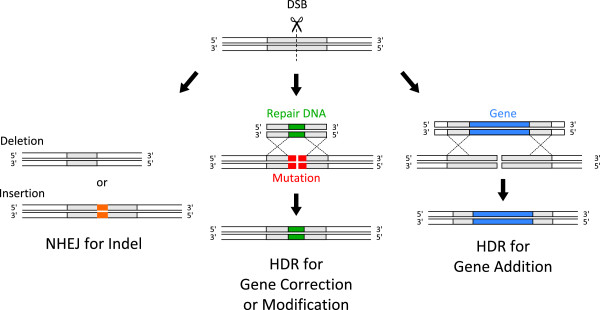
Figure 1
Figure 1
Engineered nuclease-induced genome editing pathways. Double-stranded breaks (DSBs) are induced at a targeted sequence by a microorganism-originated, engineered nuclease. Non-homologous end-joining (NHEJ) is a DSB repair pathway that ligates or joins two broken ends together, resulting in the introduction of small insertions or deletions (indels) at the site of the DSB. Homology-directed repair (HDR) is a DNA template-dependent pathway for DSB repair, using a homology-containing donor template along with a site-specific nuclease, enabling the insertion of single or multiple transgenes (gene addition) in addition to single-nucleotide substitutions in which an amino acid substitution of a protein occurs (gene modification), or a mutation is completely repaired in the resultant organism genome (gene correction).
Figure 2
Figure 2
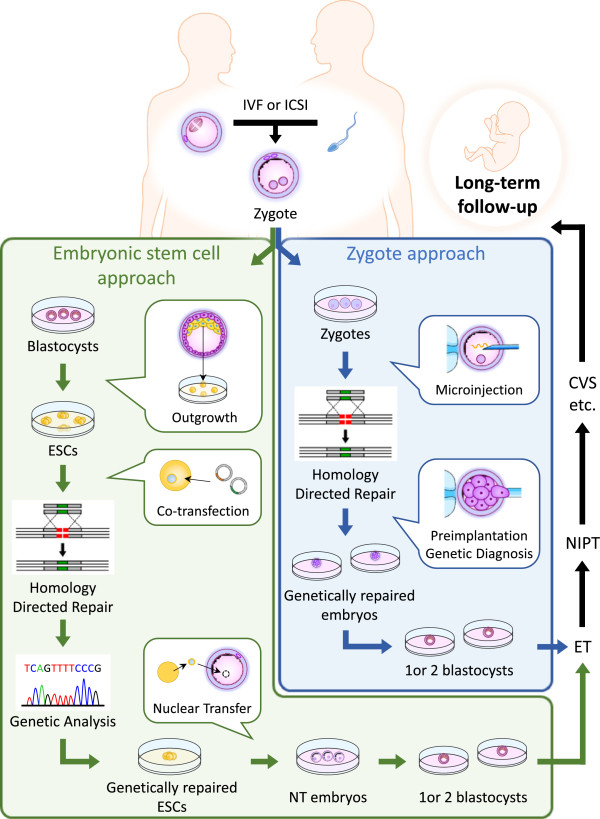
Embryonic stem cell approach and zygote approach for genome editing-mediated gene correction to prevent a genetic disease. Zygotes with a mutation are treated with genome editing-mediated gene correction via embryonic stem cell approach or zygote approach. After embryo screening by preimplantation genetic diagnosis, one or more embryos which have a corrected gene with no off-target mutations are subjected to embryo transfer. NIPT can be used to confirm the genetic condition of the fetus. Subsequently, CVS or amniocentesis can confirm whether a fetus has genetic mosaic mutations. Long-term follow-up is required even after a successful birth owing to the contribution of the modified germline to the entire body. CVS: chorionic villus sampling, ESCs: embryonic stem cells, ET: embryo transfer, ICSI: intracytoplasmic sperm injection, IVF: in vitro fertilization, NIPT: non-invasive prenatal genetic testing, NT: nuclear transfer.
Figure 3
Figure 3
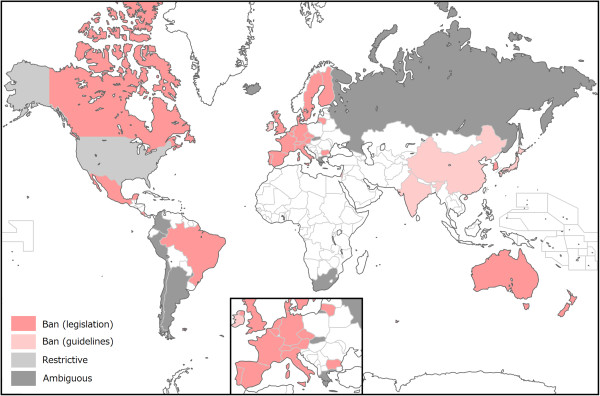
An international regulatory landscape regarding human germline gene modification. Thirty nine countries were surveyed and categorized as “Ban based on legislation” (25, pink), “Ban based on guidelines” (4, faint pink), “Ambiguous” (9, gray), and “Restrictive” (1, light gray). Non-colored countries were excluded in this survey. See also Additional file 1: Table S1.

References

    1. Billings PR, Hubbard R, Newman SA. Human germline gene modification: a dissent. Lancet. 1999;353(9167):1873–1875. - PubMed
    1. Frankel MS, Chapman AR. American Association for the Advancement of Sciences. 2000. Human Inheritable Genetic Modifications. Assessing Scientific, Ethical, Religious and Policy Issues.
    1. Davis BD. Germ-line therapy: evolutionary and moral considerations. Hum Gene Ther. 1992;3(4):361–363. - PubMed
    1. Neel JV. Germ-line gene therapy: another view. Hum Gene Ther. 1993;4(2):127–128. - PubMed
    1. Glover J. What Sort of People Should There Be? London: Penguin Books; 1984. pp. 45–47.

Publication types

MeSH terms