


Direct and Indirect Effects of Maternal and Peer Influences on Sexual Intention among Urban African American and Hispanic Females
- PMID: 25422533
- PMCID: PMC4239706
- DOI: 10.1007/s10560-014-0338-4
Direct and Indirect Effects of Maternal and Peer Influences on Sexual Intention among Urban African American and Hispanic Females
Abstract
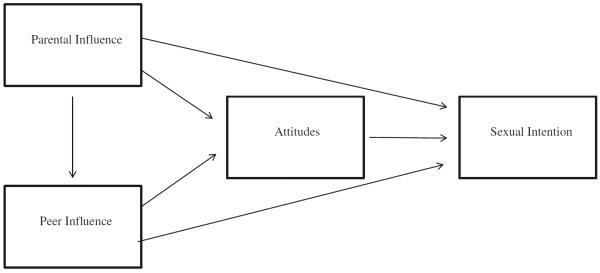
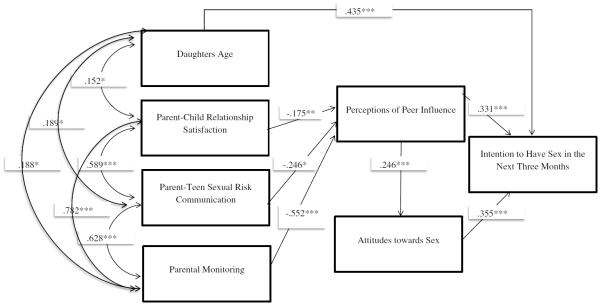
Peer and family influences are interconnected in complex ways. These influences shape adolescent decision-making regarding engagement in sexual behaviors. Evidence indicates the more proximal (and direct) a process is to an individual, the more likely it is to affect his/her development and behavior. Therefore, family factors (e.g., parenting practices) and peer influence (e.g., peer norms) tend to be more strongly associated with adolescent behavior than distal factors (e.g., media or the economy). Guided by an ecological framework, this study explored how maternal influence variables interact with perceptions of peer influence to affect daughters' intentions to have sex. A nonprobability sample of 176 mother-daughter dyads was recruited in clinics and service organizations in the northeastern United States. Results from path analysis revealed that maternal influence variables had a significant indirect relationship with daughters' intentions to have sex through daughters' perceptions of peer influence. Maternal processes can act as protective factors for adolescent girls who perceive their peers are engaged in sexual behaviors. Therefore, risk reduction interventions with adolescents should include opportunities for parents to learn about sex-related issues and develop skills that will allow them to buffer negative peer influence.
Keywords: At-risk youth; Minority families; Mother–daughter relationship; Sexual intention.
Figures
References
-
- Aspy CB, Vesely SK, Oman RF, Rodine S, Marshall L, McLeroy K. Parental communication and youth sexual behavior. Journal of Adolescence. 2007;30:449–466. - PubMed
-
- Benda BB, DiBlasio FA. An integration of theory: Adolescent sexual contacts. Journal of Youth and Adolescence. 1994;23(3):403–420.
-
- Bronfenbrenner U. Ecology of the family as a context for human development: Research perspectives. Developmental Psychology. 1986;22(6):723.
-
- Bronfenbrenner U. Measuring environment across the life span: Emerging methods and concepts. American Psychological Association; Washington, DC: 1999. Environments in developmental perspective: Theoretical and operational models; pp. 3–28.
Grants and funding
LinkOut - more resources
Full Text Sources
Other Literature Sources