


Levonorgestrel-releasing intrauterine system (Mirena) in compare to medroxyprogesterone acetate as a therapy for endometrial hyperplasia
- PMID: 25422650
- PMCID: PMC4235085
Levonorgestrel-releasing intrauterine system (Mirena) in compare to medroxyprogesterone acetate as a therapy for endometrial hyperplasia
Abstract
Background: This study was designed to evaluate the comparison of insertion of levonorgestrel (LNG)-releasing intrauterine system versus oral medroxyprogesterone acetate on endometrial hyperplasia in a randomized controlled trial.
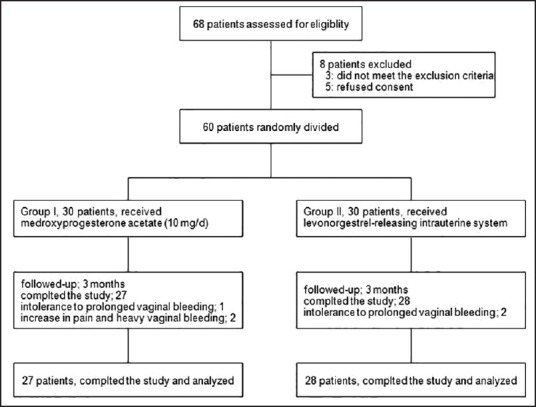
Materials and methods: A total of 60 women with the initial histopathological diagnosis of endometrial hyperplasia in two groups received LNG or medroxyprogesterone (10 mg/d orally) for 12 days a month for 3 months). Endometrial biopsy was obtained for all patients after 3 months of treatment. Response to treatment was defined based on the histopathology of the post treatment pipelle endometrial specimens in three categories of resolution, persistence and progression.
Results: Treatment response rate in patients in the LNG group was 89.3% (25 of 28 patients), versus 70.4% (19 of 27 patients) in patients in the medroxyprogesterone group. The rate of persistence was 10.7% (3 of 28 patients) and 22.2% (6 of 27 patients) in LNG and medroxyprogesterone groups respectively. No progression of endometrial hyperplasia observed in any of the patients in LNG group, but progression of endometrial hyperplasia was observed in 7.4% (2 of 27 patients) in the medroxyprogesterone group. There was no statistically significant difference between groups regarding the response to treatment (P = 0.15). Side effects such as bloating, weight gain, fatigue and hair loss were comparable between the groups (P > 0.05). Hirsutism was significantly more in the medroxyprogesterone group than LNG group (P = 0.013).
Conclusion: Results showed that the use of LNG for treating endometrial hyperplasia for 3 months was associated with high-treatment response rate and the low proportion of patients with progression compared to the use of medroxyprogesterone.
Keywords: Endometrial hyperplasia; levonorgestrel-releasing intrauterine system; medroxyprogesterone.
Conflict of interest statement
Figures
References
-
- Karimi-Zarchi M, Dehghani-Firoozabadi R, Tabatabaie A, Dehghani-Firoozabadi Z, Teimoori S, Chiti Z, et al. A comparison of the effect of levonorgestrel IUD with oral medroxyprogesterone acetate on abnormal uterine bleeding with simple endometrial hyperplasia and fertility preservation. Clin Exp Obstet Gynecol. 2013;40:421–4. - PubMed
-
- Horn LC, Schnurrbusch U, Bilek K, Hentschel B, Einenkel J. Risk of progression in complex and atypical endometrial hyperplasia: Clinicopathologic analysis in cases with and without progestogen treatment. Int J Gynecol Cancer. 2004;14:348–53. - PubMed
-
- Orbo A, Arnes M, Pettersen I, Larsen K, Hanssen K, Moe B. Down-regulated progesterone receptor A and B coinciding with successful treatment of endometrial hyperplasia by the levonorgestrel impregnated intrauterine system. Acta Obstet Gynecol Scand. 2010;89:1438–46. - PubMed
-
- Buttini MJ, Jordan SJ, Webb PM. The effect of the levonorgestrel releasing intrauterine system on endometrial hyperplasia: An Australian study and systematic review. Aust N Z J Obstet Gynaecol. 2009;49:316–22. - PubMed
-
- Wildemeersch D, Dhont M. Treatment of nonatypical and atypical endometrial hyperplasia with a levonorgestrel-releasing intrauterine system. Am J Obstet Gynecol. 2003;188:1297–8. - PubMed
LinkOut - more resources
Full Text Sources