


Dietary restriction and exercise for diabetic patients with chronic kidney disease: a systematic review
- PMID: 25423489
- PMCID: PMC4244158
- DOI: 10.1371/journal.pone.0113667
Dietary restriction and exercise for diabetic patients with chronic kidney disease: a systematic review
Abstract
Background: Obesity and sedentary lifestyle are major health problems and key features to develop cardiovascular disease. Data on the effects of lifestyle interventions in diabetics with chronic kidney disease (CKD) have been conflicting.
Study design: Systematic review.
Population: Diabetes patients with CKD stage 3 to 5. SEARCH STRATEGY AND SOURCES: Medline, Embase and Central were searched to identify papers.
Intervention: Effect of a negative energy balance on hard outcomes in diabetics with CKD.
Outcomes: Death, cardiovascular events, glycaemic control, kidney function, metabolic parameters and body composition.
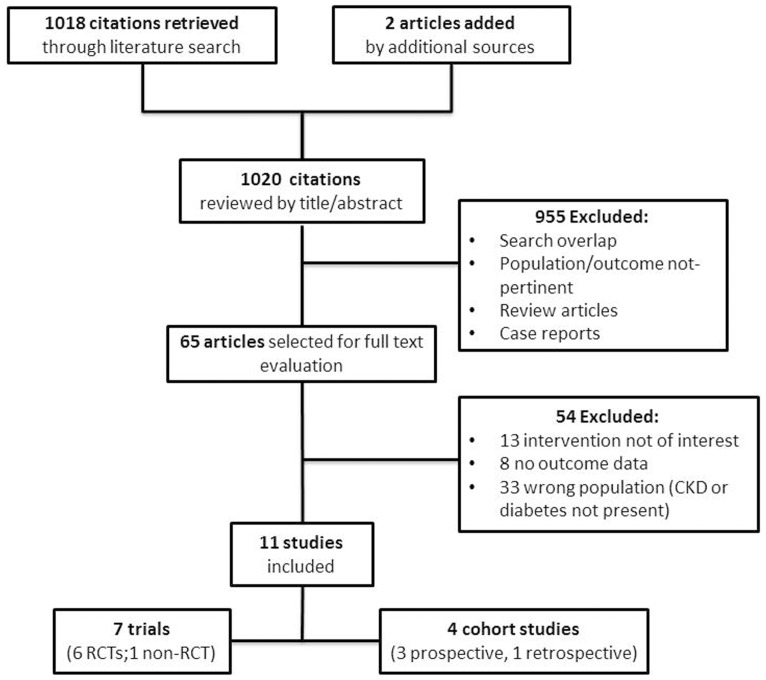
Results: We retained 11 studies. There are insufficient data to evaluate the effect on mortality to promote negative energy balance. None of the studies reported a difference in incidence of Major Adverse Cardiovascular Events. Reduction of energy intake does not alter creatinine clearance but significantly reduces proteinuria (mean difference from -0.66 to -1.77 g/24 h). Interventions with combined exercise and diet resulted in a slower decline of eGFR (-9.2 vs. -20.7 mL/min over two year observation; p<0.001). Aerobic and resistance exercise reduced HbA1c (-0.51 (-0.87 to -0.14); p = 0.007 and -0.38 (-0.72 to -0.22); p = 0.038, respectively). Exercise interventions improve the overall functional status and quality of life in this subgroup. Aerobic exercise reduces BMI (-0.74% (-1.29 to -0.18); p = 0.009) and body weight (-2.2 kg (-3.9 to -0.6); p = 0.008). Resistance exercise reduces trunk fat mass (-0,7±0,1 vs. +0,8 kg ±0,1 kg; p = 0,001-0,005). In none of the studies did the intervention cause an increase in adverse events.
Limitations: All studies used a different intervention type and mixed patient groups.
Conclusions: There is insufficient evidence to evaluate the effect of negative energy balance interventions on mortality in diabetic patients with advanced CKD. Overall, these interventions have beneficial effects on glycaemic control, BMI and body composition, functional status and quality of life, and no harmful effects were observed.
Conflict of interest statement
Figures
References
-
- International Diabetes Federation. IDF Diabetes Atlas, 6th edn. Brussels, Belgium: International Diabetes Federation. 2013;Available at: http://www.idf.org/diabetesatlas.
-
- Centers for Disease Control and Prevention (CDC). National Chronic Kidney Disease Fact Sheet: General Information and National Estimates on Chronic Kidney Disease in the United States. Atlanta, GA: US Department of Health and Human Services, Centers for Disease Control and Prevention. 2014.
-
- Castaneda C, Layne JE, Munoz-Orians L, Gordon PL, Walsmith J, et al. A randomized controlled trial of resistance exercise training to improve control in older adults with type 2 diabetes. Diabetes Care. 2002;25:2335–2341. - PubMed
-
- Chen PY, Huang YC, Kao YH, Chen JY. Effects of an exercise program on blood biochemical values and exercise stage of chronic kidney disease patients. J Nurs Res. 2010;18:98–107. - PubMed
Publication types
MeSH terms
LinkOut - more resources
Full Text Sources
Other Literature Sources
Medical
Research Materials
Miscellaneous
